


Real Professional-Cloud-Architect dumps - Real Google dumps PDF in here [Oct-2021]
Realistic DumpsFree Professional-Cloud-Architect Dumps PDF - 100% Passing Guarantee
Section #6. Improving and validating the reliability of processes and solutions
The final exam domain is compact and throws light on concepts like deployment & release management, evaluations of quality control measures, monitoring and logging solutions, and helping users through deployed aids for the same.
NEW QUESTION 138
For this question, refer to the Mountkirk Games case study.
Mountkirk Games' gaming servers are not automatically scaling properly. Last month, they rolled out a new feature, which suddenly became very popular. A record number of users are trying to use the service, but many of them are getting 503 errors and very slow response times. What should they investigate first?
- A. Verify that the new feature code did not introduce any performance bugs.
- B. Verify that the load-testing team is not running their tool against production.
- C. Verify that the project quota hasn't been exceeded.
- D. Verify that the database is online.
Answer: D
Explanation:
Topic 2, TerramEarth Case Study
Company Overview
TerramEarth manufactures heavy equipment for the mining and agricultural industries:
About 80% of their business is from mining and 20% from agriculture. They currently have over 500 dealers and service centers in 100 countries. Their mission is to build products that make their customers more productive.
Company Background
TerramEarth formed in 1946, when several small, family owned companies combined to retool after World War II. The company cares about their employees and customers and considers them to be extended members of their family.
TerramEarth is proud of their ability to innovate on their core products and find new markets as their customers' needs change. For the past 20 years trends in the industry have been largely toward increasing productivity by using larger vehicles with a human operator.
Solution Concept
There are 20 million TerramEarth vehicles in operation that collect 120 fields of data per second. Data is stored locally on the vehicle and can be accessed for analysis when a vehicle is serviced. The data is downloaded via a maintenance port. This same port can be used to adjust operational parameters, allowing the vehicles to be upgraded in the field with new computing modules.
Approximately 200,000 vehicles are connected to a cellular network, allowing TerramEarth to collect data directly. At a rate of 120 fields of data per second, with 22 hours of operation per day. TerramEarth collects a total of about 9 TB/day from these connected vehicles.
Existing Technical Environment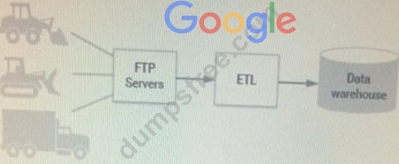
TerramEarth's existing architecture is composed of Linux-based systems that reside in a data center. These systems gzip CSV files from the field and upload via FTP, transform and aggregate them, and place the data in their data warehouse. Because this process takes time, aggregated reports are based on data that is 3 weeks old.
With this data, TerramEarth has been able to preemptively stock replacement parts and reduce unplanned downtime of their vehicles by 60%. However, because the data is stale, some customers are without their vehicles for up to 4 weeks while they wait for replacement parts.
Business Requirements
* Decrease unplanned vehicle downtime to less than 1 week, without increasing the cost of carrying surplus inventory
* Support the dealer network with more data on how their customers use their equipment IP better position new products and services.
* Have the ability to partner with different companies-especially with seed and fertilizer suppliers in the fast-growing agricultural business-to create compelling joint offerings for their customers CEO Statement We have been successful in capitalizing on the trend toward larger vehicles to increase the productivity of our customers. Technological change is occurring rapidly and TerramEarth has taken advantage of connected devices technology to provide our customers with better services, such as our intelligent farming equipment. With this technology, we have been able to increase farmers' yields by 25%, by using past trends to adjust how our vehicles operate. These advances have led to the rapid growth of our agricultural product line, which we expect will generate 50% of our revenues by 2020.
CTO Statement
Our competitive advantage has always been in the manufacturing process with our ability to build better vehicles for tower cost than our competitors. However, new products with different approaches are constantly being developed, and I'm concerned that we lack the skills to undergo the next wave of transformations in our industry. Unfortunately, our CEO doesn't take technology obsolescence seriously and he considers the many new companies in our industry to be niche players. My goals are to build our skills while addressing immediate market needs through incremental innovations.
NEW QUESTION 139
Your customer runs a web service used by e-commerce sites to offer product recommendations to users. The company has begun experimenting with a machine learning model on Google Cloud Platform to improve the quality of results.
What should the customer do to improve their model's results over time?
- A. Build a roadmap to move the machine learning model training from Cloud GPUs to Cloud TPUs, which offer better results.
- B. Export Cloud Machine Learning Engine performance metrics from Stackdriver to BigQuery, to be used to analyze the efficiency of the model.
- C. Monitor Compute Engine announcements for availability of newer CPU architectures, and deploy the model to them as soon as they are available for additional performance.
- D. Save a history of recommendations and results of the recommendations in BigQuery, to be used as training data.
Answer: D
NEW QUESTION 140
You want to automate the creation of a managed instance group and a startup script to install the OS package dependencies. You want to minimize the startup time for VMs in the instance group.
What should you do?
- A. Use Deployment Manager to create the managed instance group and Ansible to install the OS package dependencies.
- B. Create a custom VM image with all OS package dependencies. Use Deployment Manager to create the managed instance group with the VM image.
- C. Use Terraform to create the managed instance group and a startup script to install the OS package dependencies.
- D. Use Puppet to create the managed instance group and install the OS package dependencies.
Answer: B
NEW QUESTION 141
Mountkirk Games wants to set up a real-time analytics platform for their new game. The new platform must meet their technical requirements.
Which combination of Google technologies will meet all of their requirements?
- A. Cloud SQL, Cloud Storage, Cloud Pub/Sub, and Cloud Dataflow
- B. Cloud Dataflow, Cloud Storage, Cloud Pub/Sub, and BigQuery
- C. Cloud Pub/Sub, Compute Engine, Cloud Storage, and Cloud Dataproc
- D. Kubernetes Engine, Cloud Pub/Sub, and Cloud SQL
- E. Cloud Dataproc, Cloud Pub/Sub, Cloud SQL, and Cloud Dataflow
Answer: B
Explanation:
Ingest millions of streaming events per second from anywhere in the world with Cloud Pub/Sub, powered by Google's unique, high-speed private network. Process the streams with Cloud Dataflow to ensure reliable, exactly-once, low-latency data transformation. Stream the transformed data into BigQuery, the cloud-native data warehousing service, for immediate analysis via SQL or popular visualization tools.
From scenario: They plan to deploy the game's backend on Google Compute Engine so they can capture streaming metrics, run intensive analytics.
Requirements for Game Analytics Platform
1. Dynamically scale up or down based on game activity
2. Process incoming data on the fly directly from the game servers
3. Process data that arrives late because of slow mobile networks
4. Allow SQL queries to access at least 10 TB of historical data
5. Process files that are regularly uploaded by users' mobile devices
6. Use only fully managed services
References: https://cloud.google.com/solutions/big-data/stream-analytics/ Mountkirk Games, B Testlet 1 Company Overview Mountkirk Games makes online, session-based, multiplayer games for mobile platforms. They build all of their games using some server-side integration. Historically, they have used cloud providers to lease physical servers.
Due to the unexpected popularity of some of their games, they have had problems scaling their global audience, application servers, MySQL databases, and analytics tools.
Their current model is to write game statistics to files and send them through an ETL tool that loads them into a centralized MySQL database for reporting.
Solution Concept
Mountkirk Games is building a new game, which they expect to be very popular. They plan to deploy the game's backend on Google Compute Engine so they can capture streaming metrics, run intensive analytics, and take advantage of its autoscaling server environment and integrate with a managed NoSQL database.
Business Requirements
* Increase to a global footprint.
* Improve uptime - downtime is loss of players.
* Increase efficiency of the cloud resources we use.
* Reduce latency to all customers.
Technical Requirements
Requirements for Game Backend Platform
* Dynamically scale up or down based on game activity.
* Connect to a transactional database service to manage user profiles and game state.
* Store game activity in a timeseries database service for future analysis.
* As the system scales, ensure that data is not lost due to processing backlogs.
* Run hardened Linux distro.
Requirements for Game Analytics Platform
* Dynamically scale up or down based on game activity
* Process incoming data on the fly directly from the game servers
* Process data that arrives late because of slow mobile networks
* Allow queries to access at least 10 TB of historical data
* Process files that are regularly uploaded by users' mobile devices
Executive Statement
Our last successful game did not scale well with our previous cloud provider, resulting in lower user adoption and affecting the game's reputation. Our investors want more key performance indicators (KPIs) to evaluate the speed and stability of the game, as well as other metrics that provide deeper insight into usage patterns so we can adapt the game to target users. Additionally, our current technology stack cannot provide the scale we need, so we want to replace MySQL and move to an environment that provides autoscaling, low latency load balancing, and frees us up from managing physical servers.
NEW QUESTION 142
As part of Dress4Win's plans to migrate to the cloud, they want to be able to set up a managed logging and monitoring system so they can handle spikes in their traffic load.
They want to ensure that:
* The infrastructure can be notified when it needs to scale up and down to handle the ebb and flow of usage throughout the day
* Their administrators are notified automatically when their application reports errors.
* They can filter their aggregated logs down in order to debug one piece of the application across many hosts Which Google StackDriver features should they use?
- A. Logging, Alerts, Insights, Debug
- B. Monitoring, Logging, Debug, Error Report
- C. Monitoring, Trace, Debug, Logging
- D. Monitoring, Logging, Alerts, Error Reporting
Answer: B
NEW QUESTION 143
Your company plans to migrate a multi-petabyte data set to the cloud. The data set must be available
24hrs a day. Your business analysts have experience only with using a SQL interface.
How should you store the data to optimize it for ease of analysis?
- A. Load data into Google BigQuery
- B. Put flat files into Google Cloud Storage
- C. Insert data into Google Cloud SQL
- D. Stream data into Google Cloud Datastore
Answer: A
Explanation:
Explanation/Reference:
Explanation:
BigQuery is Google's serverless, highly scalable, low cost enterprise data warehouse designed to make all your data analysts productive. Because there is no infrastructure to manage, you can focus on analyzing data to find meaningful insights using familiar SQL and you don't need a database administrator.
BigQuery enables you to analyze all your data by creating a logical data warehouse over managed, columnar storage as well as data from object storage, and spreadsheets.
References: https://cloud.google.com/bigquery/
NEW QUESTION 144
Your customer is receiving reports that their recently updated Google App Engine application is taking approximately 30 seconds to load for some of their users. This behavior was not reported before the update.
What strategy should you take?
- A. Open a support ticket to ask for network capture and flow data to diagnose the problem, then roll back your application
- B. Work with your ISP to diagnose the problem
- C. Roll back to an earlier known good release initially, then use Stackdriver Trace and Logging to diagnose the problem in a development/test/staging environment
- D. Roll back to an earlier known good release, then push the release again at a quieter period to investigate. Then use Stackdriver Trace and Logging to diagnose the problem
Answer: C
Explanation:
Stackdriver Logging allows you to store, search, analyze, monitor, and alert on log data and events from Google Cloud Platform and Amazon Web Services (AWS). Our API also allows ingestion of any custom log data from any source. Stackdriver Logging is a fully managed service that performs at scale and can ingest application and system log data from thousands of VMs. Even better, you can analyze all that log data in real time.
Reference: https://cloud.google.com/logging/
NEW QUESTION 145
Your company has decided to build a backup replica of their on-premises user authentication PostgreSQL database on Google Cloud Platform. The database is 4 TB, and large updates are frequent. Replication requires private address space communication.
Which networking approach should you use?
- A. Google Cloud VPN connected to the data center network
- B. Google Cloud Dedicated Interconnect
- C. A Google Compute Engine instance with a VPN server installed connected to the data center network
- D. A NAT and TLS translation gateway installed on-premises
Answer: B
Explanation:
Explanation/Reference:
Explanation:
Google Cloud Dedicated Interconnect provides direct physical connections and RFC 1918 communication between your on-premises network and Google's network. Dedicated Interconnect enables you to transfer large amounts of data between networks, which can be more cost effective than purchasing additional bandwidth over the public Internet or using VPN tunnels.
Benefits:
Traffic between your on-premises network and your VPC network doesn't traverse the public Internet.
Traffic traverses a dedicated connection with fewer hops, meaning there are less points of failure where traffic might get dropped or disrupted.
Your VPC network's internal (RFC 1918) IP addresses are directly accessible from your on-premises
network. You don't need to use a NAT device or VPN tunnel to reach internal IP addresses. Currently, you can only reach internal IP addresses over a dedicated connection. To reach Google external IP addresses, you must use a separate connection.
You can scale your connection to Google based on your needs. Connection capacity is delivered over
one or more 10 Gbps Ethernet connections, with a maximum of eight connections (80 Gbps total per interconnect).
The cost of egress traffic from your VPC network to your on-premises network is reduced. A dedicated
connection is generally the least expensive method if you have a high-volume of traffic to and from Google's network.
References: https://cloud.google.com/interconnect/docs/details/dedicated
NEW QUESTION 146
Your company wants to track whether someone is present in a meeting room reserved for a scheduled meeting. There are 1000 meeting rooms across 5 offices on 3 continents.
Each room is equipped with a motion sensor that reports its status every second. The data from the motion detector includes only a sensor ID and several different discrete items of information. Analysts will use this data, together with information about account owners and office locations. Which database type should you use?
- A. Blobstore
- B. NoSQL
- C. Flat file
- D. Relational
Answer: B
NEW QUESTION 147
For this question refer to the TerramEarth case study
Operational parameters such as oil pressure are adjustable on each of TerramEarth's vehicles to increase their efficiency, depending on their environmental conditions. Your primary goal is to increase the operating efficiency of all 20 million cellular and unconnected vehicles in the field How can you accomplish this goal?
- A. Have your engineers inspect the data for patterns, and then create an algorithm with rules that make operational adjustments automatically.
- B. Capture all operating data, train machine learning models that identify ideal operations, and host in Google Cloud Machine Learning (ML) Platform to make operational adjustments automatically.
- C. Implement a Google Cloud Dataflow streaming job with a sliding window, and use Google Cloud Messaging (GCM) to make operational adjustments automatically.
- D. Capture all operating data, train machine learning models that identify ideal operations, and run locally to make operational adjustments automatically.
Answer: D
Explanation:
Topic 3, JencoMart Case Study
Company Overview
JencoMart is a global retailer with over 10,000 stores in 16 countries. The stores carry a range of goods, such as groceries, tires, and jewelry. One of the company's core values is excellent customer service. In addition, they recently introduced an environmental policy to reduce their carbon output by 50% over the next 5 years.
Company Background
JencoMart started as a general store in 1931, and has grown into one of the world's leading brands known for great value and customer service. Over time, the company transitioned from only physical stores to a stores and online hybrid model, with 25% of sales online. Currently, JencoMart has little presence in Asia, but considers that market key for future growth.
Solution Concept
JencoMart wants to migrate several critical applications to the cloud but has not completed a technical review to determine their suitability for the cloud and the engineering required for migration. They currently host all of these applications on infrastructure that is at its end of life and is no longer supported.
Existing Technical Environment
JencoMart hosts all of its applications in 4 data centers: 3 in North American and 1 in Europe, most applications are dual-homed.
JencoMart understands the dependencies and resource usage metrics of their on-premises architecture.
Application Customer loyalty portal
LAMP (Linux, Apache, MySQL and PHP) application served from the two JencoMart- owned U.S. data centers.
Database
* Oracle Database stores user profiles
* 20 TB
* Complex table structure
* Well maintained, clean data
* Strong backup strategy
* PostgreSQL database stores user credentials
* Single-homed in US West
No redundancy
Backed up every 12 hours
* 100% uptime service level agreement (SLA)
* Authenticates all users
Compute
* 30 machines in US West Coast, each machine has:
Twin, dual core CPUs
32GB of RAM
* Twin 250 GB HDD (RAID 1)
* 20 machines in US East Coast, each machine has:
Single dual-core CPU
2 4 GB of RAM
* Twin 250 GB HDD (RAID 1)
Storage
* Access to shared 100 TB SAN in each location
* Tape backup every week
Business Requirements
* Optimize for capacity during peak periods and value during off-peak periods
* Guarantee service availably and support
* Reduce on-premises footprint and associated financial and environmental impact.
* Move to outsourcing model to avoid large upfront costs associated with infrastructure purchase
* Expand services into Asia.
Technical Requirements
* Assess key application for cloud suitability.
* Modify application for the cloud.
* Move applications to a new infrastructure.
* Leverage managed services wherever feasible
* Sunset 20% of capacity in existing data centers
* Decrease latency in Asia
CEO Statement
JencoMart will continue to develop personal relationships with our customers as more people access the web. The future of our retail business is in the global market and the connection between online and in-store experiences. As a large global company, we also have a responsibility to the environment through 'green' initiatives and polices.
CTO Statement
The challenges of operating data centers prevents focus on key technologies critical to our long-term success. Migrating our data services to a public cloud infrastructure will allow us to focus on big data and machine learning to improve our service customers.
CFO Statement
Since its founding JencoMart has invested heavily in our data services infrastructure.
However, because of changing market trends, we need to outsource our infrastructure to ensure our long-term success. This model will allow us to respond to increasing customer demand during peak and reduce costs.
NEW QUESTION 148
You set up an autoscaling instance group to serve web traffic for an upcoming launch. After configuring the instance group as a backend service to an HTTP(S) load balancer, you notice that virtual machine (VM) instances are being terminated and re-launched every minute. The instances do not have a public IP address. You have verified the appropriate web response is coming from each instance using the curl command. You want to ensure the backend is configured correctly.
What should you do?
- A. Ensure that a firewall rules exists to allow source traffic on HTTP/HTTPS to reach the load balancer.
- B. Create a tag on each instance with the name of the load balancer. Configure a firewall rule with the name of the load balancer as the source and the instance tag as the destination.
- C. Ensure that a firewall rule exists to allow load balancer health checks to reach the instances in the instance group.
- D. Assign a public IP to each instance and configure a firewall rule to allow the load balancer to reach the instance public IP.
Answer: C
Explanation:
Explanation/Reference:
Explanation:
The best practice when configuration a health check is to check health and serve traffic on the same port.
However, it is possible to perform health checks on one port, but serve traffic on another. If you do use two different ports, ensure that firewall rules and services running on instances are configured appropriately. If you run health checks and serve traffic on the same port, but decide to switch ports at some point, be sure to update both the backend service and the health check.
Backend services that do not have a valid global forwarding rule referencing it will not be health checked and will have no health status.
References: https://cloud.google.com/compute/docs/load-balancing/http/backend-service
NEW QUESTION 149
Your company has decided to make a major revision of their API in order to create better experiences for their developers. They need to keep the old version of the API available and deployable, while allowing new customers and testers to try out the new API. They want to keep the same SSL and DNS records in place to serve both APIs. What should they do?
- A. Configure a new load balancer for the new version of the API.
- B. Have the old API forward traffic to the new API based on the path.
- C. Reconfigure old clients to use a new endpoint for the new API.
- D. Use separate backend pools for each API path behind the load balancer.
Answer: D
Explanation:
A is not correct because a single load balancer with URL maps is sufficient.
B is not correct because it goes against the requirements. The company wants to keep the old API available while new customers and testers try the new API.
C is not correct because it is not a requirement to decommission the implementation behind the old API Moreover, it introduces unnecessary risk in case bugs or incompatibilities are discovered in the new API.
D is correct because an HTTP(S) load balancer can direct traffic reaching a single IP to different backends based on the incoming URL.
NEW QUESTION 150
You set up an autoscaling instance group to serve web traffic for an upcoming launch. After configuring the instance group as a backend service to an HTTP(S) load balancer, you notice that virtual machine (VM) instances are being terminated and re-launched every minute. The instances do not have a public IP address. You have verified the appropriate web response is coming from each instance using the curl command. You want to ensure the backend is configured correctly. What should you do?
- A. Ensure that a firewall rule exists to allow source traffic on HTTP/HTTPS to reach the load balancer.
- B. Create a tag on each instance with the name of the load balancer. Configure a firewall rule with the name of the load balancer as the source and the instance tag as the destination.
- C. Ensure that a firewall rule exists to allow load balancer health checks to reach the instances in the instance group.
- D. Assign a public IP to each instance and configure a firewall rule to allow the load balancer to reach the instance public IP.
Answer: C
Explanation:
Explanation: https://cloud.google.com/vpc/docs/using-firewalls
NEW QUESTION 151
A production database virtual machine on Google Compute Engine has an ext4-formatted persistent disk for data files. The database is about to run out of storage space.
How can you remediate the problem with the least amount of downtime?
- A. In the Cloud Platform Console, create a snapshot of the persistent disk restore the snapshot to a new larger disk, unmount the old disk, mount the new disk and restart the database service
- B. In the Cloud Platform Console, increase the size of the persistent disk and verify the new space is ready to use with the fdisk command in Linux
- C. In the Cloud Platform Console, increase the size of the persistent disk and use the resize2fs command in Linux.
- D. In the Cloud Platform Console, create a new persistent disk attached to the virtual machine, format and mount it, and configure the database service to move the files to the new disk
- E. Shut down the virtual machine, use the Cloud Platform Console to increase the persistent disk size, then restart the virtual machine
Answer: C
Explanation:
Explanation/Reference:
Explanation:
On Linux instances, connect to your instance and manually resize your partitions and file systems to use the additional disk space that you added.
Extend the file system on the disk or the partition to use the added space. If you grew a partition on your disk, specify the partition. If your disk does not have a partition table, specify only the disk ID.
sudo resize2fs /dev/[DISK_ID][PARTITION_NUMBER]
where [DISK_ID] is the device name and [PARTITION_NUMBER] is the partition number for the device where you are resizing the file system.
References: https://cloud.google.com/compute/docs/disks/add-persistent-disk
NEW QUESTION 152
Your company places a high value on being responsive and meeting customer needs quickly. Their primary business objectives are release speed and agility. You want to reduce the chance of security errors being accidentally introduced. Which two actions can you take? Choose 2 answers
- A. Run a vulnerability security scanner as part of your continuous-integration /continuous- delivery (CI/CD) pipeline.
- B. Ensure every code check-in is peer reviewed by a security SME.
- C. Use source code security analyzers as part of the CI/CD pipeline.
- D. Ensure you have stubs to unit test all interfaces between components.
- E. Enable code signing and a trusted binary repository integrated with your CI/CD pipeline.
Answer: B,D
NEW QUESTION 153
You have an application that makes HTTP requests to Cloud Storage. Occasionally the requests fail with HTTP status codes of 5xx and 429.
How should you handle these types of errors?
- A. Implement retry logic using a truncated exponential backoff strategy.
- B. Use gRPC instead of HTTP for better performance.
- C. Make sure the Cloud Storage bucket is multi-regional for geo-redundancy.
- D. Monitor https://status.cloud.google.com/feed.atom and only make requests if Cloud Storage is not reporting an incident.
Answer: A
Explanation:
Explanation
Reference https://cloud.google.com/storage/docs/json_api/v1/status-codes
NEW QUESTION 154
A few days after JencoMart migrates the user credentials database to Google Cloud Platform and shuts down the old server, the new database server stops responding to SSH connections. It is still serving database requests to the application servers correctly.
What three steps should you take to diagnose the problem? (Choose three.)
- A. Connect the machine to another network with very simple firewall rules and investigate
- B. Print the Serial Console output for the instance for troubleshooting, activate the interactive console, and investigate
- C. Take a snapshot of the disk and connect to a new machine to investigate
- D. Delete the virtual machine (VM) and disks and create a new one
- E. Delete the instance, attach the disk to a new VM, and investigate
- F. Check inbound firewall rules for the network the machine is connected to
Answer: B,C,F
Explanation:
D: Handling "Unable to connect on port 22" error message
Possible causes include:
* There is no firewall rule allowing SSH access on the port. SSH access on port 22 is enabled on all Compute Engine instances by default. If you have disabled access, SSH from the Browser will not work. If you run sshd on a port other than 22, you need to enable the access to that port with a custom firewall rule.
* The firewall rule allowing SSH access is enabled, but is not configured to allow connections from GCP Console services. Source IP addresses for browser-based SSH sessions are dynamically allocated by GCP Console and can vary from session to session.
F: Handling "Could not connect, retrying..." error
You can verify that the daemon is running by navigating to the serial console output page and looking for output lines prefixed with the accounts-from-metadata: string. If you are using a standard image but you do not see these output prefixes in the serial console output, the daemon might be stopped. Reboot the instance to restart the daemon.
Reference:
https://cloud.google.com/compute/docs/ssh-in-browser
https://cloud.google.com/compute/docs/ssh-in-browser
NEW QUESTION 155
You have developed an application using Cloud ML Engine that recognizes famous paintings from uploaded images. You want to test the application and allow specific people to upload images for the next 24 hours. Not all users have a Google Account. How should you have users upload images?
- A. Have users upload the images to Cloud Storage. Protect the bucket with a password that expires after 24 hours.
- B. Create an App Engine web application where users can upload images. Configure App Engine to disable the application after 24 hours. Authenticate users via Cloud Identity.
- C. Create an App Engine web application where users can upload images for the next 24 hours.
Authenticate users via Cloud Identity. - D. Have users upload the images to Cloud Storage using a signed URL that expires after 24 hours.
Answer: A
NEW QUESTION 156
For this question, refer to the TerramEarth case study
Your development team has created a structured API to retrieve vehicle data. They want to allow third parties to develop tools for dealerships that use this vehicle event data. You want to support delegated authorization against this data. What should you do?
- A. Build or leverage an OAuth-compatible access control system.
- B. Restrict data access based on the source IP address of the partner systems.
- C. Build SAML 2.0 SSO compatibility into your authentication system.
- D. Create secondary credentials for each dealer that can be given to the trusted third party.
Answer: A
Explanation:
Explanation
https://cloud.google.com/appengine/docs/flexible/go/authorizing-apps
https://cloud.google.com/docs/enterprise/best-practices-for-enterprise-organizations#delegate_application_autho Delegate application authorization with OAuth2 Cloud Platform APIs support OAuth 2.0, and scopes provide granular authorization over the methods that are supported. Cloud Platform supports both service-account and user-account OAuth, also called three-legged OAuth.
References:
https://cloud.google.com/docs/enterprise/best-practices-for-enterprise-organizations#delegate_application_autho
https://cloud.google.com/appengine/docs/flexible/go/authorizing-apps
Topic 2, Mountkirk Games Case Study
Company Overview
Mountkirk Games makes online, session-based. multiplayer games for the most popular mobile platforms.
Company Background
Mountkirk Games builds all of their games with some server-side integration and has historically used cloud providers to lease physical servers. A few of their games were more popular than expected, and they had problems scaling their application servers, MySQL databases, and analytics tools.
Mountkirk's current model is to write game statistics to files and send them through an ETL tool that loads them into a centralized MySQL database for reporting.
Solution Concept
Mountkirk Games is building a new game, which they expect to be very popular. They plan to deploy the game's backend on Google Compute Engine so they can capture streaming metrics, run intensive analytics and take advantage of its autoscaling server environment and integrate with a managed NoSQL database.
Technical Requirements
Requirements for Game Backend Platform
1. Dynamically scale up or down based on game activity.
2. Connect to a managed NoSQL database service.
3. Run customized Linx distro.
Requirements for Game Analytics Platform
1. Dynamically scale up or down based on game activity.
2. Process incoming data on the fly directly from the game servers.
3. Process data that arrives late because of slow mobile networks.
4. Allow SQL queries to access at least 10 TB of historical data.
5. Process files that are regularly uploaded by users' mobile devices.
6. Use only fully managed services
CEO Statement
Our last successful game did not scale well with our previous cloud provider, resuming in lower user adoption and affecting the game's reputation. Our investors want more key performance indicators (KPIs) to evaluate the speed and stability of the game, as well as other metrics that provide deeper insight into usage patterns so we can adapt the gams to target users.
CTO Statement
Our current technology stack cannot provide the scale we need, so we want to replace MySQL and move to an environment that provides autoscaling, low latency load balancing, and frees us up from managing physical servers.
CFO Statement
We are not capturing enough user demographic data usage metrics, and other KPIs. As a result, we do not engage the right users. We are not confident that our marketing is targeting the right users, and we are not selling enough premium Blast-Ups inside the games, which dramatically impacts our revenue.
NEW QUESTION 157
......
Verified Professional-Cloud-Architect dumps Q&As Latest Professional-Cloud-Architect Download: https://www.dumpsfree.com/Professional-Cloud-Architect-valid-exam.html
Free Google Professional-Cloud-Architect Exam Questions & Answer: https://drive.google.com/open?id=1PdeLufBSoZhxvGN6ECiGa7XydfyBGNa3