


New 2024 Databricks-Certified-Data-Analyst-Associate Dumps for Data Analyst Certified Exam Questions and Answer
Realistic Verified Databricks-Certified-Data-Analyst-Associate exam dumps Q&As - Databricks-Certified-Data-Analyst-Associate Free Update
Databricks Databricks-Certified-Data-Analyst-Associate Exam Syllabus Topics:
| Topic | Details |
|---|---|
| Topic 1 |
|
| Topic 2 |
|
| Topic 3 |
|
| Topic 4 |
|
| Topic 5 |
|
NEW QUESTION # 16
Which of the following layers of the medallion architecture is most commonly used by data analysts?
- A. Gold
- B. Silver
- C. None of these layers are used by data analysts
- D. All of these layers are used equally by data analysts
- E. Bronze
Answer: A
Explanation:
The gold layer of the medallion architecture contains data that is highly refined and aggregated, and powers analytics, machine learning, and production applications. Data analysts typically use the gold layer to access data that has been transformed into knowledge, rather than just information. The gold layer represents the final stage of data quality and optimization in the lakehouse. Reference: What is the medallion lakehouse architecture?
NEW QUESTION # 17
A data analyst wants to create a dashboard with three main sections: Development, Testing, and Production. They want all three sections on the same dashboard, but they want to clearly designate the sections using text on the dashboard.
Which of the following tools can the data analyst use to designate the Development, Testing, and Production sections using text?
- A. Separate queries for each section
- B. Direct text written into the dashboard in editing mode
- C. Markdown-based text boxes
- D. Separate endpoints for each section
- E. Separate color palettes for each section
Answer: C
Explanation:
Markdown-based text boxes are useful as labels on a dashboard. They allow the data analyst to add text to a dashboard using the %md magic command in a notebook cell and then select the dashboard icon in the cell actions menu. The text can be formatted using markdown syntax and can include headings, lists, links, images, and more. The text boxes can be resized and moved around on the dashboard using the float layout option. Reference: Dashboards in notebooks, How to add text to a dashboard in Databricks
NEW QUESTION # 18
A data analyst has been asked to produce a visualization that shows the flow of users through a website.
Which of the following is used for visualizing this type of flow?
- A. Sankey
- B. Pivot Table
- C. Heatmap
- D. Word Cloud
- E. IChoropleth
Answer: A
Explanation:
A Sankey diagram is a type of visualization that shows the flow of data between different nodes or categories. It is often used to represent the movement of users through a website, as it can show the paths they take, the sources they come from, the pages they visit, and the outcomes they achieve. A Sankey diagram consists of links and nodes, where the links represent the volume or weight of the flow, and the nodes represent the stages or steps of the flow. The width of the links is proportional to the amount of flow, and the color of the links can indicate different attributes or segments of the flow. A Sankey diagram can help identify the most common or popular user journeys, the bottlenecks or drop-offs in the flow, and the opportunities for improvement or optimization. Reference: The answer can be verified from Databricks documentation which provides examples and instructions on how to create Sankey diagrams using Databricks SQL Analytics and Databricks Visualizations. Reference links: Databricks SQL Analytics - Sankey Diagram, Databricks Visualizations - Sankey Diagram
NEW QUESTION # 19
A data analysis team is working with the table_bronze SQL table as a source for one of its most complex projects. A stakeholder of the project notices that some of the downstream data is duplicative. The analysis team identifies table_bronze as the source of the duplication.
Which of the following queries can be used to deduplicate the data from table_bronze and write it to a new table table_silver?
A)
CREATE TABLE table_silver AS
SELECT DISTINCT *
FROM table_bronze;
B)
CREATE TABLE table_silver AS
INSERT *
FROM table_bronze;
C)
CREATE TABLE table_silver AS
MERGE DEDUPLICATE *
FROM table_bronze;
D)
INSERT INTO TABLE table_silver
SELECT * FROM table_bronze;
E)
INSERT OVERWRITE TABLE table_silver
SELECT * FROM table_bronze;
- A. Option B
- B. Option C
- C. Option D
- D. Option A
- E. Option E
Answer: D
Explanation:
Option A uses the SELECT DISTINCT statement to remove duplicate rows from the table_bronze and create a new table table_silver with the deduplicated data. This is the correct way to deduplicate data using Spark SQL12. Option B simply inserts all the rows from table_bronze into table_silver, without removing any duplicates. Option C is not a valid syntax for Spark SQL, as there is no MERGE DEDUPLICATE statement. Option D appends all the rows from table_bronze into table_silver, without removing any duplicates. Option E overwrites the existing data in table_silver with the data from table_bronze, without removing any duplicates. Reference: Delete Duplicate using SPARK SQL, Spark SQL - How to Remove Duplicate Rows
NEW QUESTION # 20
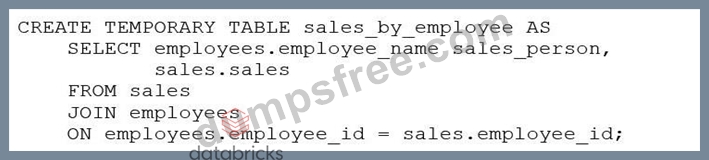
A business analyst has been asked to create a data entity/object called sales_by_employee. It should always stay up-to-date when new data are added to the sales table. The new entity should have the columns sales_person, which will be the name of the employee from the employees table, and sales, which will be all sales for that particular sales person. Both the sales table and the employees table have an employee_id column that is used to identify the sales person.
Which of the following code blocks will accomplish this task?
- A.
- B.

- C.

- D.

Answer: C
Explanation:
The SQL code provided in Option D is the correct way to create a view named sales_by_employee that will always stay up-to-date with the sales and employees tables. The code uses the CREATE OR REPLACE VIEW statement to define a new view that joins the sales and employees tables on the employee_id column. It selects the employee_name as sales_person and all sales for each employee, ensuring that the data entity/object is always up-to-date when new data are added to these tables.
NEW QUESTION # 21
Which of the following describes how Databricks SQL should be used in relation to other business intelligence (BI) tools like Tableau, Power BI, and looker?
- A. As a complete replacement with additional functionality
- B. As a substitute with less functionality
- C. As a complementary tool for professional-grade presentations
- D. As an exact substitute with the same level of functionality
- E. As a complementary tool for quick in-platform Bl work
Answer: E
Explanation:
Databricks SQL is not meant to replace or substitute other BI tools, but rather to complement them by providing a fast and easy way to query, explore, and visualize data on the lakehouse using the built-in SQL editor, visualizations, and dashboards. Databricks SQL also integrates seamlessly with popular BI tools like Tableau, Power BI, and Looker, allowing analysts to use their preferred tools to access data through Databricks clusters and SQL warehouses. Databricks SQL offers low-code and no-code experiences, as well as optimized connectors and serverless compute, to enhance the productivity and performance of BI workloads on the lakehouse. Reference: Databricks SQL, Connecting Applications and BI Tools to Databricks SQL, Databricks integrations overview, Databricks SQL: Delivering a Production SQL Development Experience on the Lakehouse
NEW QUESTION # 22
Which of the following benefits of using Databricks SQL is provided by Data Explorer?
- A. It can be used to make visualizations that can be shared with stakeholders.
- B. It can be used to run UPDATE queries to update any tables in a database.
- C. It can be used to connect to third party Bl cools.
- D. It can be used to view metadata and data, as well as view/change permissions.
- E. It can be used to produce dashboards that allow data exploration.
Answer: D
Explanation:
Data Explorer is a user interface that allows you to discover and manage data, schemas, tables, models, and permissions in Databricks SQL. You can use Data Explorer to view schema details, preview sample data, and see table and model details and properties. Administrators can view and change owners, and admins and data object owners can grant and revoke permissions1. Reference: Discover and manage data using Data Explorer
NEW QUESTION # 23
A data analyst is working with gold-layer tables to complete an ad-hoc project. A stakeholder has provided the analyst with an additional dataset that can be used to augment the gold-layer tables already in use.
Which of the following terms is used to describe this data augmentation?
- A. Ad-hoc improvements
- B. Data testing
- C. Last-mile ETL
- D. Last-mile
- E. Data enhancement
Answer: E
Explanation:
Data enhancement is the process of adding or enriching data with additional information to improve its quality, accuracy, and usefulness. Data enhancement can be used to augment existing data sources with new data sources, such as external datasets, synthetic data, or machine learning models. Data enhancement can help data analysts to gain deeper insights, discover new patterns, and solve complex problems. Data enhancement is one of the applications of generative AI, which can leverage machine learning to generate synthetic data for better models or safer data sharing1.
In the context of the question, the data analyst is working with gold-layer tables, which are curated business-level tables that are typically organized in consumption-ready project-specific databases234. The gold-layer tables are the final layer of data transformations and data quality rules in the medallion lakehouse architecture, which is a data design pattern used to logically organize data in a lakehouse2. The stakeholder has provided the analyst with an additional dataset that can be used to augment the gold-layer tables already in use. This means that the analyst can use the additional dataset to enhance the existing gold-layer tables with more information, such as new features, attributes, or metrics. This data augmentation can help the analyst to complete the ad-hoc project more effectively and efficiently.
Reference:
What is the medallion lakehouse architecture? - Databricks
Data Warehousing Modeling Techniques and Their Implementation on the Databricks Lakehouse Platform | Databricks Blog What is the medallion lakehouse architecture? - Azure Databricks What is a Medallion Architecture? - Databricks Synthetic Data for Better Machine Learning | Databricks Blog
NEW QUESTION # 24
Which of the following is an advantage of using a Delta Lake-based data lakehouse over common data lake solutions?
- A. Scalable storage
- B. Flexible schemas
- C. Open-source formats
- D. ACID transactions
- E. Data deletion
Answer: D
Explanation:
A Delta Lake-based data lakehouse is a data platform architecture that combines the scalability and flexibility of a data lake with the reliability and performance of a data warehouse. One of the key advantages of using a Delta Lake-based data lakehouse over common data lake solutions is that it supports ACID transactions, which ensure data integrity and consistency. ACID transactions enable concurrent reads and writes, schema enforcement and evolution, data versioning and rollback, and data quality checks. These features are not available in traditional data lakes, which rely on file-based storage systems that do not support transactions. Reference:
Delta Lake: Lakehouse, warehouse, advantages | Definition
Synapse - Data Lake vs. Delta Lake vs. Data Lakehouse
Data Lake vs. Delta Lake - A Detailed Comparison
Building a Data Lakehouse with Delta Lake Architecture: A Comprehensive Guide
NEW QUESTION # 25
Which of the following should data analysts consider when working with personally identifiable information (PII) data?
- A. Legal requirements for the area in which the analysis is being performed
- B. Organization-specific best practices for Pll data
- C. Legal requirements for the area in which the data was collected
- D. All of these considerations
- E. None of these considerations
Answer: D
Explanation:
Data analysts should consider all of these factors when working with PII data, as they may affect the data security, privacy, compliance, and quality. PII data is any information that can be used to identify a specific individual, such as name, address, phone number, email, social security number, etc. PII data may be subject to different legal and ethical obligations depending on the context and location of the data collection and analysis. For example, some countries or regions may have stricter data protection laws than others, such as the General Data Protection Regulation (GDPR) in the European Union. Data analysts should also follow the organization-specific best practices for PII data, such as encryption, anonymization, masking, access control, auditing, etc. These best practices can help prevent data breaches, unauthorized access, misuse, or loss of PII data. Reference:
How to Use Databricks to Encrypt and Protect PII Data
Automating Sensitive Data (PII/PHI) Detection
Databricks Certified Data Analyst Associate
NEW QUESTION # 26
A data analyst has created a user-defined function using the following line of code:
CREATE FUNCTION price(spend DOUBLE, units DOUBLE)
RETURNS DOUBLE
RETURN spend / units;
Which of the following code blocks can be used to apply this function to the customer_spend and customer_units columns of the table customer_summary to create column customer_price?
- A. SELECT double(price(customer_spend, customer_units)) AS customer_price FROM customer_summary
- B. SELECT price FROM customer_summary
- C. SELECT function(price(customer_spend, customer_units)) AS customer_price FROM customer_summary
- D. SELECT price(customer_spend, customer_units) AS customer_price FROM customer_summary
- E. SELECT PRICE customer_spend, customer_units AS customer_price FROM customer_summary
Answer: D
Explanation:
A user-defined function (UDF) is a function defined by a user, allowing custom logic to be reused in the user environment1. To apply a UDF to a table, the syntax is SELECT udf_name(column_name) AS alias FROM table_name2. Therefore, option E is the correct way to use the UDF price to create a new column customer_price based on the existing columns customer_spend and customer_units from the table customer_summary. Reference:
What are user-defined functions (UDFs)?
User-defined scalar functions - SQL
V
NEW QUESTION # 27
In which of the following situations should a data analyst use higher-order functions?
- A. When custom logic needs to be applied at scale to array data objects
- B. When custom logic needs to be applied to simple, unnested data
- C. When built-in functions need to run through the Catalyst Optimizer
- D. When custom logic needs to be converted to Python-native code
- E. When built-in functions are taking too long to perform tasks
Answer: A
Explanation:
Higher-order functions are a simple extension to SQL to manipulate nested data such as arrays. A higher-order function takes an array, implements how the array is processed, and what the result of the computation will be. It delegates to a lambda function how to process each item in the array. This allows you to define functions that manipulate arrays in SQL, without having to unpack and repack them, use UDFs, or rely on limited built-in functions. Higher-order functions provide a performance benefit over user defined functions. Reference: Higher-order functions | Databricks on AWS, Working with Nested Data Using Higher Order Functions in SQL on Databricks | Databricks Blog, Higher-order functions - Azure Databricks | Microsoft Learn, Optimization recommendations on Databricks | Databricks on AWS
NEW QUESTION # 28
A data analyst has recently joined a new team that uses Databricks SQL, but the analyst has never used Databricks before. The analyst wants to know where in Databricks SQL they can write and execute SQL queries.
On which of the following pages can the analyst write and execute SQL queries?
- A. Alerts page
- B. Dashboards page
- C. SQL Editor page
- D. Queries page
- E. Data page
Answer: C
Explanation:
The SQL Editor page is where the analyst can write and execute SQL queries in Databricks SQL. The SQL Editor page has a query pane where the analyst can type or paste SQL statements, and a results pane where the analyst can view the query results in a table or a chart. The analyst can also browse data objects, edit multiple queries, execute a single query or multiple queries, terminate a query, save a query, download a query result, and more from the SQL Editor page. Reference: Create a query in SQL editor
NEW QUESTION # 29
A data analyst has set up a SQL query to run every four hours on a SQL endpoint, but the SQL endpoint is taking too long to start up with each run.
Which of the following changes can the data analyst make to reduce the start-up time for the endpoint while managing costs?
- A. Turn off the Auto stop feature
- B. Increase the SQL endpoint cluster size
- C. Reduce the SQL endpoint cluster size
- D. Increase the minimum scaling value
- E. Use a Serverless SQL endpoint
Answer: E
Explanation:
A Serverless SQL endpoint is a type of SQL endpoint that does not require a dedicated cluster to run queries. Instead, it uses a shared pool of resources that can scale up and down automatically based on the demand. This means that a Serverless SQL endpoint can start up much faster than a SQL endpoint that uses a cluster, and it can also save costs by only paying for the resources that are used. A Serverless SQL endpoint is suitable for ad-hoc queries and exploratory analysis, but it may not offer the same level of performance and isolation as a SQL endpoint that uses a cluster. Therefore, a data analyst should consider the trade-offs between speed, cost, and quality when choosing between a Serverless SQL endpoint and a SQL endpoint that uses a cluster. Reference: Databricks SQL endpoints, Serverless SQL endpoints, SQL endpoint clusters
NEW QUESTION # 30
How can a data analyst determine if query results were pulled from the cache?
- A. Go to the Alerts tab and check the Cache Status alert.
- B. Go to the Data tab and click Last Query. The details of the query will show if the results came from the cache.
- C. Go to the Query History tab and click on the text of the query. The slideout shows if the results came from the cache.
- D. Go to the Queries tab and click on Cache Status. The status will be green if the results from the last run came from the cache.
- E. Go to the SQL Warehouse (formerly SQL Endpoints) tab and click on Cache. The Cache file will show the contents of the cache.
Answer: C
Explanation:
Databricks SQL uses a query cache to store the results of queries that have been executed previously. This improves the performance and efficiency of repeated queries. To determine if a query result was pulled from the cache, you can go to the Query History tab in the Databricks SQL UI and click on the text of the query. A slideout will appear on the right side of the screen, showing the query details, including the cache status. If the result came from the cache, the cache status will show "Cached". If the result did not come from the cache, the cache status will show "Not cached". You can also see the cache hit ratio, which is the percentage of queries that were served from the cache. Reference: The answer can be verified from Databricks SQL documentation which provides information on how to use the query cache and how to check the cache status. Reference link: Databricks SQL - Query Cache
NEW QUESTION # 31
Which of the following statements describes descriptive statistics?
- A. A branch of statistics that uses quantitative variables that must take on a finite or countably infinite set of values.
- B. A branch of statistics that uses summary statistics to categorically describe and summarize data.
- C. A branch of statistics that uses summary statistics to quantitatively describe and summarize data.
- D. A branch of statistics that uses quantitative variables that must take on an uncountable set of values.
- E. A branch of statistics that uses a variety of data analysis techniques to infer properties of an underlying distribution of probability.
Answer: C
Explanation:
Descriptive statistics is a branch of statistics that uses summary statistics, such as mean, median, mode, standard deviation, range, frequency, or correlation, to quantitatively describe and summarize data. Descriptive statistics can help data analysts understand the main features of a data set, such as its central tendency, variability, or distribution. Descriptive statistics can also help data analysts visualize data using charts, graphs, or tables. Descriptive statistics do not make any inferences or predictions about the data, unlike inferential statistics, which use data analysis techniques to infer properties of an underlying population or probability distribution from a sample of data. Reference: Databricks - Descriptive Statistics, Databricks - Data Analysis with Databricks SQL
NEW QUESTION # 32
A data analyst needs to use the Databricks Lakehouse Platform to quickly create SQL queries and data visualizations. It is a requirement that the compute resources in the platform can be made serverless, and it is expected that data visualizations can be placed within a dashboard.
Which of the following Databricks Lakehouse Platform services/capabilities meets all of these requirements?
- A. Databricks Machine Learning
- B. Databricks Notebooks
- C. Tableau
- D. Databricks SQL
- E. Delta Lake
Answer: D
Explanation:
Databricks SQL is a serverless data warehouse on the Lakehouse that lets you run all of your SQL and BI applications at scale with your tools of choice, all at a fraction of the cost of traditional cloud data warehouses1. Databricks SQL allows you to create SQL queries and data visualizations using the SQL Analytics UI or the Databricks SQL CLI2. You can also place your data visualizations within a dashboard and share it with other users in your organization3. Databricks SQL is powered by Delta Lake, which provides reliability, performance, and governance for your data lake4. Reference:
Databricks SQL
Query data using SQL Analytics
Visualizations in Databricks notebooks
Delta Lake
NEW QUESTION # 33
Which of the following approaches can be used to connect Databricks to Fivetran for data ingestion?
- A. Use Workflows to establish a SQL warehouse (formerly known as a SQL endpoint) for Fivetran to interact with
- B. Use Delta Live Tables to establish a cluster for Fivetran to interact with
- C. Use Partner Connect's automated workflow to establish a SQL warehouse (formerly known as a SQL endpoint) for Fivetran to interact with
- D. Use Partner Connect's automated workflow to establish a cluster for Fivetran to interact with
- E. Use Workflows to establish a cluster for Fivetran to interact with
Answer: D
Explanation:
Partner Connect is a feature that allows you to easily connect your Databricks workspace to Fivetran and other ingestion partners using an automated workflow. You can select a SQL warehouse or a cluster as the destination for your data replication, and the connection details are sent to Fivetran. You can then choose from over 200 data sources that Fivetran supports and start ingesting data into Delta Lake. Reference: Connect to Fivetran using Partner Connect, Use Databricks with Fivetran
NEW QUESTION # 34
A data analyst has a managed table table_name in database database_name. They would now like to remove the table from the database and all of the data files associated with the table. The rest of the tables in the database must continue to exist.
Which of the following commands can the analyst use to complete the task without producing an error?
- A. DELETE TABLE database_name.table_name;
- B. DROP TABLE database_name.table_name;
- C. DELETE TABLE table_name FROM database_name;
- D. DROP TABLE table_name FROM database_name;
- E. DROP DATABASE database_name;
Answer: B
Explanation:
The DROP TABLE command removes a table from the metastore and deletes the associated data files. The syntax for this command is DROP TABLE [IF EXISTS] [database_name.]table_name;. The optional IF EXISTS clause prevents an error if the table does not exist. The optional database_name. prefix specifies the database where the table resides. If not specified, the current database is used. Therefore, the correct command to remove the table table_name from the database database_name and all of the data files associated with it is DROP TABLE database_name.table_name;. The other commands are either invalid syntax or would produce undesired results. Reference: Databricks - DROP TABLE
NEW QUESTION # 35
......
Use Real Databricks-Certified-Data-Analyst-Associate Dumps - 100% Free Databricks-Certified-Data-Analyst-Associate Exam Dumps: https://www.dumpsfree.com/Databricks-Certified-Data-Analyst-Associate-valid-exam.html
Databricks-Certified-Data-Analyst-Associate Exam Dumps, Test Engine Practice Test Questions: https://drive.google.com/open?id=11788nkVh2kAPdvR4K2VAVGIj5aMv7_H5