


[Jul 19, 2025] JN0-664 Exam Dumps, JN0-664 Practice Test Questions
Free JN0-664 Study Guides Exam Questions and Answer
Juniper JN0-664 certification exam is a computer-based test that consists of 65 multiple-choice questions. Candidates have 120 minutes to complete the exam, and they must achieve a passing score of 65% or higher to earn the certification. JN0-664 exam is administered by Pearson VUE, and it can be taken at any Pearson VUE testing center worldwide.
NEW QUESTION # 27
Your organization manages a Layer 3 VPN for multiple customers To support advanced route than one BGP community on advertised VPN routes to remote PE routers.
Which routing-instance configuration parameter would support this requirement?
- A. vrf-export
- B. vrf-target import
- C. vrf-target export
- D. vrf-import
Answer: A
Explanation:
The vrf-target statement is used in routing-instances to define route-target communities for VPN route import and export policies.
vrf-target export → Controls which route targets (RTs) are added to advertised routes (used when sending routes to remote PEs).
vrf-target import → Controls which VPN routes are accepted into the VRF (used when receiving routes from remote PEs).
NEW QUESTION # 28
Which statement is correct about IS-IS when it performs the Dijkstra algorithm?
- A. The local router moves its own local tuples into the candidate database
- B. Tuples with the lowest cost are moved from the tree database to the LSDB.
- C. When a new neighbor ID in the tree database matches a router ID in the LSDB, the neighbor ID is moved to the candidate database
- D. The algorithm will stop processing once the tree database is empty.
Answer: C
Explanation:
The Dijkstra algorithm in IS-IS operates as follows:
Tree Database Initialization: The local router (root) is added to the tree database with a cost of 0.
Candidate Database Population: Neighbors of the root (from the LSDB) are placed into the candidate database with their associated costs.
Processing Nodes: The node with the lowest cost in the candidate database is moved to the tree database.
Neighbor Evaluation: For each neighbor of the newly added node (from the LSDB), if the neighbor is not already in the tree or candidate database, it is added to the candidate database. If it exists in the candidate with a higher cost, it is updated with the lower cost.
Termination: The algorithm stops when the candidate database is empty, ensuring all shortest paths are computed.
Analysis of Options:
A . Incorrect. The local router is placed directly into the tree database, not the candidate database.
B . Correct (with context). When a node is added to the tree database, its neighbors (existing in the LSDB) are evaluated. If these neighbors are not already in the tree or candidate database, they are added (not "moved") to the candidate database. The wording "moved" is technically inaccurate, but this option aligns closest with the process of populating the candidate database using LSDB entries during tree database processing.
C . Incorrect. Tuples (nodes) with the lowest cost are moved from the candidate database to the tree database, not from the tree to the LSDB. The LSDB remains static during SPF computation.
D . Incorrect. The algorithm stops when the candidate database is empty, not the tree database. The tree database grows as nodes are processed.
NEW QUESTION # 29
Exhibit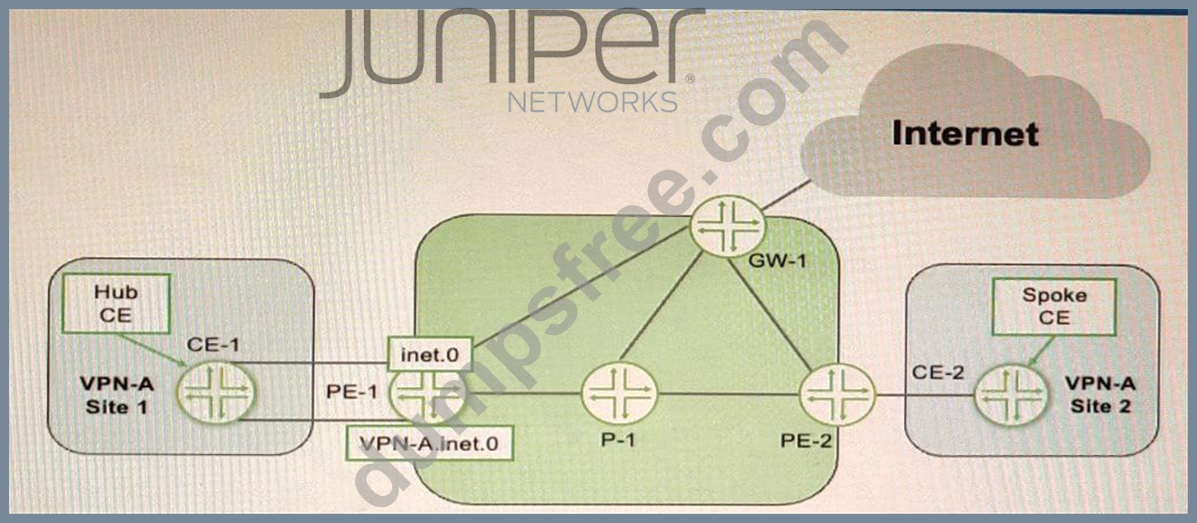
Referring to the exhibit, you must provide Internet access for VPN-A using CE-1 as the hub CE.
Which two statements are correct in this situation? (Choose two.)
- A. Internet traffic from Site 2 takes the path of PE-2 -> PE-1 -> GW-1.
- B. Internet traffic from Site 2 takes the path of PE-2 -> PE-1 -> CE-1 -> PE-1 -> GW-1.
- C. You must use RIB groups to leak routes between the inet. o and vpn-a. inet. o tables.
- D. RIB groups are not needed to leak routes between the inet. 0 and VPN-A. inet. 0 tables,
Answer: B,C
Explanation:
To provide Internet access for VPN-A using CE-1 as the hub CE, you need to do the following:
You must use RIB groups to leak routes between the inet.0 and vpn-a.inet.0 tables on PE-1 and CE-1.
RIB groups are routing options that allow you to import routes from one routing table into another routing table based on certain criteria. In this scenario, you need to configure RIB groups on PE-1 and CE-1 to import Internet routes from inet.0 into vpn-a.inet.0 and vice versa.
Internet traffic from Site 2 takes the path of PE-2 -> PE-1 -> CE-1 -> PE-1 -> GW-1. This is because Site 2 does not have direct Internet access and needs to use CE-1 as its default gateway for Internet traffic. Site 2 sends its Internet traffic to PE-2, which forwards it to PE-1 based on VPN-A routes. PE-1 then sends it to CE-1 based on RIB group import policy. CE-1 then sends it back to PE-1 based on its default route pointing to GW-1. PE-1 then forwards it to GW-1 based on RIB group import policy again.
NEW QUESTION # 30
You are configuring anycast RP for load balancing and redundancy in your PIM-SM domain. You want to share active sources between RPs.
In this scenario, what are two solutions that will accomplish this task? (Choose two.)
- A. Configure anycast PIM with the rp-set statement on each source DR router.
- B. Configure MSDP on each source DR router.
- C. Configure MSDP on each RP router.
- D. Configure anycast PIM with the rp-set statement on each RP router.
Answer: C,D
Explanation:
In a PIM Sparse Mode (PIM-SM) domain, Anycast RP is used for load balancing and redundancy by configuring multiple RPs with the same IP address. However, for active multicast sources to be shared between RPs, an additional mechanism is needed since PIM-SM does not automatically synchronize sources between RPs.
Evaluating the Answer Choices
Option A: "Configure MSDP on each RP router." ✅
Multicast Source Discovery Protocol (MSDP) is required in an Anycast RP setup to share active source information between RPs.
MSDP allows RPs to exchange source-active (SA) messages, ensuring that multicast receivers in different regions can still receive traffic from sources registered with different RPs.
Juniper Documentation confirms that MSDP is used to synchronize active sources across multiple RPs in an Anycast RP deployment.
✅ This is a correct answer.
Option B: "Configure anycast PIM with the rp-set statement on each RP router." ✅ Anycast PIM allows multiple RPs to share the same IP address, and the rp-set statement is used to define the set of Anycast RPs.
This enables receivers and sources to register with the closest RP.
However, Anycast PIM alone does not share active source information between RPs; MSDP is still needed for that.
The combination of Anycast PIM (rp-set) and MSDP is the correct approach.
✅ This is a correct answer.
NEW QUESTION # 31
Referring to the exhibit, which two statements are true? (Choose two.)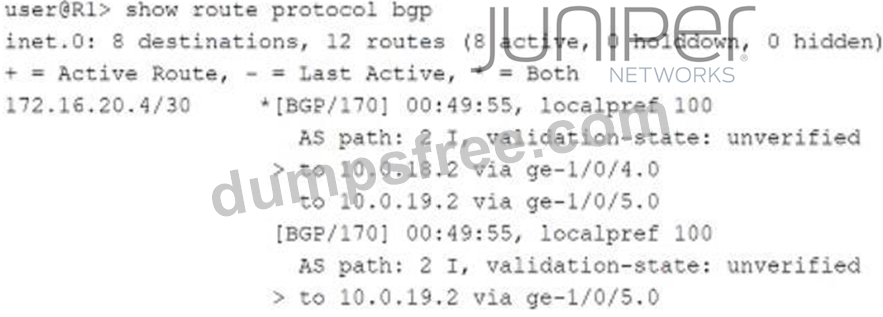
- A. The multipath configuration is used for load balancing.
- B. The multihop configuration is used for load balancing.
- C. This route is learned from the same AS number.
- D. This route is learned from two different AS numbers.
Answer: A,C
NEW QUESTION # 32
You are configuring a Layer 3 VPN between two sites. You are configuring the vrf-target target:
65100:100 statement in your routing instance.
In this scenario, which two statements describe the vrf-target configuration? (Choose two.)
- A. This value is used to identify BGP routes learned from the local CE device.
- B. This value is used to add a target community to BGP routes advertised to the remote PE device.
- C. This value is used to add a target community to BGP routes advertised to the local CE device.
- D. This value is used to identify BGP routes learned from the remote PE device.
Answer: B,D
NEW QUESTION # 33
Exhibit.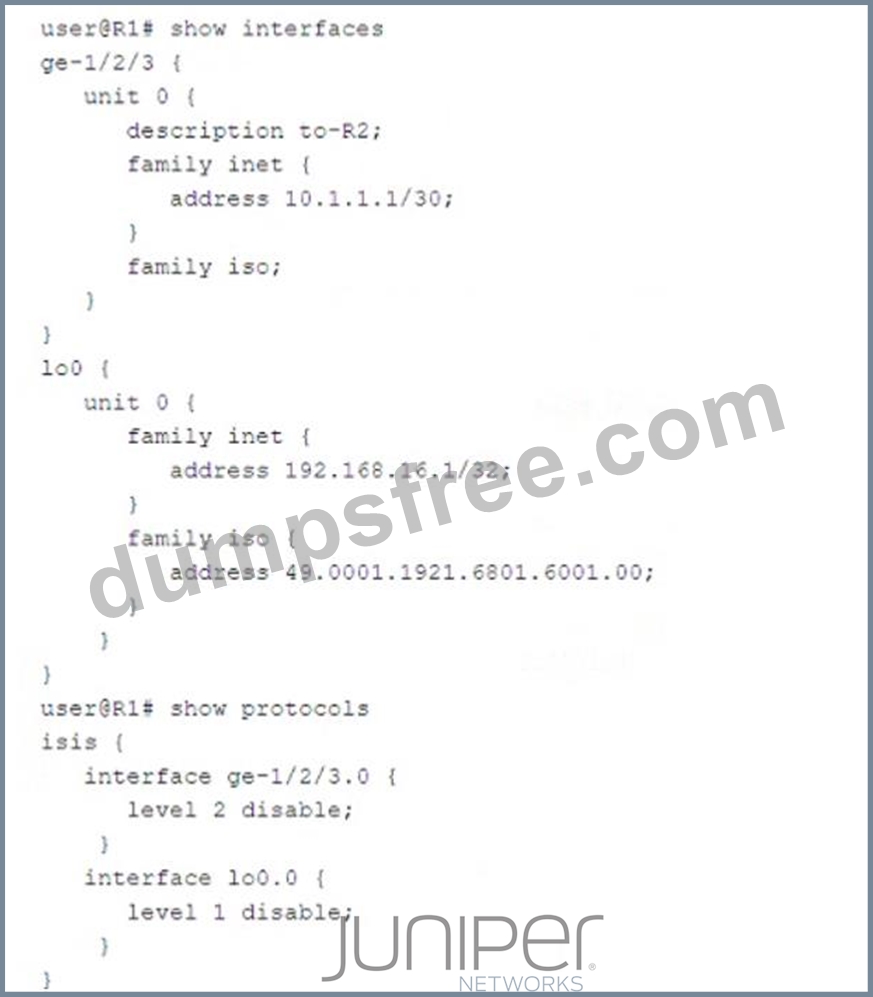
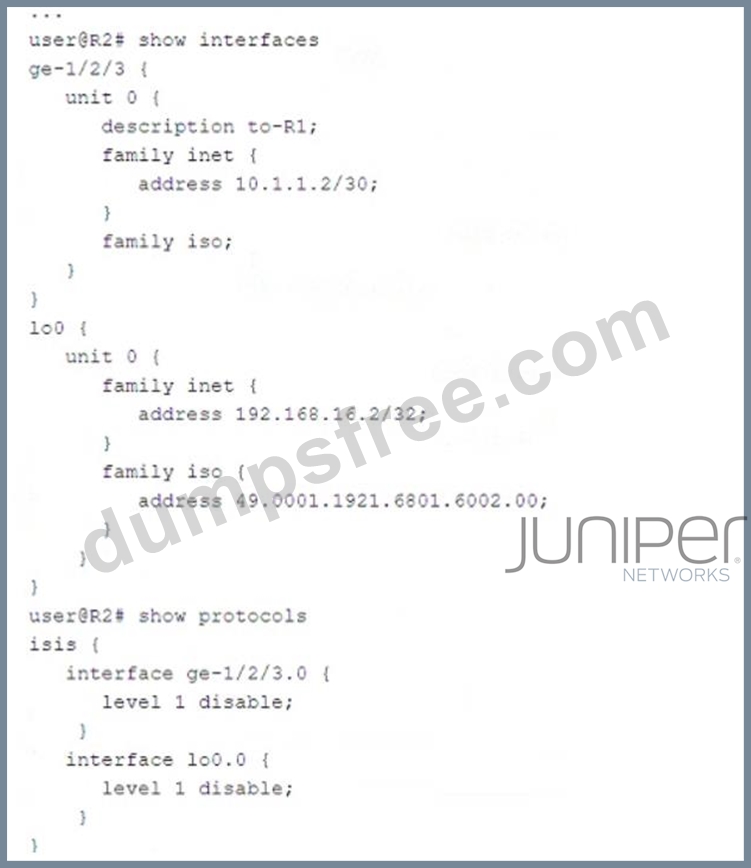
Referring to the exhibit, what must be changed to establish a Level 1 adjacency between routers R1 and R2?
- A. Change the level l disable parameter under the R1 protocols isis interface lo0.0 hierarchy to the level 2 disable parameter.
- B. Remove the level 1 disable parameter under the R2 protocols isis interface lo0.0 configuration hierarchy.
- C. Change the level 1 disable parameter under the R2 protocols isis interface ge-l/2/3.0 hierarchy to the level 2 disable parameter.
- D. Add IP addresses to the interface ge-1/2/3 unit 0 family iso hierarchy on both R1 and R2.
Answer: C
NEW QUESTION # 34
You are asked to exchange routes between R1 and R4 as shown in the exhibit. These two routers use the same AS number.
Which two steps will accomplish this task? (Choose two.)
- A. Configure the BGP group with the advertise-peer-as parameter on R2 and R3.
- B. Configure the BGP group with the as-override parameter on R1 and R4.
- C. Configure the BGP group with the advertise-peer-as parameter on R1 and R4.
- D. Configure the BGP group with the as-override parameter on R2 and R3.
Answer: A,D
Explanation:
https://www.juniper.net/documentation/us/en/software/junos/routing-
policy/bgp/topics/example/bgp-advertise-peer-as.html
Both advertise-peer-as and as-override are BGP settings applied on the PE, not the CE.
NEW QUESTION # 35
Exhibit
user@Rl show configuration interpolated-profile { interpolate {
fill-level [ 50 75 drop-probability [ > }
class-of-service drop-profiles
];
20 60 ];
Which two statements are correct about the class-of-service configuration shown in the exhibit? (Choose two.)
- A. The drop probability gradually increases from 20% to 60% as the queue level increases from 50% full to 75% full
- B. To use this drop profile, you apply it directly to an interface.
- C. The drop probability jumps immediately from 20% to 60% when the queue level reaches 75% full.
- D. To use this drop profile, you reference it in a scheduler.
Answer: A,D
Explanation:
class-of-service (CoS) is a feature that allows you to prioritize and manage network traffic based on various criteria, such as application type, user group, or packet loss priority. CoS uses different components to classify, mark, queue, schedule, shape, and drop traffic according to the configured policies.
One of the components of CoS is drop profiles, which define how packets are dropped when a queue is congested. Drop profiles use random early detection (RED) algorithm to drop packets randomly before the queue is full, which helps to avoid global synchronization and improve network performance. Drop profiles can be discrete or interpolated. A discrete drop profile maps a specific fill level of a queue to a specific drop probability. An interpolated drop profile maps a range of fill levels of a queue to a range of drop probabilities and interpolates the values in between.
In the exhibit, we can see that the class-of-service configuration shows an interpolated drop profile with two fill levels (50 and 75) and two drop probabilities (20 and 60). Based on this configuration, we can infer the following statements:
* The drop probability jumps immediately from 20% to 60% when the queue level reaches 75% full. This is not correct because the drop profile is interpolated, not discrete. This means that the drop probability gradually increases from 20% to 60% as the queue level increases from 50% full to 75% full. The drop probability for any fill level between 50% and 75% can be calculated by using linear interpolation formula.
* The drop probability gradually increases from 20% to 60% as the queue level increases from 50% full to 75% full. This is correct because the drop profile is interpolated and uses linear interpolation formula to calculate the drop probability for any fill level between 50% and 75%. For example, if the fill level is
60%, the drop probability is 28%, which is calculated by using the formula: (60 - 50) / (75 - 50) * (60 -
20) + 20 = 28.
* To use this drop profile, you reference it in a scheduler. This is correct because a scheduler is a component of CoS that determines how packets are dequeued from different queues and transmitted on an interface. A scheduler can reference a drop profile by using the random-detect statement under the
[edit class-of-service schedulers] hierarchy level. For example: scheduler test { transmit-rate percent 10; buffer-size percent 10; random-detect test-profile; }
* To use this drop profile, you apply it directly to an interface. This is not correct because a drop profile cannot be applied directly to an interface. A drop profile can only be referenced by a scheduler, which can be applied to an interface by using the scheduler-map statement under the [edit class-of-service interfaces] hierarchy level. For example: interfaces ge-0/0/0 { unit 0 { scheduler-map test-map; } }
NEW QUESTION # 36
You are configuring an interprovider Option C Layer 3 VPN to connect two customer sites.
Referring to the exhibit, which three statements are correct? (Choose three.)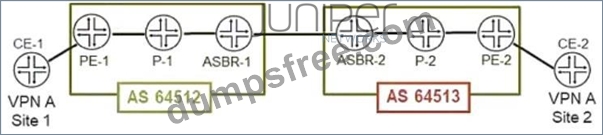
- A. PE routers maintain the internal routes from its own AS, the loopback address from the other AS Pes, and the L3VPN routes.
- B. P routers maintain the internal routes from its own AS and the loopback address from the other AS PEs.
- C. ASBR routers maintain the internal routes from its own AS and the loopback addresses from the other AS PEs.
- D. ASBR routers maintain the internal routes from its own AS, the loopback address from the other AS PEs, and the L3VPN routes.
- E. P routers only maintain the internal routes from their own AS.
Answer: A,C,E
NEW QUESTION # 37
Exhibit.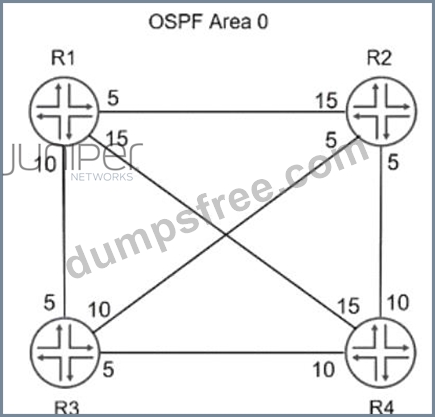
Referring to the exhibit, which path would traffic passing through R1 take to get to R4?
- A. R1 -> R2 -> R3 -> R4
- B. R1 -> R2 -> R4
- C. R1 -> R4
- D. R1 -> R3 -> R4
Answer: B
Explanation:
The OSPF cost is carried in the LSAs that are exchanged within an OSPF area. When a router calculates the cost to a destination it uses the cost of the exit interface of each router in the path to the destination.
NEW QUESTION # 38
Exhibit.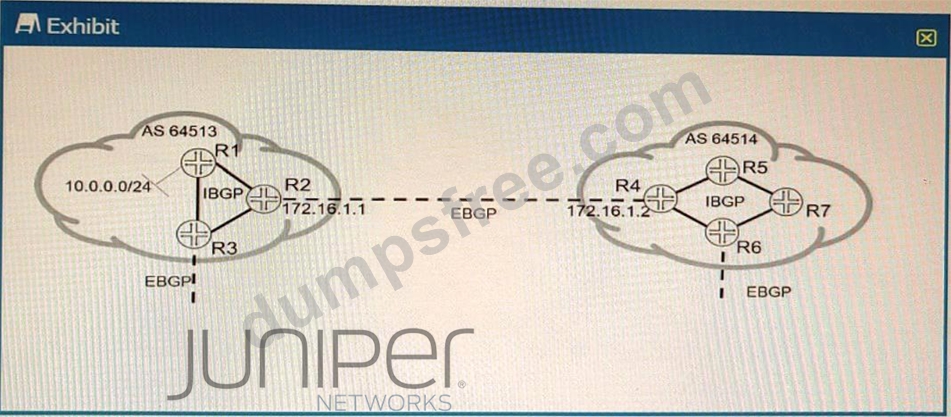
Referring to the exhibit; the 10.0.0.0/24 EBGP route is received on R5; however, the route is being hidden.
What are two solutions that will solve this problem? (Choose two.)
- A. Add the external interface prefix to the IGP routing tables
- B. On R4, create a policy to change the BGP next hop to itself and apply it to IBGP as an export policy
- C. Add the internal interface prefix to the BGP routing tables.
- D. On R4, create a policy to change the BGP next hop to 172.16.1.1 and apply it to IBGP as an export policy
Answer: A,B
Explanation:
the default behavior for iBGP is to propagate EBGP-learned prefixes without changing the next-hop. This can cause issues if the next-hop is not reachable via the IGP. One solution is to use the next-hop self command on R4, which will change the next-hop attribute to its own loopback address. This way, R5 can reach the next-hop via the IGP and install the route in its routing table.
Another solution is to add the external interface prefix (120.0.4.16/30) to the IGP routing tables of R4 and R5.
This will also make the next-hop reachable via the IGP and allow R5 to use the route. According to 2, this is a possible workaround for a pure IP network, but it may not work well for an MPLS network.
The reason why the route is being hidden is that R5 cannot reach the BGP next hop 10.0.0.1, which is the address of R1. R5 does not have a route to 10.0.0.0/24 in its routing table, and neither does R4. Therefore, R5 cannot resolve the BGP next hop and marks the route as hidden.
There are two solutions that will solve this problem:
Option A: On R4, create a policy to change the BGP next hop to itself and apply it to IBGP as an export policy. This way, R5 will receive the route with a next hop of 172.16.1.2, which is reachable via the IGP. This solution is also known as next-hop-self1.
Option B: Add the external interface prefix to the IGP routing tables. This way, R4 and R5 will learn a route to 10.0.0.0/24 via the IGP and be able to resolve the BGP next hop. This solution is also known as recursive lookup2.
Option C is not correct because adding the internal interface prefix to the BGP routing tables will not help R5 reach the BGP next hop 10.0.0.1.
Option D is not correct because changing the BGP next hop to 172.16.1.1 on R4 will not help R5 either, since R5 does not have a route to 172.16.1.1 in its routing table.
References: 1: Configuring Next-Hop-Self for IBGP Peers 2: Understanding Recursive Lookup
NEW QUESTION # 39
Referring to the exhibit, which two statements are correct about BGP routes on R3 that are learned from the ISP-A neighbor? (Choose two.)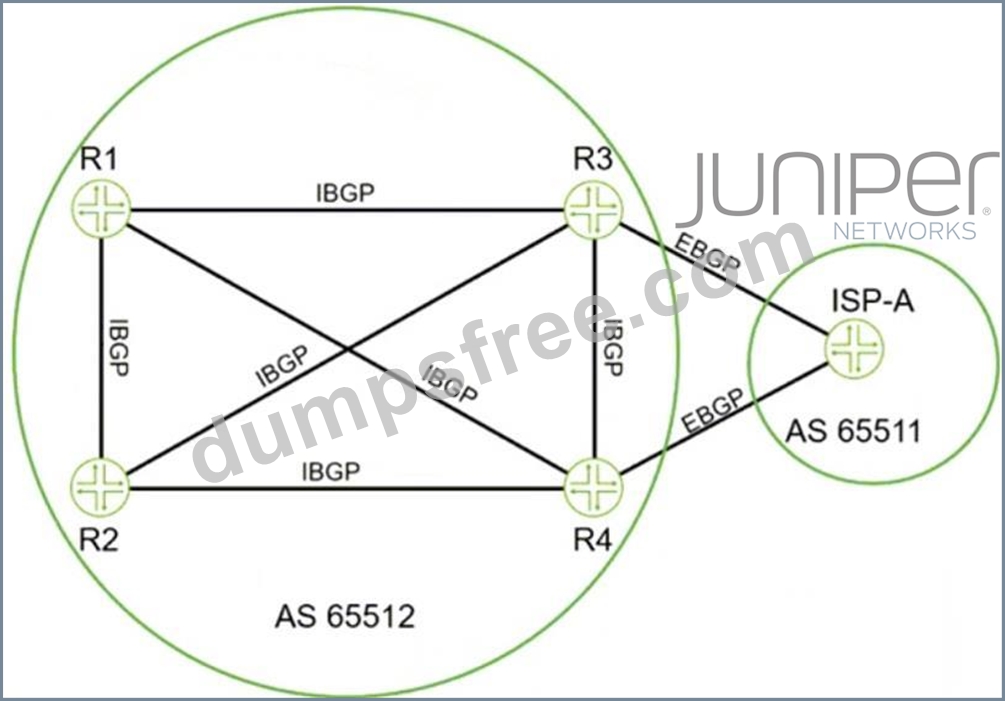
- A. The next-hop value for these routes Is changed by ISP-A before being sent to R3.
- B. By default, the next-hop value for these routes is not changed by ISP-A before being sent to R3.
- C. The BGP local-preference value that is used by ISP-A is not advertised to R3.
- D. All BGP attribute values must be removed before receiving the routes.
Answer: B,C
NEW QUESTION # 40
Exhibit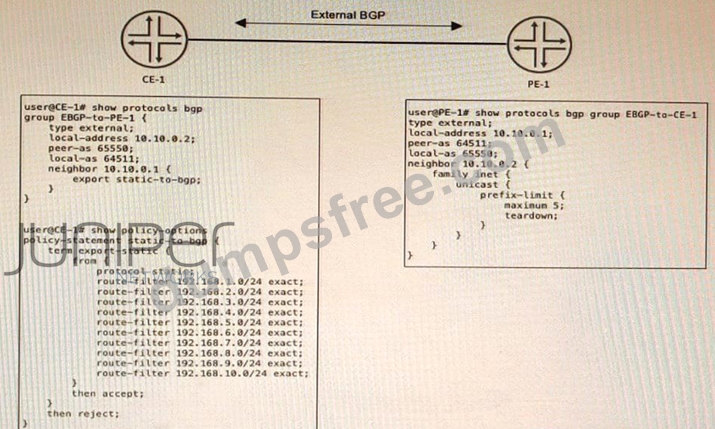
CE-1 must advertise ten subnets to PE-1 using BGP Once CE-1 starts advertising the subnets to PE-1, the BGP peering state changes to Active.
Referring to the CLI output shown in the exhibit, which statement is correct?
- A. CE-1 is advertising its entire routing table.
- B. CE-1 is unreachable
- C. The prefix limit has been reached on PE-1
- D. CE-1 is configured with an incorrect peer AS
Answer: D
Explanation:
The problem in this scenario is that CE-1 is configured with an incorrect peer AS number for its BGP session with PE-1. The CLI output shows that CE-1 is using AS 65531 as its local AS number and AS 65530 as its peer AS number. However, PE-1 is using AS 65530 as its local AS number and AS 65531 as its peer AS number. This causes a mismatch in the BGP OPEN messages and prevents the BGP session from being established. To solve this problem, CE-1 should configure its peer AS number as 65530 under [edit protocols bgp group external] hierarchy level.
NEW QUESTION # 41
Exhibit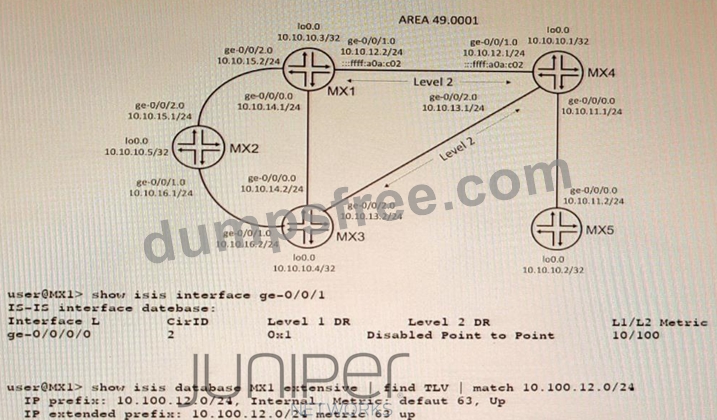
A network is using IS-IS for routing.
In this scenario, why are there two TLVs shown in the exhibit?
- A. The interface specified a metric of 100 for L2.
- B. Wide metrics have specifically been requested
- C. Both IPv4 and IPv6 are being used in the topology
- D. There are both narrow and wide metric devices in the topology
Answer: D
Explanation:
TLVs are tuples of (Type, Length, Value) that can be advertised in IS-IS packets. TLVs can carry different kinds of information in the Link State Packets (LSPs). IS-IS supports both narrow and wide metrics for link costs. Narrow metrics use a single octet to encode the link cost, while wide metrics use three octets. Narrow metrics have a maximum value of 63, while wide metrics have a maximum value of 16777215. If there are both narrow and wide metric devices in the topology, IS-IS will advertise two TLVs for each link: one with the narrow metric and one with the wide metric. This allows backward compatibility with older devices that only support narrow metrics12.
NEW QUESTION # 42
Exhibit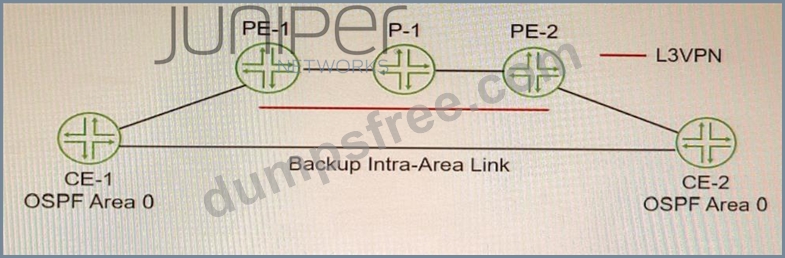
You must ensure that the VPN backbone is preferred over the back door intra-area link as long as the VPN is available. Referring to the exhibit, which action will accomplish this task?
- A. Enable OSPF traffic-engineering.
- B. Configure an import routing policy on the CE routers that rejects OSPF routes learned on the backup intra-area link.
- C. Create an OSPF sham link between the PE routers.
- D. Configure the OSPF metric on the backup intra-area link that is higher than the L3VPN link.
Answer: C
Explanation:
Explanation
A sham link is a logical link between two PE routers that belong to the same OSPF area but are connected through an L3VPN. A sham link makes the PE routers appear as if they are directly connected, and prevents OSPF from preferring an intra-area back door link over the VPN backbone. To create a sham link, you need to configure the local and remote addresses of the PE routers under the [edit protocols ospf area area-id] hierarchy level1.
NEW QUESTION # 43
Exhibit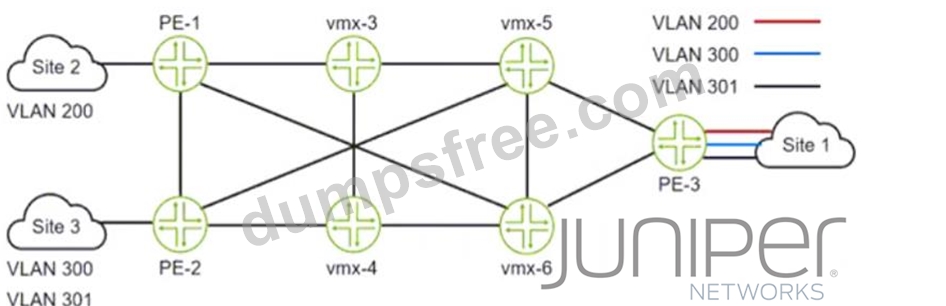
You want Site 1 to access three VLANs that are located in Site 2 and Site 3 The customer-facing interface on the PE-1 router is configured for Ethernet-VLAN encapsulation.
What is the minimum number of L2VPN routing instances to be configured to accomplish this task?
- A. 0
- B. 1
- C. 2
- D. 3
Answer: C
Explanation:
To allow Site 1 to access three VLANs that are located in Site 2 and Site 3, you need to configure three L2VPN routing instances on PE-1, one for each VLAN. Each L2VPN routing instance will have a different VLAN ID and a different VNI for VXLAN encapsulation. Each L2VPN routing instance will also have a different vrf-target export value to identify which VPN routes belong to which VLAN. This way, PE-1 can forward traffic from Site 1 to Site 2 and Site 3 based on the VLAN tags and VNIs.
NEW QUESTION # 44
You are configuring a Layer 3 VPN between two sites. You are configuring the vrf-target target : 65100:100 statement in your routing instance.
In this scenario, which two statements describe the vrf-target configuration? (Choose two.)
- A. This value is used to identify BGP routes learned from the local CE device.
- B. This value is used to add a target community to BGP routes advertised to the remote PE device.
- C. This value is used to add a target community to BGP routes advertised to the local CE device.
- D. This value is used to identify BGP routes learned from the remote PE device.
Answer: B,D
Explanation:
The `vrf-target` statement in a Layer 3 VPN configuration is used to control the import and export of VPN routes by attaching a target community to the routes. This helps in defining which VPN routes should be imported into or exported from a particular VRF (Virtual Routing and Forwarding) instance.
1. **Understanding VRF Target**:
- The `vrf-target` statement specifies the extended community attributes (route targets) that are used to control the import and export of routes in a VRF.
- These attributes help in identifying which routes should be shared between different VRFs, particularly across different PE (Provider Edge) devices.
2. **Statements Analysis**:
- **A. This value is used to identify BGP routes learned from the local CE device.**
- Incorrect. The `vrf-target` attribute is not used to identify routes learned from the local CE device. It is used to manage routes between PE devices and within the provider's MPLS network.
- **B. This value is used to identify BGP routes learned from the remote PE device.**
- Correct. The `vrf-target` value helps in identifying which routes from remote PE devices should be imported into the local VRF. It essentially acts as a filter for importing BGP routes with matching target communities.
- **C. This value is used to add a target community to BGP routes advertised to the local CE device.**
- Incorrect. Routes advertised to the local CE device do not use the `vrf-target` attribute. Instead, these routes are typically managed within the local VRF routing table.
- **D. This value is used to add a target community to BGP routes advertised to the remote PE device.**
- Correct. When advertising routes from the local PE to remote PE devices, the `vrf-target` value is added to these routes. This target community ensures that the correct routes are shared across the VPN.
**Conclusion**:
The correct statements about the `vrf-target` configuration in a Layer 3 VPN scenario are:
**B. This value is used to identify BGP routes learned from the remote PE device.**
**D. This value is used to add a target community to BGP routes advertised to the remote PE device.**
**References**:
- Juniper Networks Documentation on VRF Target: [VRF Target
Configuration](https://www.juniper.net/documentation/en_US/junos/topics/topic-map/layer-3-vpns.html)
- MPLS and VPN Architectures by Ivan Pepelnjak and Jim Guichard
NEW QUESTION # 45
Exhibit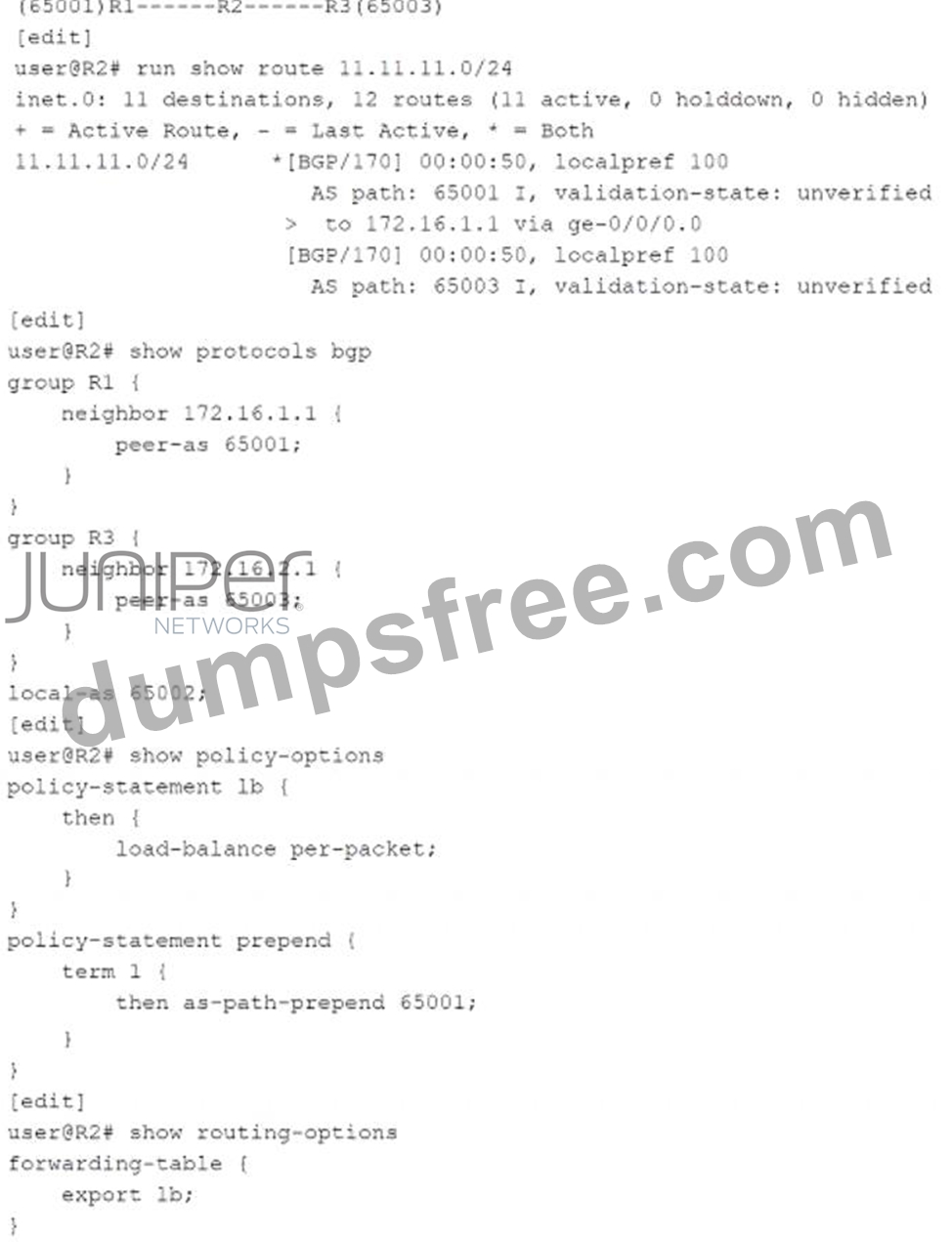
R2 is receiving the same route from R1 and R3. You must ensure that you can load balance traffic for that route.
Referring to the exhibit, which configuration change will allow load balancing?
- A. Apply the prepend policy as an import policy under group R1.
- B. Configure the multipath parameter under the global BGP configuration.
- C. Configure the multipath multiple-as parameter under the global BGP configuration.
- D. Apply the prepend policy as an import policy under group R3.
Answer: C
NEW QUESTION # 46
Exhibit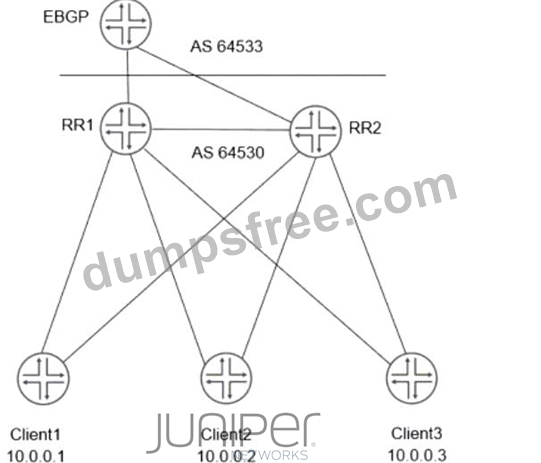
Referring to the exhibit, which two statements are correct about the dual route reflectors within a cluster?
(Choose two.)
- A. RR1 and RR2 must have the same duster ID to exchange routes learned from the client.
- B. RR1 and RR2 advertise routes learned from the clients to EBGP peers, using itself as the next hop.
- C. RR1 and RR2 append the duster ID when advertising routes from dient to dient.
- D. RR1 advertises routes from the client to RR2. using itself as the next hop.
Answer: B,C
NEW QUESTION # 47
Exhibit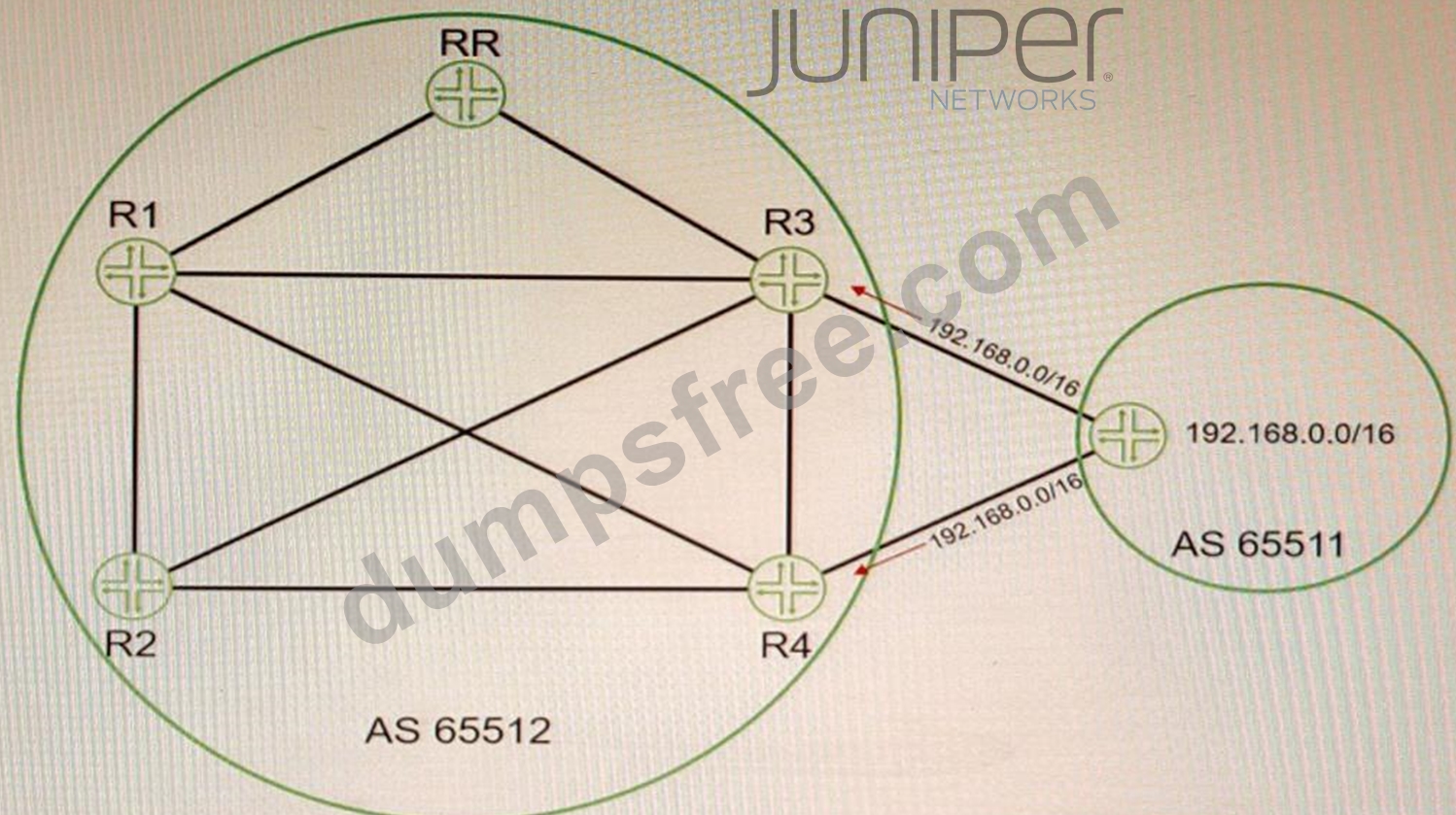
Referring to the exhibit, you are receiving the 192.168 0 0/16 route on both R3 and R4 from your EBGP neighbor You must ensure that R1 and R2 receive both BGP routes from the route reflector In this scenario, which BGP feature should you configure to accomplish this behavior?
- A. multihop
- B. multipath
- C. route-target
- D. add-path
Answer: D
Explanation:
BGP add-path is a feature that allows the advertisement of multiple paths through the same peering session for the same prefix without the new paths implicitly replacing any previous paths. This behavior promotes path diversity and reduces multi-exit discriminator (MED) oscillations. BGP add-path is implemented by adding a path identifier to each path in the NLRI. The path identifier can be considered as something similar to a route distinguisher in VPNs, except that a path ID can apply to any address family. Path IDs are unique to a peering session and are generated for each network3. In this question, we have a route reflector (RR) that receives two routes for the same prefix (192.168.0.0/16) from an EBGP neighbor. By default, the RR will only advertise its best path to its clients (R1 and R2). However, we want R1 and R2 to receive both routes from the RR. To achieve this, we need to configure BGP add-path on the RR and enable it to send multiple paths for the same prefix to its clients.
NEW QUESTION # 48
Referring to the exhibit, which two statements are correct regarding the output shown in the exhibit? (Choose two.)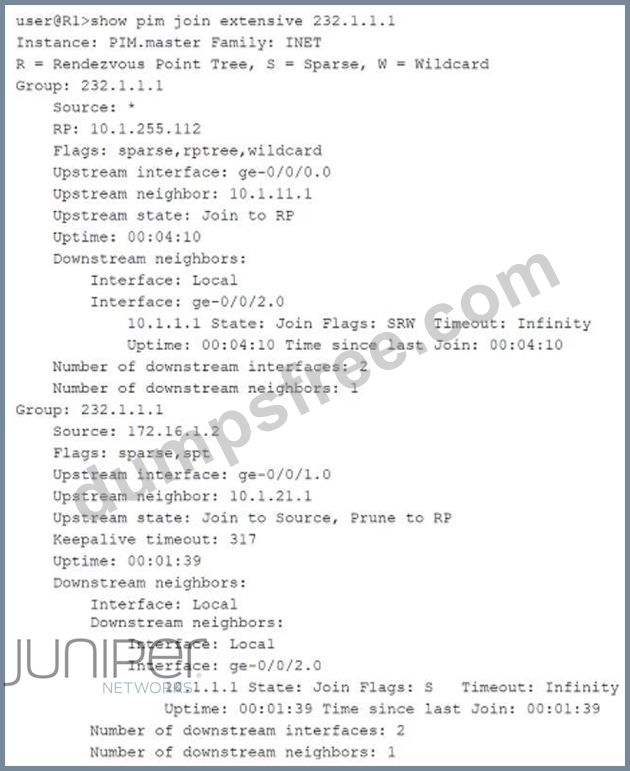
- A. The multicast group is an SSM group.
- B. The multicast traffic is using the RPT.
- C. The multicast group is an ASM group.
- D. The multicast traffic is using the SPT.
Answer: A,D
Explanation:
The group address is from SSM address block range (232.0.0.0 through 232.255.255.255).
NEW QUESTION # 49
Exhibit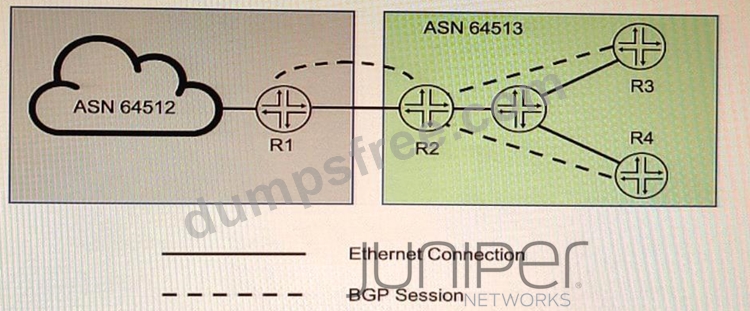
You want to implement the BGP Generalized TTL Security Mechanism (GTSM) on the network Which three statements are correct in this scenario? (Choose three)
- A. BGP GTSM requires a TTL of 1 to be configured between neighbors.
- B. You can implement BGP GTSM between R2 and R1.
- C. BGP GTSM requires a TTL of 255 to be configured between neighbors.
- D. You can implement BGP GTSM between R2, R3, and R4
- E. BGP GTSM requires a firewall filter to discard packets with incorrect TTL.
Answer: B,C,E
Explanation:
https://www.juniper.net/documentation/us/en/software/junos/bgp/topics/ref/statement/multihop-edit-protocols-bg
NEW QUESTION # 50
......
JN0-664 Exam Dumps, JN0-664 Practice Test Questions: https://www.dumpsfree.com/JN0-664-valid-exam.html
Attested JN0-664 Dumps PDF Resource [2025]: https://drive.google.com/open?id=1tXkYnXjsl34RBnFYxPJuwFURuFV0s9uI