


[Feb 28, 2023] Get Free Updates Up to 365 days On Developing Associate-Cloud-Engineer Braindumps
Best Quality Google Associate-Cloud-Engineer Exam Questions
Training
While the exam curriculum covers a lot of knowledge and skills, Google offers enough tools to help candidates systematize their preparation process. Self-paced and in-classroom courses as well we lab practice are also available.
So, you can take advantage of Architecting with Google Compute Engine, a three-day course that will introduce you to Google Cloud infrastructure and platform services by focusing on Compute Engine.
Alternatively, candidates can pose their questions to an expert instructor regarding Google Сloud products at a one-day Google Cloud Fundamentals: Core Infrastructure training session that includes lectures, presentations, and lab activities.
In addition, Google recommends that all applicants who want to know more about the format, structure, and topics of the certification exam finish the Preparing for the Associate Cloud Engineer Examination course. It helps applicants to assess their strengths and weaknesses and be fully prepared on the day of the final test.
If you are not confident in your readiness, you can also check your skills by answering sample questions alongside doing self-paced labs offered by the vendor.
Google Associate Cloud Engineer Exam
An associated cloud engineer distributes applications, monitors operations and manages business solutions. This person can use the Google Cloud Console and the command-line interface to perform common platform-based activities to maintain one or more distributed solutions that take advantage of services managed or self-managed by Google in Google Cloud
The Google Cloud Certification Program offers Google Cloud users, customers and partners a way to demonstrate their technical skills in a specific role or technology. People are evaluated using a variety of rigorously developed standard methods to determine if they meet Google Cloud competition standards. The cost of certification exams varies. if you do not pass an exam, you can repeat it after 14 days. If you do not take it a second time, you must wait 60 days before you can take it a third time. If it fails a third time, you must wait a year before resuming it. You can try the test in several languages, but each attempt, regardless of language, counts the total number of attempts allowed and the waiting period between attempts remains valid. Payment is required each time an exam is taken. Avoiding this recovery policy by registering with a different name or any other means constitutes a violation of the terms and conditions of the exam and will result in the denial or revocation of a certification. Exams are designed to determine only if a person meets a minimum standard of approval or not. They are not meant to be diagnostic or spread people on a capacity scale. For this reason, numerical scores are not significant for the candidate and can be misunderstood. Google Cloud Certification Program recognizes that some other exam providers provide section comments on their exams. Google doesn't do it because it makes no sense and could be misleading. Google Cloud Certification tests are not designed to diagnose strengths and weaknesses. Google Cloud Certification exam sections are very broad categories of topics, and the range of specific questions that can be received for each section in a single exam session is extremely small in comparison. Based on such a small amount of data, there are no significant comments at the section level that we can provide responsibly. We follow the procedures accepted by the industry to ensure that our exams are valid and accurate. Our exam development process includes the following steps: A task analysis (JTA) is a formal study that begins with the identification of role representatives, technology experts and stakeholders. These experts are interviewed and interviewed in a seminar to obtain information about what people do in a particular job or role and what skills distinguish the skills. These skills are defined in the exam guides that we write on the web. Our question authors are subject matter experts who worked in the certified role. The question editors are trained in the exam standards and conventions that we apply to our exams. All questions are examined to determine if they meet the standards and are technically accurate. Once the questions have passed all warnings and approvals, they are published in a beta test. The purpose of the beta exam is to collect performance statistics related to the exam questions to determine which ones are the most effective. We review the statistics and comments on the questions and eliminate questions that do not meet our standards. The minimum score for each exam is reserved. It is determined by a group of internal and external experts in the field, following a process of setting standards accepted by the sector. The minimum score applies equally to all candidates. It is reevaluated when changes are made to the content of the exam. The delivery method for an exam depends on its format.
The Google Associate Cloud Engineer exam targets software engineers who would like to dabble into the Google Cloud. So, you need to be capable of using the command-line interfaces and Google Cloud Console to handle core platform-based tasks. These mostly include monitoring operations and managing enterprise solutions to maintain deployed applications. In addition, after successful writing of the test, candidates obtain the appropriate Google Cloud certification.
NEW QUESTION 104
Your organization uses G Suite for communication and collaboration. All users in your organization have a G Suite account. You want to grant some G Suite users access to your Cloud Platform project. What should you do?
- A. Grant them the required IAM roles using their G Suite email address.
- B. Create a CSV sheet with all users' email addresses. Use the gcloud command line tool to convert them into Google Cloud Platform accounts.
- C. Enable Cloud Identity in the GCP Console for your domain.
- D. In the G Suite console, add the users to a special group called cloud-console- [email protected]. Rely on the default behavior of the Cloud Platform to grant users access if they are members of this group.
Answer: A
Explanation:
Explanation/Reference: https://cloud.google.com/resource-manager/docs/creating-managing-organization
NEW QUESTION 105
You have downloaded and installed the gcloud command line interface (CLI) and have authenticated with your Google Account. Most of your Compute Engine instances in your project run in the europe-west1-d zone. You want to avoid having to specify this zone with each CLI command when managing these instances. What should you do?
- A. Set the europe-west1-d zone as the default zone using the gcloud config subcommand.
- B. In the Settings page for Compute Engine under Default location, set the zone to europe-west1-d.
- C. Create a Metadata entry on the Compute Engine page with key compute/zone and value europe- west1-d
- D. In the CLI installation directory, create a file called default.conf containing zone=europe-west1-d.
Answer: A
Explanation:
gcloud config - view and edit Cloud SDK properties
Default zone to use when working with zonal Compute Engine resources.
https://cloud.google.com/sdk/gcloud/reference/config
NEW QUESTION 106
You are using Deployment Manager to create a Google Kubernetes Engine cluster. Using the same Deployment Manager deployment, you also want to create a DaemonSet in the kube-system namespace of the cluster. You want a solution that uses the fewest possible services. What should you do?
- A. Add the cluster's API as a new Type Provider in Deployment Manager, and use the new type to create the DaemonSet.
- B. With Deployment Manager, create a Compute Engine instance with a startup script that uses kubectl to create the DaemonSet.
- C. In the cluster's definition in Deployment Manager, add a metadata that has kube-system as key and the DaemonSet manifest as value.
- D. Use the Deployment Manager Runtime Configurator to create a new Config resource that contains the DaemonSet definition.
Answer: B
NEW QUESTION 107
You are using Data Studio to visualize a table from your data warehouse that is built on top of BigQuery. Data is appended to the data warehouse during the day. At night, the daily summary is recalculated by overwriting the table. You just noticed that the charts in Data Studio are broken, and you want to analyze the problem. What should you do?
- A. Use Cloud Debugger to find out why the data was not refreshed correctly
- B. Review the Error Reporting page in the Cloud Console to find any errors.
- C. Use the BigQuery interface to review the nightly Job and look for any errors
- D. In Cloud Logging create a filter for your Data Studio report
Answer: C
Explanation:
https://cloud.google.com/bigquery/docs/managing-jobs#view-job.
Cloud Debugger is for inspecting apps: https://cloud.google.com/debugger/docs.
NEW QUESTION 108
You have designed a solution on Google Cloud Platform (GCP) that uses multiple GCP products. Your company has asked you to estimate the costs of the solution. You need to provide estimates for the monthly total cost. What should you do?
- A. Provision the solution on GCP. Leave the solution provisioned for 1 week. Navigate to the Billing Report page in the Google Cloud Platform Console. Multiply the 1 week cost to determine the monthly costs.
- B. For each GCP product in the solution, review the pricing details on the products pricing page. Create a Google Sheet that summarizes the expected monthly costs for each product.
- C. Provision the solution on GCP. Leave the solution provisioned for 1 week. Use Stackdriver to determine the provisioned and used resource amounts. Multiply the 1 week cost to determine the monthly costs.
- D. For each GCP product in the solution, review the pricing details on the products pricing page. Use the pricing calculator to total the monthly costs for each GCP product.
Answer: A
NEW QUESTION 109
You've deployed a microservice called myapp1 to a Google Kubernetes Engine cluster using the YAML file specified below: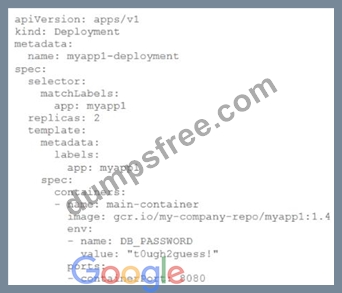
You need to refactor this configuration so that the database password is not stored in plain text. You want to follow Google-recommended practices. What should you do?
- A. Store the database password inside a Secret object. Modify the YAML file to populate the DB_PASSWORD environment variable from the Secret.
- B. Store the database password in a file inside a Kubernetes persistent volume, and use a persistent volume claim to mount the volume to the container.
- C. Store the database password inside the Docker image of the container, not in the YAML file.
- D. Store the database password inside a ConfigMap object. Modify the YAML file to populate the DB_PASSWORD environment variable from the ConfigMap.
Answer: D
NEW QUESTION 110
You have set a firewall rule that will permit inbound connections to a VM instance named server-
2.
You want to apply this rule only if there is not another rule that would deny that traffic. What priority would you give to this rule?
- A. 0
- B. 1
- C. 2
- D. 3
Answer: B
Explanation:
If the rule will have the lowest priority, it will permit inbound traffic/ connections to the VM instance server-2. The large will be the number, the low will be the priority. The lowest priority will ensure that the other rules that match will apply. So, the largest number should be selected to make the priority lowest.
NEW QUESTION 111
A customer is deploying a production portal application on AWS. The database tier has structured data. The company requires a solution that is easily manageable and highly available.
How can these requirements be met?
- A. Use Amazon DynamoDB.
- B. Use RDS with a single Available Zone option and schedule periodic database snapshots.
- C. Use Amazon RDS with a multiple Availability Zone option.
- D. Deploy the database on multiple Amazon EC2 instances backed by Amazon EBS across multiple Availability Zones.
Answer: C
Explanation:
Explanation/Reference: https://aws.amazon.com/rds/
NEW QUESTION 112
You are using Data Studio to visualize a table from your data warehouse that is built on top of BigQuery. Data is appended to the data warehouse during the day. At night, the daily summary is recalculated by overwriting the table. You just noticed that the charts in Data Studio are broken, and you want to analyze the problem. What should you do?
- A. Use Cloud Debugger to find out why the data was not refreshed correctly
- B. Review the Error Reporting page in the Cloud Console to find any errors.
- C. Use the BigQuery interface to review the nightly Job and look for any errors
- D. In Cloud Logging create a filter for your Data Studio report
Answer: A
NEW QUESTION 113
Your company implemented BigQuery as an enterprise data warehouse. Users from multiple business units run queries on this data warehouse. However, you notice that query costs for BigQuery are very high, and you need to control costs. Which two methods should you use?
(Choose two.)
- A. Apply a user- or project-level custom query quota for BigQuery data warehouse.
- B. Split your BigQuery data warehouse into multiple data warehouses for each business unit.
- C. Split the users from business units to multiple projects.
- D. Create separate copies of your BigQuery data warehouse for each business unit.
- E. Change your BigQuery query model from on-demand to flat rate. Apply the appropriate number of slots to each Project.
Answer: A,E
NEW QUESTION 114
You have 32 GB of data in a single file that you need to upload to a Nearline Storage bucket. The WAN connection you are using is rated at 1 Gbps, and you are the only one on the connection. You want to use as match of the rated 1 Gbps as possible to transfer the file rapidly. How should you upload the file?
- A. Use the GCP Console to transfer the file instead of gsutil.
- B. Enable parallel composite uploads using gsutil on the file transfer.
- C. Change the storage class of the bucket from Nearline to Multi-Regional.
- D. Decrease the TCP window size on the machine initiating the transfer.
Answer: B
NEW QUESTION 115
You are deploying a production application on Compute Engine. You want to prevent anyone from accidentally destroying the instance by clicking the wrong button. What should you do?
- A. Enable Preemptibility on the instance.
- B. Enable delete protection on the instance.
- C. Disable Automatic restart on the instance.
- D. Disable the flag "Delete boot disk when instance is deleted."
Answer: B
Explanation:
Preventing Accidental VM Deletion
This document describes how to protect specific VM instances from deletion by setting the deletionProtection property on an Instance resource. To learn more about VM instances, read the Instances documentation.
https://cloud.google.com/compute/docs/instances/preventing-accidental-vm-deletion
NEW QUESTION 116
Your customer has implemented a solution that uses Cloud Spanner and notices some read latency-related performance issues on one table. This table is accessed only by their users using a primary key. The table schema is shown below.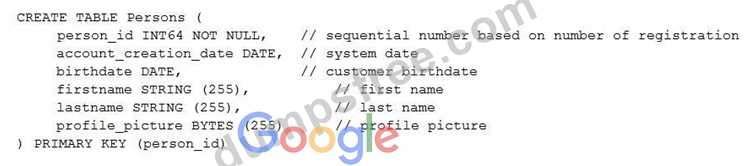
You want to resolve the issue. What should you do?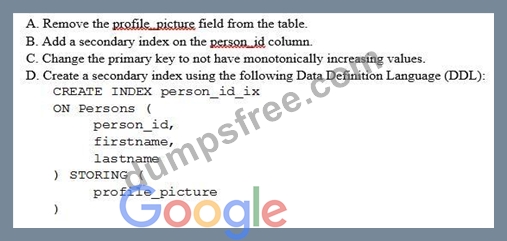
- A. Option A
- B. Option D
- C. Option B
- D. Option C
Answer: B
NEW QUESTION 117
You deployed an App Engine application using gcloud app deploy, but it did not deploy to the intended project. You want to find out why this happened and where the application deployed.
What should you do?
- A. Go to Deployment Manager and review settings for deployment of applications.
- B. Check the web-application.xml file for your application and check project settings.
- C. Check the app.yaml file for your application and check project settings.
- D. Go the Cloud Shell and run gcloud config list to review the Google Cloud configuration used for deployment.
Answer: C
NEW QUESTION 118
You are the team lead of a group of 10 developers. You provided each developer with an individual Google Cloud Project that they can use as their personal sandbox to experiment with different Google Cloud solutions.
You want to be notified if any of the developers are spending above $500 per month on their sandbox environment. What should you do?
- A. Create a single budget for all projects and configure budget alerts on this budget.
- B. Create a separate billing account per sandbox project and enable BigQuery billing exports. Create a Data Studio dashboard to plot the spending per billing account.
- C. Create a budget per project and configure budget alerts on all of these budgets.
- D. Create a single billing account for all sandbox projects and enable BigQuery billing exports. Create a Data Studio dashboard to plot the spending per project.
Answer: C
Explanation:
Explanation/Reference: https://cloud.google.com/billing/docs/how-to/budgets
NEW QUESTION 119
You create a Deployment with 2 replicas in a Google Kubernetes Engine cluster that has a single preemptible node pool. After a few minutes, you use kubectl to examine the status of your Pod and observe that one of them is still in Pending status:
What is the most likely cause?
- A. The pending Pod's resource requests are too large to fit on a single node of the cluster.
- B. Too many Pods are already running in the cluster, and there are not enough resources left to schedule the pending Pod.
- C. The pending Pod was originally scheduled on a node that has been preempted between the creation of the Deployment and your verification of the Pods' status. It is currently being rescheduled on a new node.
- D. The node pool is configured with a service account that does not have permission to pull the container image used by the pending Pod.
Answer: B
NEW QUESTION 120
You have an App Engine application running in us-east1. You've noticed 90% of your traffic comes from the West Coast. You'd like to change the region. What's the best way to change the App Engine region?
- A. Create a new project and create an App Engine instance in us-west2.
- B. Contact Google Cloud Support and request the change.
- C. From the console, under the App Engine page, click edit, and change the region drop-down.
- D. Use the gcloud app region set command and supply the name of the new region.
Answer: A
NEW QUESTION 121
You have a Compute Engine instance hosting a production application. You want to receive an email if the instance consumes more than 90% of its CPU resources for more than 15 minutes.
You want to use Google services. What should you do?
- A. 1. Create a Stackdriver Workspace, and associate your GCP project with it.
2. Write a script that monitors the CPU usage and sends it as a custom metric to Stackdriver.
3. Create an uptime check for the instance in Stackdriver. - B. 1. In Stackdriver Logging, create a logs-based metric to extract the CPU usage by using this regular expression: CPU Usage: ([0-9] {1,3})%
2. In Stackdriver Monitoring, create an Alerting Policy based on this metric.
3. Configure your email address in the notification channel. - C. 1. Create a consumer Gmail account.
2. Write a script that monitors the CPU usage.
3. When the CPU usage exceeds the threshold, have that script send an email using the Gmail account and smtp.gmail.com on port 25 as SMTP server. - D. 1. Create a Stackdriver Workspace, and associate your Google Cloud Platform (GCP) project with it.
2. Create an Alerting Policy in Stackdriver that uses the threshold as a trigger condition.
3. Configure your email address in the notification channel.
Answer: B
NEW QUESTION 122
Your organization is a financial company that needs to store audit log files for 3 years. Your organization has hundreds of Google Cloud projects. You need to implement a cost-effective approach for log file retention. What should you do?
- A. Export these logs to Cloud Pub/Sub and write a Cloud Dataflow pipeline to store logs to Cloud SQL.
- B. Create an export to the sink that saves logs from Cloud Audit to a Coldline Storage bucket.
- C. Create an export to the sink that saves logs from Cloud Audit to BigQuery.
- D. Write a custom script that uses logging API to copy the logs from Stackdriver logs to BigQuery.
Answer: B
NEW QUESTION 123
You need to deploy an application, which is packaged in a container image, in a new project. The application exposes an HTTP endpoint and receives very few requests per day. You want to minimize costs. What should you do?
- A. Deploy the container on Cloud Run on GKE.
- B. Deploy the container on Google Kubernetes Engine, with cluster autoscaling and horizontal pod autoscaling enabled.
- C. Deploy the container on App Engine Flexible.
- D. Deploy the container on Cloud Run.
Answer: D
Explanation:
Cloud Run takes any container images and pairs great with the container ecosystem: Cloud Build, Artifact Registry, Docker. ... No infrastructure to manage: once deployed, Cloud Run manages your services so you can sleep well. Fast autoscaling. Cloud Run automatically scales up or down from zero to N depending on traffic.
https://cloud.google.com/run
NEW QUESTION 124
You created a Google Cloud Platform project with an App Engine application inside the project.
You initially configured the application to be served from the us-central region. Now you want the application to be served from the asia-northeast1 region. What should you do?
- A. Change the region property setting in the existing App Engine application from us-central to asia- northeast1.
- B. Create a second App Engine application in the existing GCP project and specify asia-northeast1 as the region to serve your application.
- C. Change the default region property setting in the existing GCP project to asia-northeast1.
- D. Create a new GCP project and create an App Engine application inside this new project.
Specify asia-northeast1 as the region to serve your application.
Answer: D
Explanation:
https://cloud.google.com/appengine/docs/flexible/nodejs/an-overview-of-app-engine
NEW QUESTION 125
......
Google Exam Practice Test To Gain Brilliante Result: https://www.dumpsfree.com/Associate-Cloud-Engineer-valid-exam.html
Tested Material Used To Associate-Cloud-Engineer: https://drive.google.com/open?id=1P5IQrVLjkaT81N6pFLjPbEru0FXpra3a