


Buy Latest Jan 09, 2022 AZ-120 Exam Q&A PDF - One Year Free Update
Download the Latest AZ-120 Dump - 2022 AZ-120 Exam Questions
Exam Details
The total number of questions contained in the Microsoft AZ-120 exam is not actually mentioned on the official website. It is highly possible that the test will include about 40-60 scenario-based questions with single-answer and multiple-answer options. The exam is known to be available for the candidates in the English, Simplified Chinese, Korean, and Japanese languages. The registration fee for the test is $165 in the United States but it may be different in other countries.
Prerequisites
The candidates who are planning to take the Microsoft AZ-120 exam should have plenty of experience and thorough knowledge of SAP applications, ARM templates, virtualization, SAP BW, SAP HANA, S/4 HANA, operating systems, networking, data protection concepts, storage structure, Cloud infrastructure, as well as disaster recovery design. These are not mandatory prerequisites for attempting the test, but the above-mentioned competencies are highly recommended before sitting for this certification exam. Holding an extra certificate, such as Azure Administrator Associate or Azure Solutions Architect Expert in addition to Linux as well as SAP HANA, will be an added advantage.
NEW QUESTION 60
You need to connect SAP HANA on Azure (Large Instances) to an Azure Log Analytics workspace.
Which four actions should you perform in sequence? To answer, move the appropriate actions from the list of actions to the answer area and arrange them in the correct order.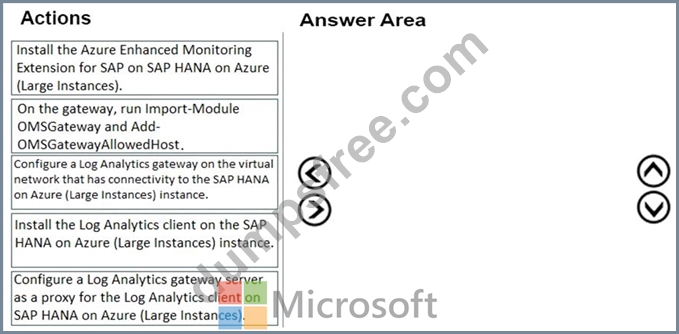
Answer:
Explanation: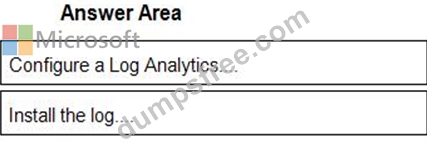
1 - Configure a Log Analytics....
2 - Install the log....
References:
http://www.deployazure.com/compute/virtual-machines/sap-azure-enhanced-monitoring-extension/
https://docs.microsoft.com/en-us/azure/azure-monitor/platform/gateway
NEW QUESTION 61
Your on-premises network contains SAP and non-SAP applications.
You have JAVA-based SAP systems that use SPNEGO for single-sign on (SSO) authentication.
Your external portal uses multi-factor authentication (MFA) to authenticate users.
You plan to extend the on-premises authentication features to Azure and to migrate the SAP applications to Azure.
For each of the following statements, select Yes if the statement is true. Otherwise, select No.
NOTE: Each correct selection is worth one point.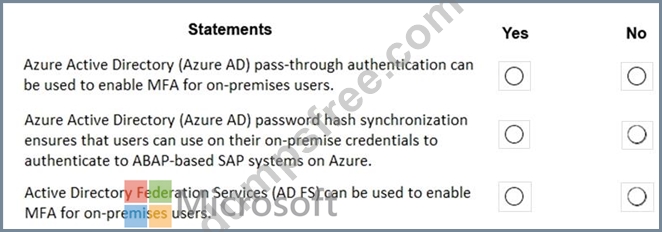
Answer:
Explanation: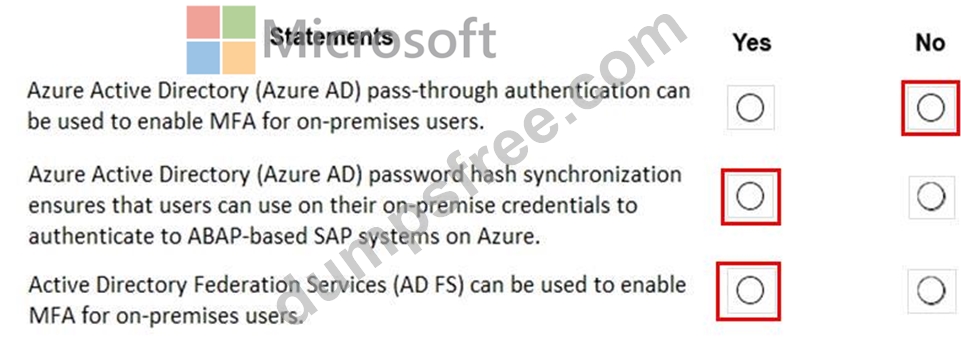
Explanation:
Box 1: No
Need AD FS for MF
Note: Azure Active Directory (Azure AD) Pass-through Authentication allows your users to sign in to both on-premises and cloud-based applications using the same passwords. This feature is an alternative to Azure AD Password Hash Synchronization (see Box 2).
Box 2: Yes
Password hash synchronization is one of the sign-in methods used to accomplish hybrid identity. Azure AD Connect synchronizes a hash, of the hash, of a users password from an on-premises Active Directory instance to a cloud-based Azure AD instance.
Password hash synchronization is an extension to the directory synchronization feature implemented by Azure AD Connect sync. You can use this feature to sign in to Azure AD services like Office 365. You sign in to the service by using the same password you use to sign in to your on-premises Active Directory instance.
Box 3: Yes
If your organization is federated with Azure AD, you can use Azure Multi-Factor Authentication to secure AD FS resources, both on-premises and in the cloud. Azure MFA enables you to eliminate passwords and provide a more secure way to authenticate.
References:
https://docs.microsoft.com/en-us/azure/active-directory/hybrid/whatis-phs
https://docs.microsoft.com/en-us/windows-server/identity/ad-fs/operations/configure-ad-fs-and-azure-mfa
NEW QUESTION 62
Your on-premises network contains SAP and non-SAP applications.
You have JAVA-based SAP systems that use SPNEGO for single-sign on (SSO) authentication.
Your external portal uses multi-factor authentication (MFA) to authenticate users.
You plan to extend the on-premises authentication features to Azure and to migrate the SAP applications to Azure.
For each of the following statements, select Yes if the statement is true. Otherwise, select No.
NOTE: Each correct selection is worth one point.
Answer:
Explanation: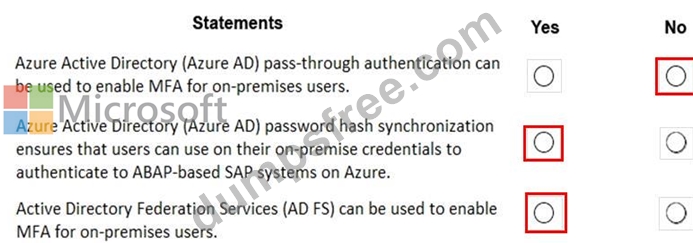
Explanation:
Box 1: No
Need AD FS for MF
Note: Azure Active Directory (Azure AD) Pass-through Authentication allows your users to sign in to both on-premises and cloud-based applications using the same passwords. This feature is an alternative to Azure AD Password Hash Synchronization (see Box 2).
Box 2: Yes
Password hash synchronization is one of the sign-in methods used to accomplish hybrid identity. Azure AD Connect synchronizes a hash, of the hash, of a users password from an on-premises Active Directory instance to a cloud-based Azure AD instance.
Password hash synchronization is an extension to the directory synchronization feature implemented by Azure AD Connect sync. You can use this feature to sign in to Azure AD services like Office 365. You sign in to the service by using the same password you use to sign in to your on-premises Active Directory instance.
Box 3: Yes
If your organization is federated with Azure AD, you can use Azure Multi-Factor Authentication to secure AD FS resources, both on-premises and in the cloud. Azure MFA enables you to eliminate passwords and provide a more secure way to authenticate.
References:
https://docs.microsoft.com/en-us/azure/active-directory/hybrid/whatis-phs
https://docs.microsoft.com/en-us/windows-server/identity/ad-fs/operations/configure-ad-fs-and-azure-mfa
NEW QUESTION 63
Note: This question is part of a series of questions that present the same scenario. Each question in the series contains a unique solution that might meet the stated goals. Some question sets might have more than one correct solution, while others might not have a correct solution.
After you answer a question in this section, you will NOT be able to return to it. As a result, these questions will not appear in the review screen.
You deploy SAP HANA on Azure (Large Instances).
You need to back up the SAP HANA database to Azure.
Solution: You create a Recovery Services vault and a backup policy.
Does this meet the goal?
- A. No
- B. Yes
Answer: A
Explanation:
Explanation
https://docs.microsoft.com/en-us/azure/virtual-machines/workloads/sap/hana-backup-restore
NEW QUESTION 64
Before putting the SAP environment on Azure into production, which command should you run to ensure that the virtual machine disks meet the business requirements? To answer, select the appropriate options in the answer area.
NOTE: Each correct selection is worth one point.
Answer:
Explanation:
Explanation:
Scenario: Ensure that all the production databases can withstand the failure of an Azure region.
References:
https://docs.microsoft.com/en-us/powershell/module/az.compute/get-azvmimage
NEW QUESTION 65
You have an on- premises SAP environment hosted on VMware VSphere that in Microsoft SQL Server as the database platform. You plan to migrate the environment to Azure. The database platform will remain the same. You need gather information to size the target Azure Environment for the migration. What should you use?
What should you use?
- A. Azure Monitor
- B. the SAP NANA sizing report
- C. the SAP EarlyWatch Alert report
- D. Azure Advisor
Answer: C
Explanation:
https://azure.microsoft.com/nl-nl/blog/sap-on-azure-architecture-designing-for-performance-and-scalability/
"For existing on-premises systems, you should reference system configuration and resource utilization data. The system utilization information is collected by the SAP OS Collector and can be reported via SAP transaction OS07N as well as the EarlyWatch Alert. "
NEW QUESTION 66
Your on-premises network contains an Active Directory domain.
You have an SAP environment on Azure that runs on SUSE Linux Enterprise Server (SLES) servers.
You configure the SLES servers to use domain controllers as their NTP servers and their DNS servers.
You need to join the SLES servers to the Active Directory domain.
Which three actions should you perform in sequence? To answer, move the appropriate actions from the list of actions to the answer area and arrange them in the correct order.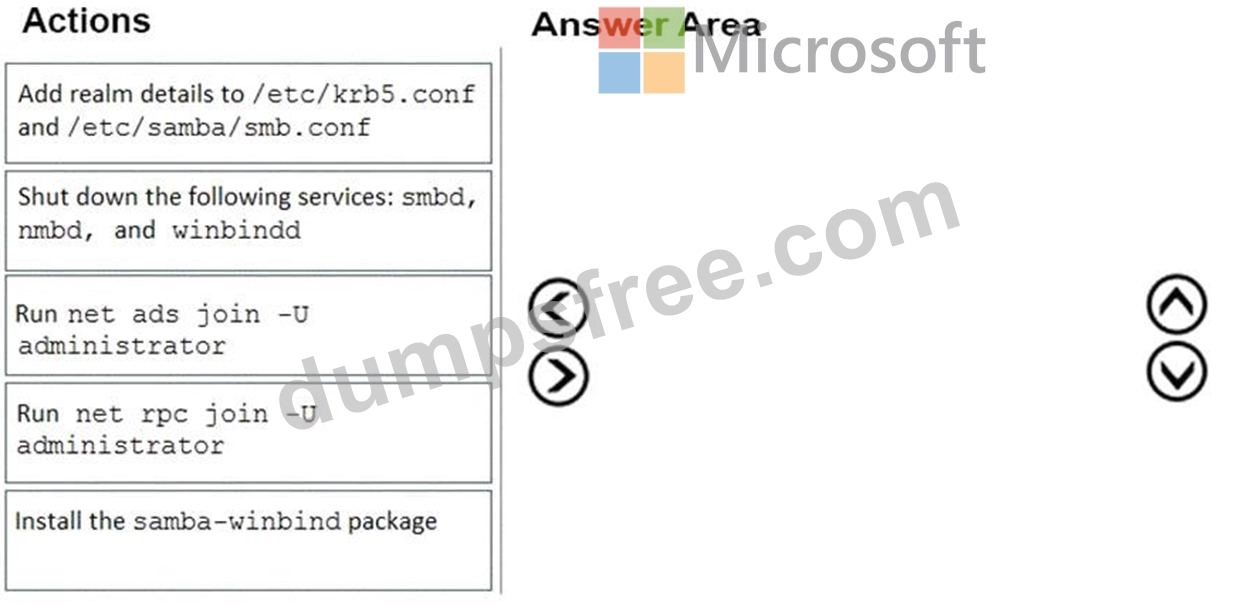
Answer:
Explanation: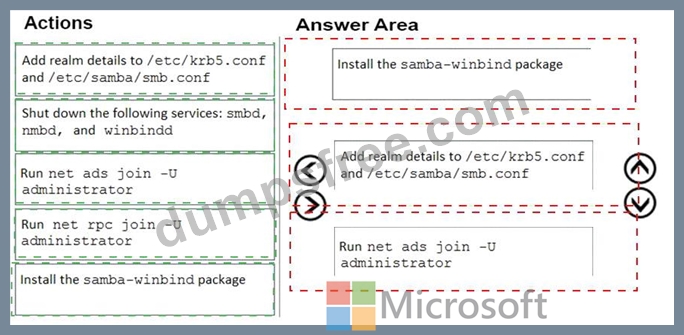
Explanation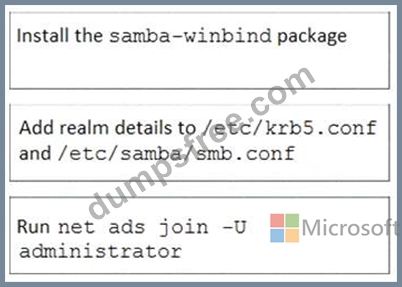
Step 1: Install the samba-winbind package
Install samba-winbind
Step 2: Add realm details to /etc/krb5.conf and /etc/samba/smb.conf
Edit files - best way to do this is to use yast on test machine and copy files from it In following examples you need to replace EXAMPLE/EXAMPLE.COM/.example.com with your values/settings
/etc/samba/smb.conf
[global]
workgroup = EXAMPLE
usershare allow guests = NO #disallow guests from sharing
idmap gid = 10000-20000
idmap uid = 10000-20000
kerberos method = secrets and keytab
realm = EXAMPLE.COM
security = ADS
template homedir = /home/%D/%U
template shell = /bin/bash
winbind offline logon = yes
winbind refresh tickets = yes
/etc/krb5.conf
[libdefaults]
default_realm = EXAMPLE.COM
clockskew = 300
[realms]
EXAMPLE.COM = {
kdc = PDC.EXAMPLE.COM
default_domain = EXAMPLE.COM
admin_server = PDC.EXAMPLE.COM
}
Step 3: Run net ads join -U administrator
Join the SLES 12 Server to the AD domain
References:
https://www.suse.com/support/kb/doc/?id=7018461
NEW QUESTION 67
You are evaluating the proposed backup policy.
For each of the following statements, select Yes if the statement is true. otherwise, select No.
NOTE: Each correct selection is worth one point.
Answer:
Explanation: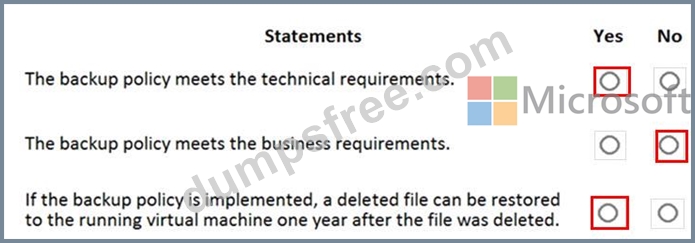
Explanation:
Box 1: Yes
Scenario: Technical requirements: Ensure that an application server can be restored from a backup created during the last five days within 15 minutes.
Instant Restore has 'The instance recovery snapshot(s) for 5 Day(s)'.
Box 2: No
Scenario: Ensure that all the production application servers can restore daily backups from the last 21 days.
The Retention of daily backup point is set to for 14 days only.
Box 3: Yes
Reference:
https://docs.microsoft.com/en-us/azure/backup/backup-instant-restore-capability
NEW QUESTION 68
You are integrating SAP HANA and Azure Active Directory (Azure AD).
For each of the following statements, select Yes if the statement is true. Otherwise, select No.
NOTE: Each correct selection is worth one point.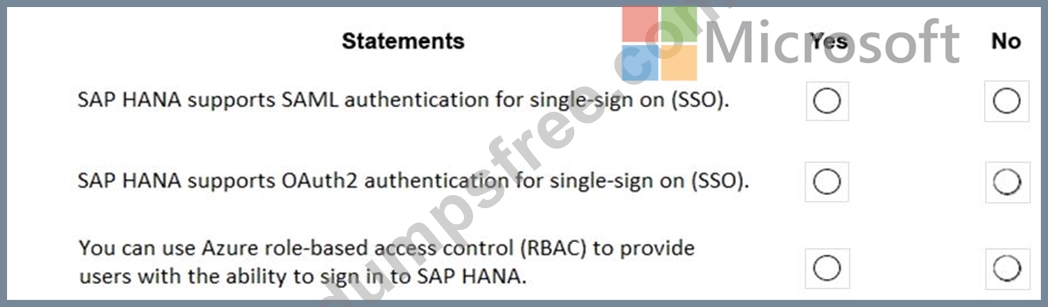
Answer:
Explanation: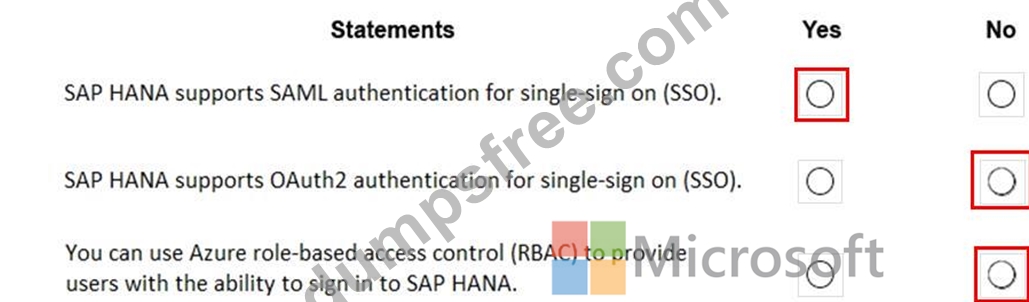
Explanation:
Box 1: Yes
To configure Azure AD single sign-on with SAP HANA, perform the following steps:
1. In the Azure portal, on the SAP HANA application integration page, select Single sign-on.
2. On the Select a Single sign-on method dialog, select SAML/WS-Fed mode to enable single sign-on.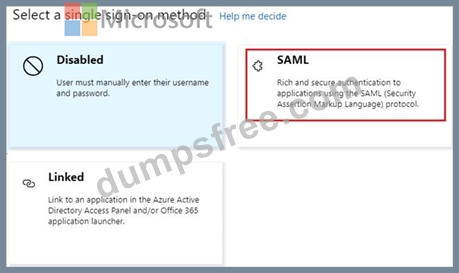
Box 2: No
Box 3: No
Key security considerations for deploying SAP on Azure
References:
https://docs.microsoft.com/en-us/azure/active-directory/saas-apps/saphana-tutorial
NEW QUESTION 69
You have an on-premises SAP environment that uses AIX servers and IBM DB2 as the database platform.
You plan to migrate SAP to Azure. In Azure, the SAP workloads will use Windows Server and Microsoft SQL Server as the database platform.
What should you use to export from DB2 and import the data to SQL Server?
- A. R3trans
- B. Azure SQL Data Warehouse
- C. SQL Server Management Studio (SSMS)
- D. R3load
Answer: D
Explanation:
Both R3load and SSMA can be used to migrate from DB2 to SQL Server. In the options there is not SSMA, but SSMS, the SSMS cannot be use to migrate DB2 to SQL Server. please refer to: https://techcommunity.microsoft.com/t5/running-sap-applications-on-the/sap-os-db-migration-to-sql-server-faq/ba-p/366986
https://sapnwnewbie.blogspot.com/2013/07/osdb-migration-cmd-str-toc-ext-r3load.html https://docs.microsoft.com/en-us/sql/ssma/sql-server-migration-assistant?view=sql-server-ver15
https://docs.microsoft.com/en-us/sql/ssms/sql-server-management-studio-ssms?view=sql-server-ver15
NEW QUESTION 70
Note: This question is part of a series of questions that present the same scenario. Each question in the series contains a unique solution that might meet the stated goals. Some question sets might have more than one correct solution, while others might not have a correct solution.
After you answer a question in this section, you will NOT be able to return to it. As a result, these questions will not appear in the review screen.
You deploy SAP HANA on Azure (Large Instances).
You need to back up the SAP HANA database to Azure.
Solution: You create a Recovery Services vault and a backup policy.
Does this meet the goal?
- A. No
- B. Yes
Answer: B
Explanation:
Backup architecture
* The backup process begins by creating a Recovery services vault in Azure. This vault will be used to store the backups and recovery points created over time.
* The Azure VM running SAP HANA server is registered with the vault, and the databases to be backed-up are discovered. To enable the Azure Backup service to discover databases, a preregistration script must be run on the HANA server as a root user.
* This script creates AZUREWLBACKUPHANAUSER DB user and a corresponding key with the same name in hdbuserstore. Refer to the setting up permissions section to understand more about what the script does.
* Azure Backup Service now installs the Azure Backup Plugin for HANA on the registered SAP HANA server.
* The AZUREWLBACKUPHANAUSER DB user created by the preregistration script is used by the Azure Backup Plugin for HANA to perform all backup and restore operations. If you attempt to configure backup for SAP HANA DBs without running this script, you might receive the following error:
UserErrorHanaScriptNotRun.
* To configure backup on the databases that are discovered, choose the required backup policy and enable backups.
* Once the backup is configured, Azure Backup service sets up the Backint parameters at the DATABASE level on the protected SAP HANA server.
* The Azure Backup Plugin for HANA maintains all the backup schedules and policy details. It triggers the scheduled backups and communicates with the HANA Backup Engine through the Backint APIs.
* The HANA Backup Engine returns a Backint stream with the data to be backed up.
* All the scheduled backups and on-demand backups (triggered from the Azure portal) that are either full or differential are initiated by the Azure Backup Plugin for HANA. However, log backups are managed and triggered by HANA Backup Engineitself.
References:
https://docs.microsoft.com/en-us/azure/backup/sap-hana-db-about
https://docs.microsoft.com/en-us/azure/backup/backup-azure-sap-hana-database#configure-backup
NEW QUESTION 71
You have an Azure Active Directory (Azure AD) tenant and an SAP Cloud Platform Identity Authentication Service tenant.
You need to ensure that users can use their Azure AD credentials to authenticate to SAP applications and services that trust the SAP Cloud Platform Identity Authentication Service tenant.
In which order should you perform the actions? To answer, move all actions from the list of actions to the answer area and arrange them in the correct order.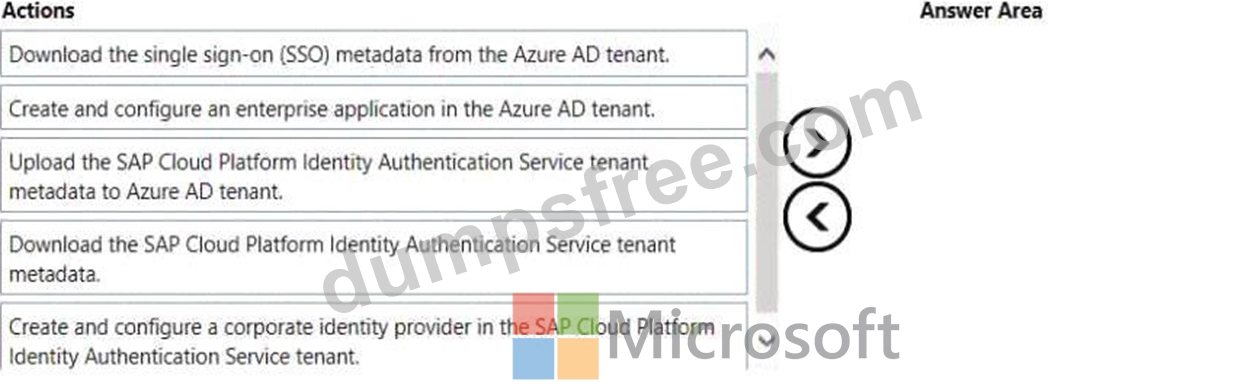
Answer:
Explanation: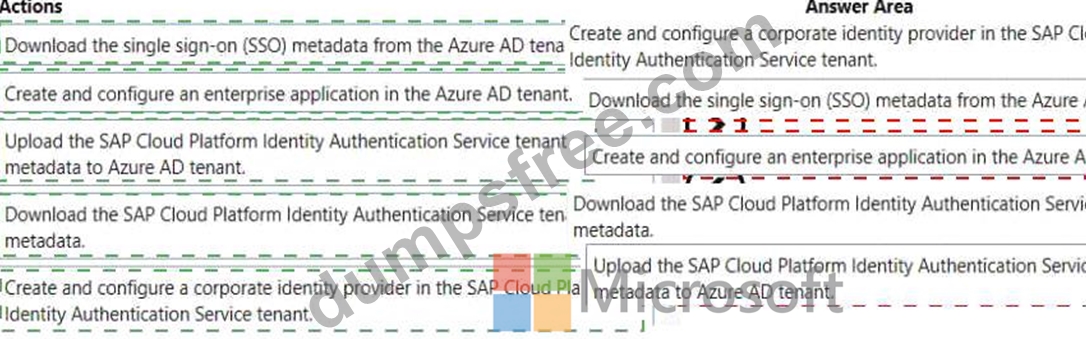
NEW QUESTION 72
Litware is evaluating whether to add high availability after the migration?
What should you recommend to meet the technical requirements?
- A. Azure virtual machine auto-restart with SAP HANA service auto-restart.
- B. Azure Site Recovery
- C. SAP HANA system replication and Azure Availability Sets
Answer: C
Explanation:
Topic 2, Contoso Ltd Case Study
This is a case study. Case studies are not timed separately. You can use as much exam time as you would like to complete each case. However, there may be additional case studies and sections on this exam. You must manage your time to ensure that you are able to complete all questions included on this exam in the time provided.
To answer the questions included in a case study, you will need to reference information that is provided in the case study. Case studies might contain exhibits and other resources that provide more information about the scenario that is described in the case study. Each question is independent of the other questions in this case study.
At the end of this case study, a review screen will appear. This screen allows you to review your answers and to make changes before you move to the next section of the exam. After you begin a new section, you cannot return to this section.
To start the case study
To display the first question in this case study, click the Next button. Use the buttons in the left pane to explore the content of the case study before you answer the questions. Clicking these buttons displays information such as business requirements, existing environment, and problem statements. If the case study has an All Information tab, note that the information displayed is identical to the information displayed on the subsequent tabs. When you are ready to answer a question, click the Question button to return to the question.
Overview
Contoso, Ltd. is a manufacturing company that has 15,000 employees.
The company uses SAP for sales and manufacturing.
Contoso has sales offices in New York and London and manufacturing facilities in Boston and Seattle.
Existing Environment
Active Directory
The network contains an on-premises Active Directory domain named ad.contoso.com. User email addresses use a domain name of contoso.com.
SAP Environment
The current SAP environment contains the following components:
* SAP Solution Manager
* SAP ERP Central Component (SAP ECC)
* SAP Supply Chain Management (SAP SCM)
* SAP application servers that run Windows Server 2008 R2
* SAP HANA database servers that run SUSE Linux Enterprise Server 12 (SLES 12) Problem Statements Contoso identifies the following issues in its current environment:
* The SAP HANA environment lacks adequate resources.
* The Windows servers are nearing the end of support.
* The datacenters are at maximum capacity.
Requirements
Planned Changes
Contoso identifies the following planned changes:
* Deploy Azure Virtual WAN.
* Migrate the application servers to Windows Server 2016.
* Deploy ExpressRoute connections to all of the offices and manufacturing facilities.
* Deploy SAP landscapes to Azure for development, quality assurance, and production.
All resources for the production landscape will be in a resource group named SAPProduction.
Business goals
Contoso identifies the following business goals:
* Minimize costs whenever possible.
* Migrate SAP to Azure without causing downtime.
* Ensure that all SAP deployments to Azure are supported by SAP.
* Ensure that all the production databases can withstand the failure of an Azure region.
* Ensure that all the production application servers can restore daily backups from the last 21 days.
Technical Requirements
Contoso identifies the following technical requirements:
* Inspect all web queries.
* Deploy an SAP HANA cluster to two datacenters.
* Minimize the bandwidth used for database synchronization.
* Use Active Directory accounts to administer Azure resources.
* Ensure that each production application server has four 1-TB data disks.
* Ensure that an application server can be restored from a backup created during the last five days within 15 minutes.
* Implement an approval process to ensure that an SAP administrator is notified before another administrator attempts to make changes to the Azure virtual machines that host SAP.
It is estimated that during the migration, the bandwidth required between Azure and the New York office will be 1 Gbps. After the migration, a traffic burst of up to 3 Gbps will occur.
Proposed Backup Policy
An Azure administrator proposes the backup policy shown in the following exhibit.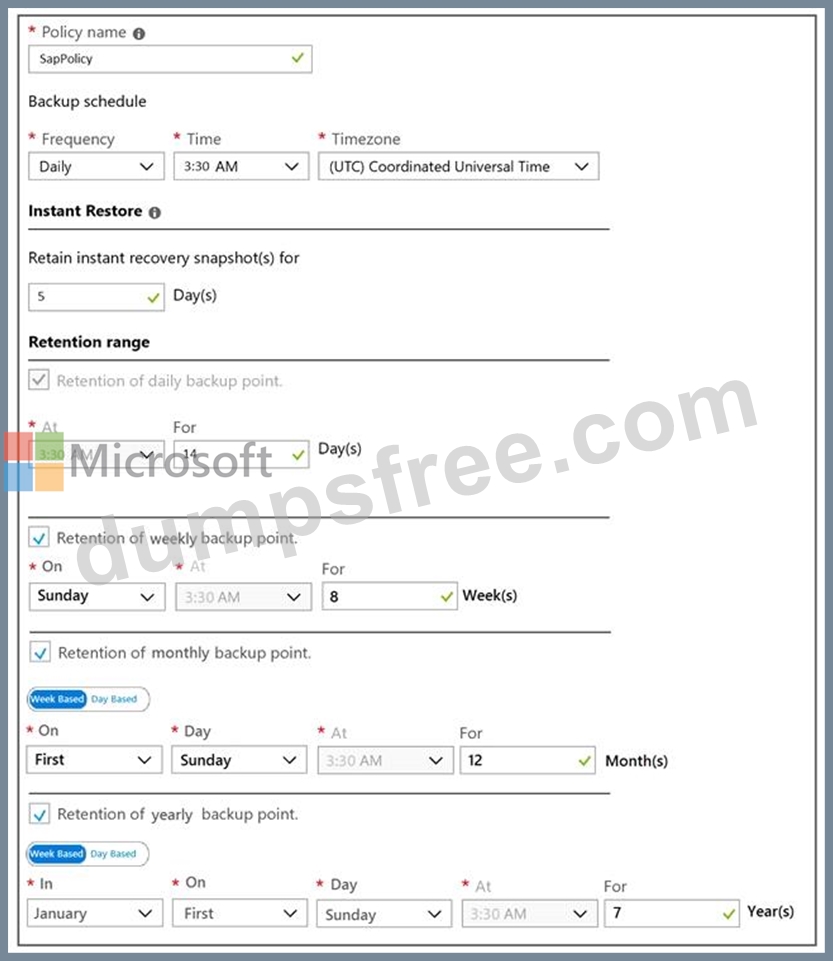
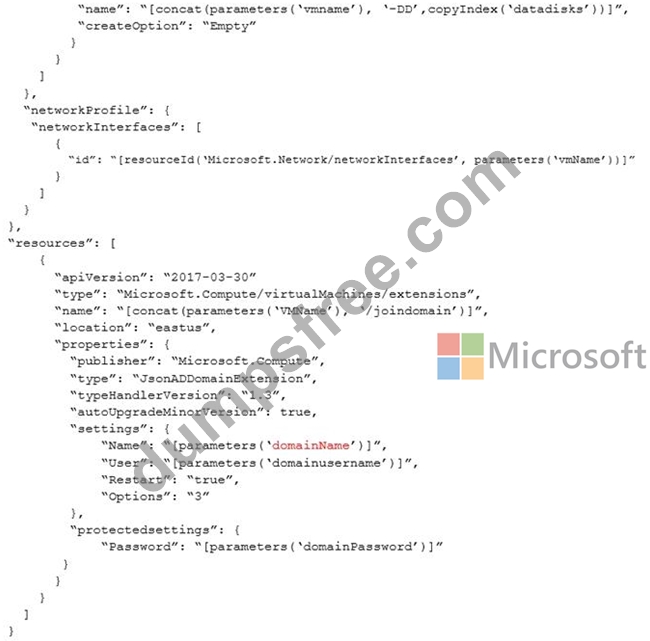
Azure Resource Manager Template
An Azure administrator provides you with the Azure Resource Manager template that will be used to provision the production application servers.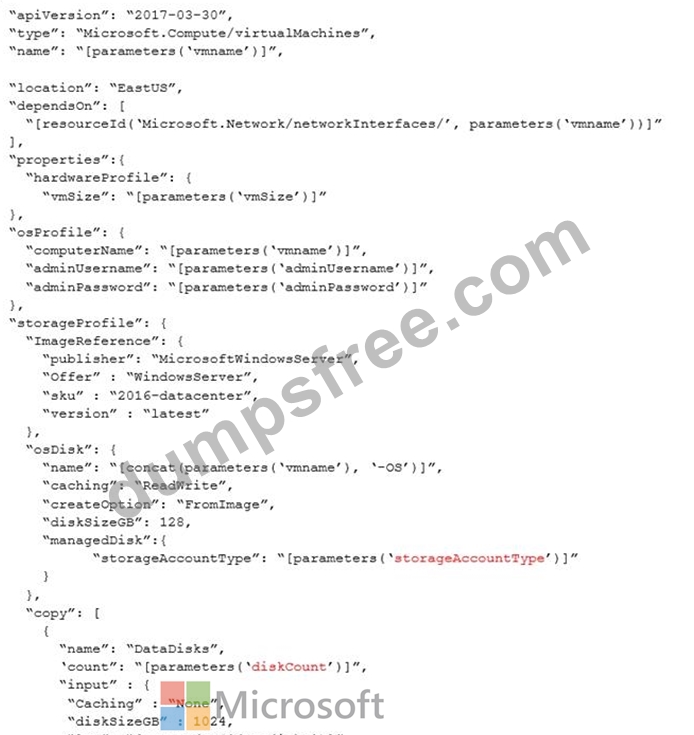
NEW QUESTION 73
You need to ensure that you can receive technical support to meet the technical requirements.
What should you deploy to Azure?
- A. SAP Landscape Management (LaMa)
- B. SAPRouter
- C. SAP Web Dispatcher
- D. SAP Gateway
Answer: B
Explanation:
Explanation
https://help.sap.com/viewer/f2ad7797884249eeb2e91dc26a991196/3.0.3.0/en-US
NEW QUESTION 74
For each of the following statements, select Yes if the statement is true. Otherwise, select No.
NOTE: Each correct selection is worth one point.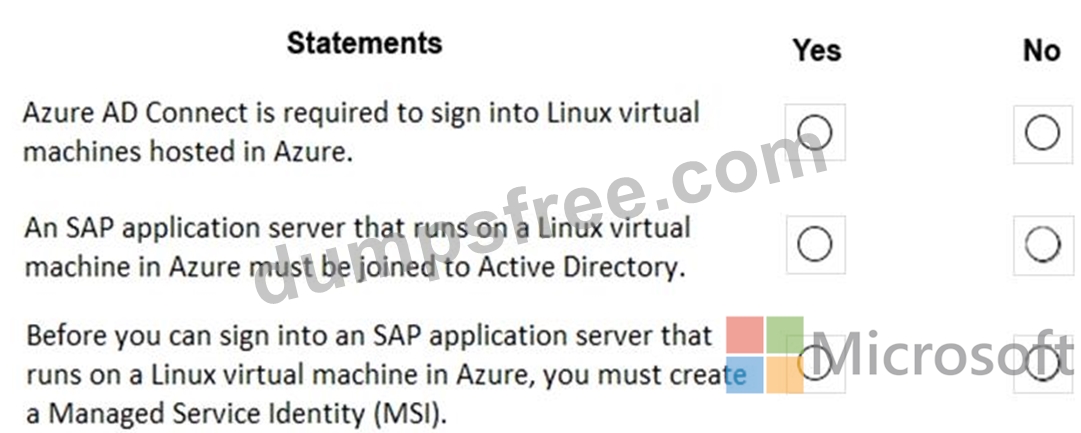
Answer:
Explanation: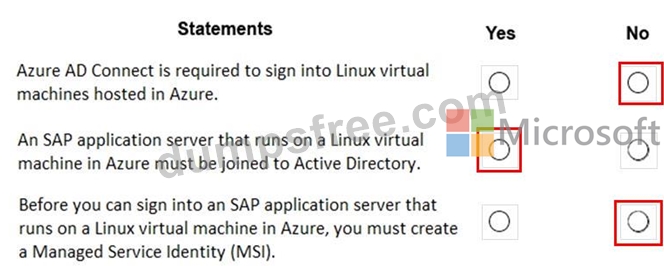
Explanation:
Box 1: No
To log in to a Linux VM with Azure AD credentials, install the Azure Active Directory login VM extension.
Note: Azure AD Connect is the Microsoft tool designed to meet and accomplish your hybrid identity goals.
Box 2: Yes
If you deploy SAP VMs in a cross-premises scenario, where on-premises Active Directory and DNS are extended in Azure, it is expected that the VMs are joining an on-premises domain.
Box 3: No
References:
https://docs.microsoft.com/en-us/azure/virtual-machines/workloads/sap/deployment-guide
NEW QUESTION 75
You deploy on SAP environment on Azure.
You need to monitor the performance of the SAP NetWeaver environment by using the Azure Enhanced Monitoring Extension for What should you do first?
- A. From Azure CLI. run the az v aem m set command.
- B. From the Azure portal, enable the Azure Network Watcher Agent.
- C. From Azure CLI, install the Linux Diagnostic Extension.
- D. From the Azure portal, enable the Custom Script Extension.
Answer: B
NEW QUESTION 76
You plan to migrate an SAP HANA instance to Azure.
You need to gather CPU metrics from the last 24 hours from the instance.
Solution: You query views from SAP HANA Studio.
Does this meet the goal?
- A. No
- B. Yes
Answer: B
Explanation:
SAP HANA Studio -> Administration -> Overview -> CPU Usage.
SAP HANA Studio -> Administration -> Performance -> Load -> [System] CPU.
NEW QUESTION 77
You have an on-premises SAP environment that runs on SUSE Linux Enterprise Server (SLES) servers and Oracle. The version of the SAP ERP system is 6.06 and the version of the portal is SAP NetWeaver 7.3.
You need to recommend a migration strategy to migrate the SAP ERP system and the portal to Azure. The solution must be hosted on SAP HANA.
What should you recommend? To answer, drag the appropriate tools to the correct components. Each tool may be used once, more than once, or not at all. You may need to drag the split bar between panes or scroll to view content.
NOTE: Each correct selection is worth one point.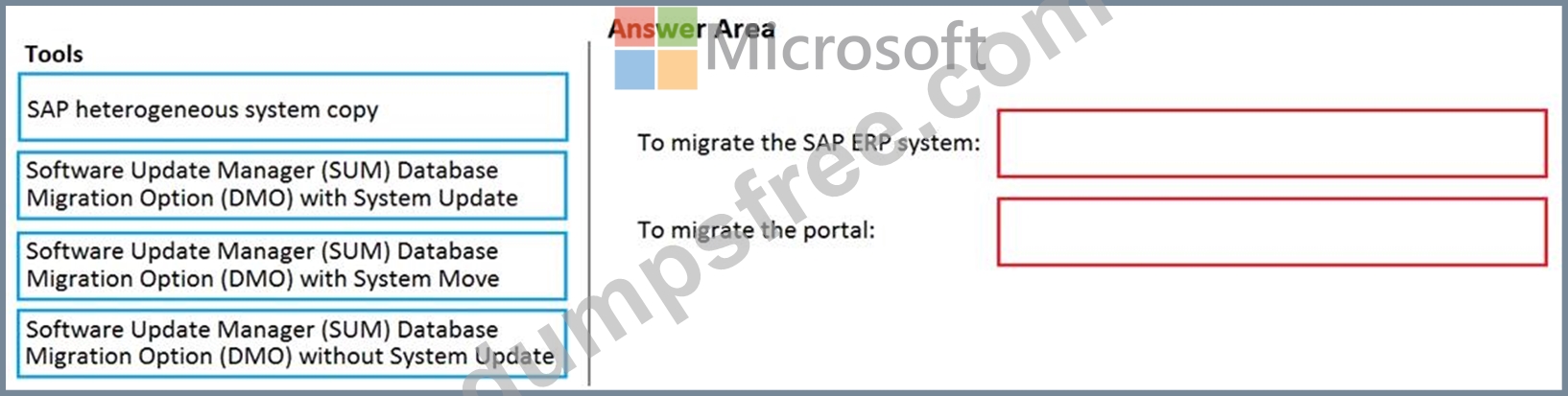
Answer:
Explanation: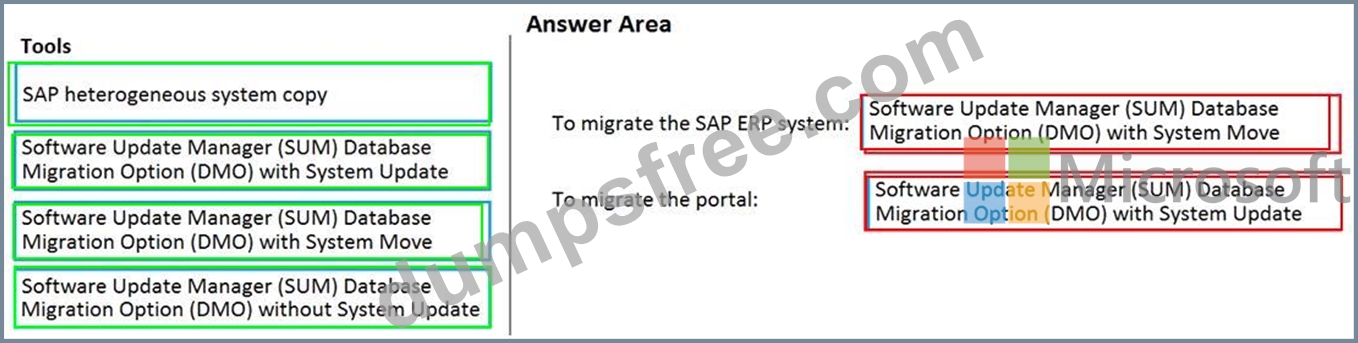
Reference:
https://blogs.sap.com/2017/10/05/your-sap-on-azure-part-2-dmo-with-system-move/
NEW QUESTION 78
Your company has a an on-premises SAP environment.
Recently, the company split into two companies named Litware, inc and Contoso.Ltd. Litware retained the SAP environment.
Litware plans to export data that is relevant only to Contoso. The export will be 1.5 TB.
Contoso build a new SAP environment on Azure.
You need to recommend a solution for Litware to make the data available to Contoso in Azure. The solution must meet the following requirements:
Minimize the impact on the network.
Minimize the administrative effort for Litware.
What should you include in the recommendation.
- A. Azure Databox
- B. Azure import/Export service
- C. Azure Site Recovery
- D. Azure Migrate
Answer: C
Explanation:
Topic 1, Litware, inc Case Study
This is a case study. Case studies are not timed separately. You can use as much exam time as you would like to complete each case. However, there may be additional case studies and sections on this exam. You must manage your time to ensure that you are able to complete all question include on this exam in the time provided.
To answer the question included in a case study, you will need to reference information that is provided in the case study. Case studies might contain and other resources that provide information about the scenario that is describe in the case study. Each question is independent of the other question in this case study.
At the end of this case study, a review screen will appear. This screen allows you to review your answer and to make changes before you move to the next section of the exam. After you begin a new section, you cannot return to this section.
To Start the case study
To display the first question in this case study, click the Next button. Use the buttons in the left pane to explore the content of the case study before you answer the questions. Clicking these buttons displays information such the content requirements, existing environment, and problem statements, if the case study has an All Information tab, note that the information displayed its identical to the information displayed on the subsequence tabs. When you are ready to answer a question click the Question button to return to the question.
Overview
Litware, inc. is an international manufacturing company that has 3,000 employees.
Litware has two main offices. The offices are located in Miami, FL, and Madrid Spain.
Existing Environment
Infrastructure
Litware currently uses a third-party provider to host a datacenter in Miami and a disaster recovery datacenter in Chicago, it.
The network contains an Active Directory domain named litware.com.Litware has two third-party applications hosted in Azure.
Litware already implemented a site-to-site VPN connection between the on-premises network and Azure.
SAP Environment
Litware currently runs the following SAP products:
* Enhancement Pack 6 for SAP ERP Central Component 6.0 (SAP ECC 6.0)
* SAP Extended Warehouse Management (SAP EWM)
* SAP Business Warehouse (SAP BW)
* SAP NetWeaver Process Integration (PI)
* SAP Solution Manager
All users run on the Windows Server platform. All databases use Microsoft SQL Server. Currently, you have
20 production servers.
You have 30 non-production servers including five testing severs, five development servers, five quality assurance (QA) servers, and 15 pre=production servers.
Currently, all SAP applications are in the litware.com domain.
Problem Statements
The current version of SAP ECC has a transaction that, when run in batches overnight, tables eight hours to complete. You confirm that upgrading to SAP Business Suite on HANA will improve performance because of code changes and the SAP HANA database platform.
Litware is dissatisfied with the performance of its current hosted infrastructure vendor. Litware experienced several hardware failures and the vendor struggled to adequately its 24/7 business operation.
Business Goals
Litware identifies the following business goals:
* Increase the performance of SAP ECC application by moving to SAP HANA. All other database will remain on SQL Server.
* Move away from the current infrastructure vendor to increase the stability and availability of the SAP services.
* Use the new Environment, Health and Safety (EH&S) in Recipe Management function.
* Ensure that any migration activities can be completed within a 48-hour period during a weekend.
Planned Changes
Litware identifies the following planned changes:
* Migrate SAP to Azure.
* Upgrade and migrate SAP ECC to SAP business Suite on HANA Enhancement Pack 8.
Technical requirements
Litware identifies the following technical requirements:
* Implement automated backups.
* Support load testing during the migrate.
* Identify opportunities to reduces costs during the migration.
* Continue to use the Litware.com domain for all SAP landscapes.
* Ensure that all SAP applications and databases are highly available.
* Remove all SAP components from the on-premises network once the migrate is complete.
* Minimize the purchase of additional SAP licenses. SAP HANA license were already purchased.
* Ensure that SAP can provide technical support for all the SAP landscapes deployed to Azure.
NEW QUESTION 79
......
Verified AZ-120 Dumps Q&As - 1 Year Free & Quickly Updates: https://www.dumpsfree.com/AZ-120-valid-exam.html
Latest Microsoft AZ-120 Certification Practice Test Questions: https://drive.google.com/open?id=1aBJi748K0jCUojbLx1xDyx-xGwyy9ns2