


Authentic MCIA-Level-1 Dumps With 100% Passing Rate Practice Tests Dumps
MuleSoft MCIA-Level-1 Real Exam Questions Guaranteed Updated Dump from DumpsFree
What is the duration, language, and format of MuleSoft mcia - Level 1: MuleSoft Certified Integration Architect - Level 1 Exam
- Length of Examination: 120 minutes
- Number of Questions: 58
- Language: English
- Type of Questions: Single and Multiple Choice.
- Passing score: 70%
NEW QUESTION 36
An organization uses a four(4) node customer hosted Mule runtime cluster to host one(1) stateless api implementation. The API is accessed over HTTPS through a load balancer that uses round-robin for load distribution. Each node in the cluster has been sized to be able to accept four(4) times the current number of requests.
Two(2) nodes in the cluster experience a power outage and are no longer available. The load balancer directs the outage and blocks the two unavailable the nodes from receiving further HTTP requests.
What performance-related consequence is guaranteed to happen to average, assuming the remaining cluster nodes are fully operational?
- A. 50% reduction in the throughput of the API
- B. 100% increase in the number of requests received by each remaining node
- C. 50% increase in the JVM heap memory consumed by each remaining node
- D. 100% increase in the average response time of the API
Answer: D
NEW QUESTION 37
Refer to the exhibit.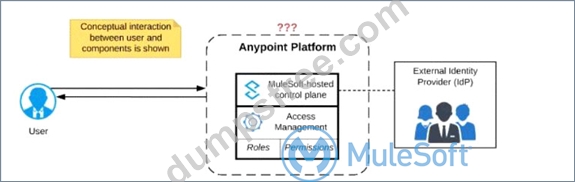
Anypoint Platform supports role-based access control (RBAC) to features of the platform. An organization has configured an external Identity Provider for identity management with Anypoint Platform.
What aspects of RBAC must ALWAYS be controlled from the Anypoint Platform control plane and CANNOT be controlled via the external Identity Provider?
- A. Controlling the business group within Anypoint Platform to which the user belongs
- B. Removing a user's access to Anypoint Platform when they no longer work for the organization
- C. Assigning Anypoint Platform permissions to a role
- D. Assigning Anypoint Platform role(s) to a user
Answer: C
NEW QUESTION 38
An integration Mule application is being designed to synchronize customer data between two systems. One system is an IBM Mainframe and the other system is a Salesforce Marketing Cloud (CRM) instance. Both systems have been deployed in their typical configurations, and are to be invoked using the native protocols provided by Salesforce and IBM.
What interface technologies are the most straightforward and appropriate to use in this Mule application to interact with these systems, assuming that Anypoint Connectors exist that implement these interface technologies?
- A. IBM: DB access
CRM: gRPC - B. IBM: REST
CRM: REST - C. IBM: CICS
CRM: SOAP - D. IBM: ActiveMQ
CRM: REST
Answer: D
NEW QUESTION 39
Refer to the exhibit. A Mule 4 application has a parent flow that breaks up a JSON array payload into 200 separate items, then sends each item one at a time inside an Async scope to a VM queue.
A second flow to process orders has a VM Listener on the same VM queue. The rest of this flow processes each received item by writing the item to a database.
This Mule application is deployed to four CloudHub workers with persistent queues enabled.
What message processing guarantees are provided by the VM queue and the CloudHub workers, and how are VM messages routed among the CloudHub workers for each invocation of the parent flow under normal operating conditions where all the CloudHub workers remain online?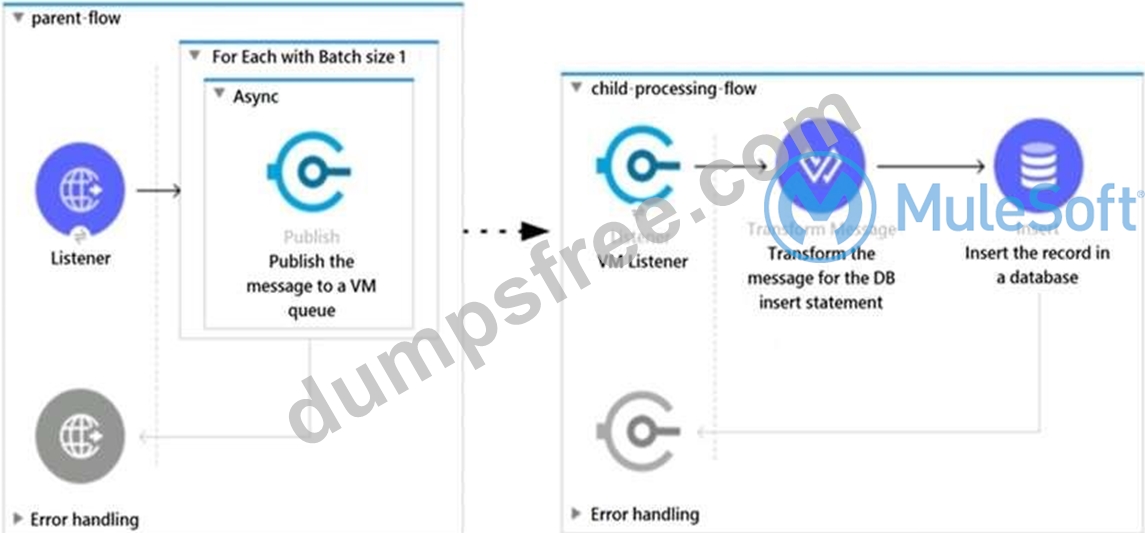
- A. EACH item VM message is processed AT LEAST ONCE by ONE ARBITRARY CloudHub worker Each of the four CloudHub workers can be expected to process some item VM messages
- B. EACH item VM message is processed AT MOST ONCE by ONE CloudHub worker, with workers chosen in a deterministic round-robin fashion Each of the four CloudHub workers can be expected to process 1/4 of the item VM messages (about 50 items)
- C. ALL item VM messages are processed AT LEAST ONCE by the SAME CloudHub worker where the parent flow was invoked This one CloudHub worker processes ALL 200 item VM messages
- D. ALL item VM messages are processed AT MOST ONCE by ONE ARBITRARY CloudHub worker This one CloudHub worker processes ALL 200 item VM messages
Answer: C
NEW QUESTION 40
Refer to the exhibit.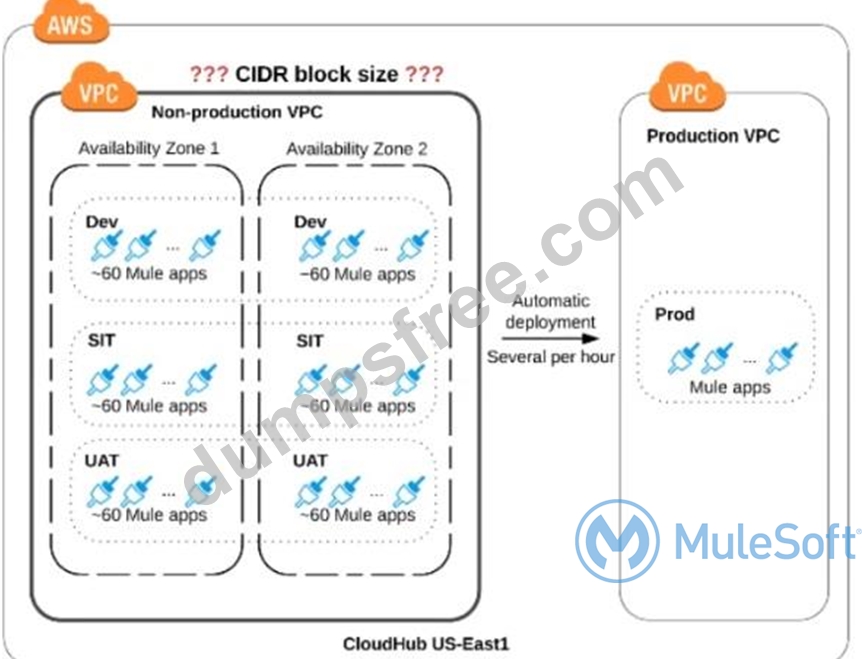
An organization is sizing an Anypoint VPC for the non-production deployments of those Mule applications that connect to the organization's on-premises systems. This applies to approx. 60 Mule applications. Each application is deployed to two CloudHub i workers. The organization currently has three non-production environments (DEV, SIT and UAT) that share this VPC. The AWS region of the VPC has two AZs.
The organization has a very mature DevOps approach which automatically progresses each application through all non-production environments before automatically deploying to production. This process results in several Mule application deployments per hour, using CloudHub's normal zero-downtime deployment feature.
What is a CIDR block for this VPC that results in the smallest usable private IP address range?
- A. 10.0.0.0/22 (1024 IPs)
- B. 10.0.0.0/25 (128 IPs)
- C. 10.0.0.0/24 (256 IPs)
- D. 10.0.0.0/26 (64 IPS)
Answer: A
NEW QUESTION 41
What comparison is true about a CloudHub Dedicated Load Balancer (DLB) vs. the CloudHub Shared Load Balancer (SLB)?
- A. Both a DLB and the SLB allow the configuration of access control via IP whitelists
- B. Only a DLB allows the configuration of a custom TLS server certificate
- C. Both a DLB and the SLB implement load balancing by sending HTTP requests to workers with the lowest workloads
- D. Only the SLB can forward HTTP traffic to the VPC-internal ports of the CloudHub workers
Answer: A
NEW QUESTION 42
Refer to the exhibit.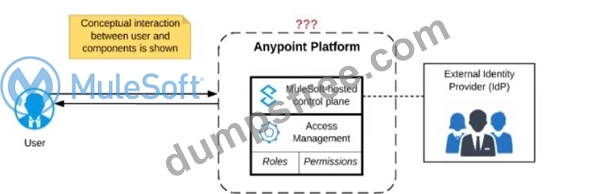
Anypoint Platform supports role-based access control (RBAC) to features of the platform. An organization has configured an external Identity Provider for identity management with Anypoint Platform.
What aspects of RBAC must ALWAYS be controlled from the Anypoint Platform control plane and CANNOT be controlled via the external Identity Provider?
- A. Controlling the business group within Anypoint Platform to which the user belongs
- B. Removing a user's access to Anypoint Platform when they no longer work for the organization
- C. Assigning Anypoint Platform permissions to a role
- D. Assigning Anypoint Platform role(s) to a user
Answer: C
NEW QUESTION 43
A set of integration Mule applications, some of which expose APIs, are being created to enable a new business process. Various stakeholders may be impacted by this. These stakeholders are a combination of semi-technical users (who understand basic integration terminology and concepts such as JSON and XML) and technically skilled potential consumers of the Mule applications and APIs.
What Is an effective way for the project team responsible for the Mule applications and APIs being built to communicate with these stakeholders using Anypoint Platform and its supplied toolset?
- A. Use Anypoint Exchange to register the various Mule applications and APIs and share the RAML definitions with the stakeholders, so they can be discovered
- B. Capture documentation about the Mule applications and APIs inline within the Mule integration flows and use Anypoint Studio's Export Documentation feature to provide an HTML version of this documentation to the stakeholders
- C. Create Anypoint Exchange entries with pages elaborating the integration design, including API notebooks (where applicable) to help the stakeholders understand and interact with the Mule applications and APIs at various levels of technical depth
- D. Use Anypoint Design Center to implement the Mule applications and APIs and give the various stakeholders access to these Design Center projects, so they can collaborate and provide feedback
Answer: D
NEW QUESTION 44
An organization uses a set of customer-hosted Mule runtimes that are managed using the Mulesoft-hosted control plane. What is a condition that can be alerted on from Anypoint Runtime Manager without any custom components or custom coding?
- A. When the Mute runtime license installed on a Mule runtime is about to expire
- B. When a Mule runtime's customer-hosted server is about to run out of disk space
- C. When an SSL certificate used by one of the deployed Mule applications is about to expire
- D. When a Mule runtime on a given customer-hosted server is experiencing high memory consumption during certain periods
Answer: D
NEW QUESTION 45
An organization has decided on a cloudhub migrationstrategy that aims to minimize the organizations own IT resources. Currently, the organizational has all of its Mule applications running on its own premises and uses an premises load balancer that exposes all APIs under the base URL https://api.acme.com As part of the migration strategy, the organization plans to migrate all of its Mule applications and load balancer to cloudhub What is the most straight-forward and cost effective approach to the Mule applications deployment and load balancing that preserves the public URLs?
- A. For each migrated Mule application, deploy an API proxy Mule application to Cloudhub with all applications under the control of a dedicated load balancer(CLB) Update the CNAME record for api.acme.com in the organization DNS server pointing to the A record of a cloudhub dedicated load balancer(DLB) Apply mapping rules in the DLB to map each API proxy application to its corresponding Mule applications
- B. Deploy the Mule applications to Cloudhub
Update the CNAME record for an api.acme.com in the organizations DNS server pointing to the A record of a cloudhub dedicated load balancer(DLB) Apply mapping rules in the DLB to map URLs totheir corresponding Mule applications - C. Deploy the Mule applications to Cloudhub
Update the CNAME record for api.acme.com in the organization DNS server pointing to the A record of the cloudhub shared load balancer(SLB) Apply mapping rules in the SLB to map URLs to their corresponding Mule applications. - D. Deploy the Mule applications to Cloudhub
Create CNAME record for api.acme.com in the Cloudhub Shared load balancer (SLB) pointing to the A record of the on-premise load balancer Apply mapping rules in the SLB to map URLs to their corresponding Mule applications
Answer: B
Explanation:
Explanation
https://help.mulesoft.com/s/feed/0D52T000055pzgsSAA.
NEW QUESTION 46
What aspects of a CI/CD pipeline for Mute applications can be automated using MuleSoft-provided Maven plugins?
- A. Compile, package, unit test, deploy, create associated API instances in API Manager B Import from API designer, compile, package, unit test, deploy, publish to Am/point Exchange
- B. Compile, package, unit test, validate unit test coverage, deploy
- C. Compile, package, unit test, deploy, integration test
Answer: B
NEW QUESTION 47
An integration Mule application is deployed to a customer-hosted multi-node Mule 4 runtime cluster. The Mule application uses a Listener operation of a JMS connector to receive incoming messages from a JMS queue.
How are the messages consumed by the Mule application?
- A. Regardless of the Listener operation configuration, all messages are consumed by ONLY the primary cluster node
- B. Regardless of the Listener operation configuration, all messages are consumed by ALL cluster nodes
- C. Depending on the JMS provider's configuration, either all messages are consumed by ONLY the primary cluster node or else ALL messages are consumed by ALL cluster nodes
- D. Depending on the Listener operation configuration, either all messages are consumed by ONLY the primary cluster node or else EACH message is consumed by ANY ONE cluster node
Answer: C
NEW QUESTION 48
Refer to the exhibit.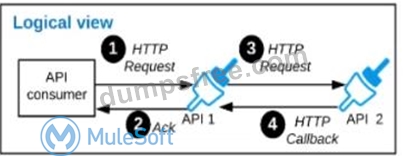
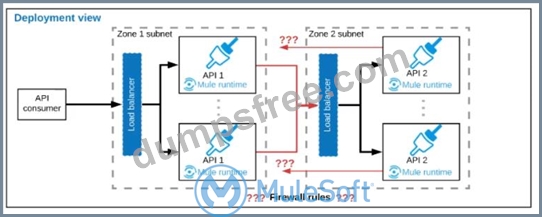
A business process involves two APIs that interact with each other asynchronously over HTTP. Each API is implemented as a Mule application. API 1 receives the initial HTTP request and invokes API 2 (in a fire and forget fashion) while API 2, upon completion of the processing, calls back into API l to notify about completion of the asynchronous process.
Each API Is deployed to multiple redundant Mule runtimes and a separate load balancer, and is deployed to a separate network zone.
In the network architecture, how must the firewall rules be configured to enable the above Interaction between API 1 and API 2?
- A. To authorize the certificates used by both the apis
- B. To enable communication from each API's Mule runtimes and network zone to the toad balancer of the other API
- C. To open direct two-way communication between the Mule runtimes of both APIs
- D. To allow communication between the load balancers used by each API
Answer: D
NEW QUESTION 49
Refer to the exhibit. An organization is designing a Mule application to receive data from one external business partner. The two companies currently have no shared IT infrastructure and do not want to establish one. Instead, all communication should be over the public internet (with no VPN).
What Anypoint Connector can be used in the organization's Mule application to securely receive data from this external business partner?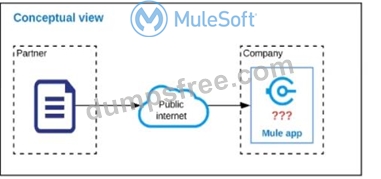
- A. VM connector
- B. File connector
- C. Object Store connector
- D. SFTP connector
Answer: D
NEW QUESTION 50
Refer to the exhibit.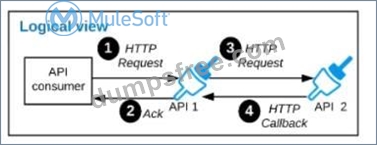
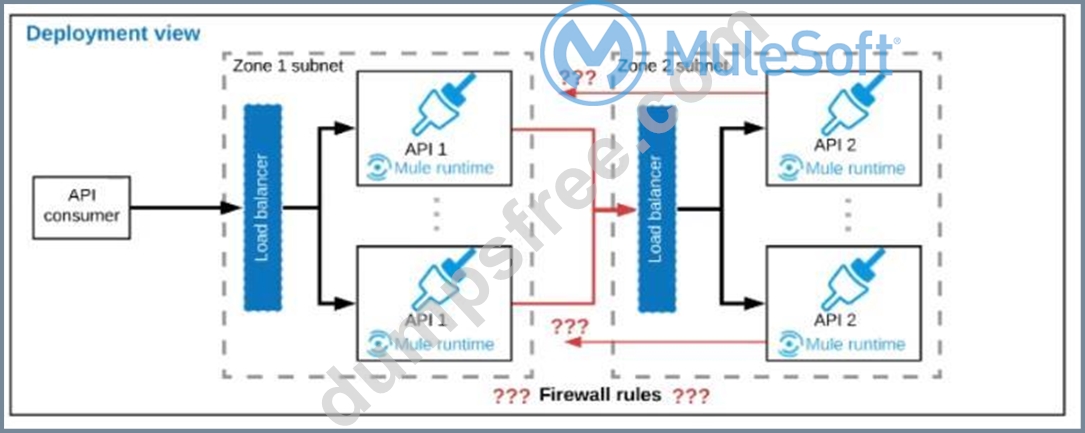
A business process involves two APIs that interact with each other asynchronously over HTTP. Each API is implemented as a Mule application. API 1 receives the initial HTTP request and invokes API 2 (in a fire and forget fashion) while API 2, upon completion of the processing, calls back into API l to notify about completion of the asynchronous process.
Each API Is deployed to multiple redundant Mule runtimes and a separate load balancer, and is deployed to a separate network zone.
In the network architecture, how must the firewall rules be configured to enable the above Interaction between API 1 and API 2?
- A. To authorize the certificates used by both the apis
- B. To enable communication from each API's Mule runtimes and network zone to the toad balancer of the other API
- C. To open direct two-way communication between the Mule runtimes of both APIs
- D. To allow communication between the load balancers used by each API
Answer: D
NEW QUESTION 51
Refer to the exhibit. Anypoint Platform supports role-based access control (RBAC) to features of the platform.
An organization has configured an external Identity Provider for identity management with Anypoint Platform.
What aspects of RBAC must ALWAYS be controlled from the Anypoint Platform control plane and CANNOT be controlled via the external Identity Provider?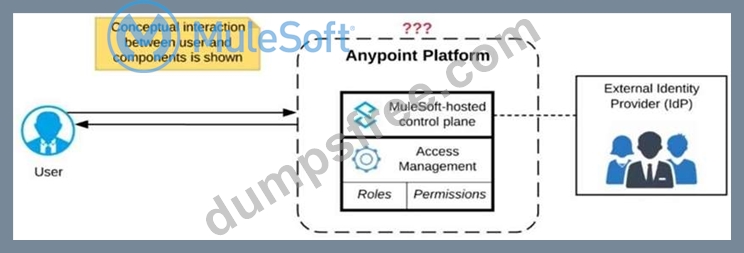
- A. Controlling the business group within Anypoint Platform to which the user belongs
- B. Removing a user's access to Anypoint Platform when they no longer work for the organization
- C. Assigning Anypoint Platform permissions to a role
- D. Assigning Anypoint Platform role(s) to a user
Answer: C
NEW QUESTION 52
......
The benefit of obtaining the MuleSoft mcia - Level 1: MuleSoft Certified Integration Architect - Level 1 Exam Certification
- It helps you to make your career into MuleSoft development covering design, build, test and debug, deploy, and manage basic APIs and integrations, this will help you to get respectful plus highly paid jobs into the Market. Statistics on the MuleSoft Certification website indicate that 91% of hiring managers consider certification as part of their hiring criteria. The main benefit of earning a MuleSoft Certification is that it shows potential employers/hiring managers that you have the requirements and skills to be the perfect candidate for the job.
- This certification credential will give you an edge over other counterparts. Apart from knowledge from MuleSoft mcia - Level 1: MuleSoft Certified Integration Architect - Level 1 Exam.
- MCD Level 1 certification will be judging your skills and knowledge on your understanding of Application Development security concepts & Understanding of the need to secure an Application Development, what objects can be secured, what objects ought to be secured, user accounts, roles.
Verified Pass MCIA-Level-1 Exam in First Attempt Guaranteed: https://www.dumpsfree.com/MCIA-Level-1-valid-exam.html