


(2023) NSE8_812 Dumps and Practice Test (62 Questions)
Guide (New 2023) Actual Fortinet NSE8_812 Exam Questions
Fortinet NSE8_812 exam is a written test that is designed to measure the knowledge and skills of candidates in the field of network security. It is an advanced-level certification exam that is meant for individuals who have extensive experience in designing, implementing, and managing complex security solutions. The NSE8_812 exam is part of the Fortinet Network Security Expert (NSE) program, which is a multi-level certification program that offers different levels of certification to network security professionals.
Fortinet NSE8_812 (Fortinet NSE 8 - Written Exam) is a certification exam designed for network and security professionals who aim to showcase their expertise and knowledge in designing, implementing, and managing complex network security solutions. NSE8_812 exam is the highest level of certification offered by Fortinet, which is a leading provider of network security solutions globally.
One of the benefits of achieving the Fortinet NSE8_812 certification is that it can help you stand out in a competitive job market. By earning this certification, you'll be able to demonstrate that you have the skills and expertise needed to help organizations secure their networks and protect against advanced threats. This can make you a more attractive candidate for roles such as network security engineer, security analyst, and security operations center (SOC) analyst.
NEW QUESTION # 26
Which two statements are correct on a FortiGate using the FortiGuard Outbreak Protection Service (VOS)? (Choose two.)
- A. The antivirus database queries FortiGuard with the hash of a scanned file
- B. If third-party AV database returns a match the scanned file is deemed to be malicious.
- C. The FortiGuard VOS can be used only with proxy-base policy inspections.
- D. The hash signatures are obtained from the FortiGuard Global Threat Intelligence database.
- E. The AV engine scan must be enabled to use the FortiGuard VOS feature
Answer: A,D
Explanation:
The FortiGuard Outbreak Prevention Service (VOS) is a feature that enhances the antivirus scanning capabilities of FortiGate by querying FortiGuard with the hash of a scanned file that is not found in the local antivirus database. If the hash matches a signature in the FortiGuard Global Threat Intelligence database, which contains information about known malware and zero-day threats, the file is deemed to be malicious and blocked by FortiGate. The VOS feature can be used with both proxy-based and flow-based policy inspections, and does not require the AV engine scan to be enabled. Reference: https://docs.fortinet.com/document/fortigate/6.2.14/cookbook/968606/outbreak-prevention-service
NEW QUESTION # 27
Refer to the exhibits.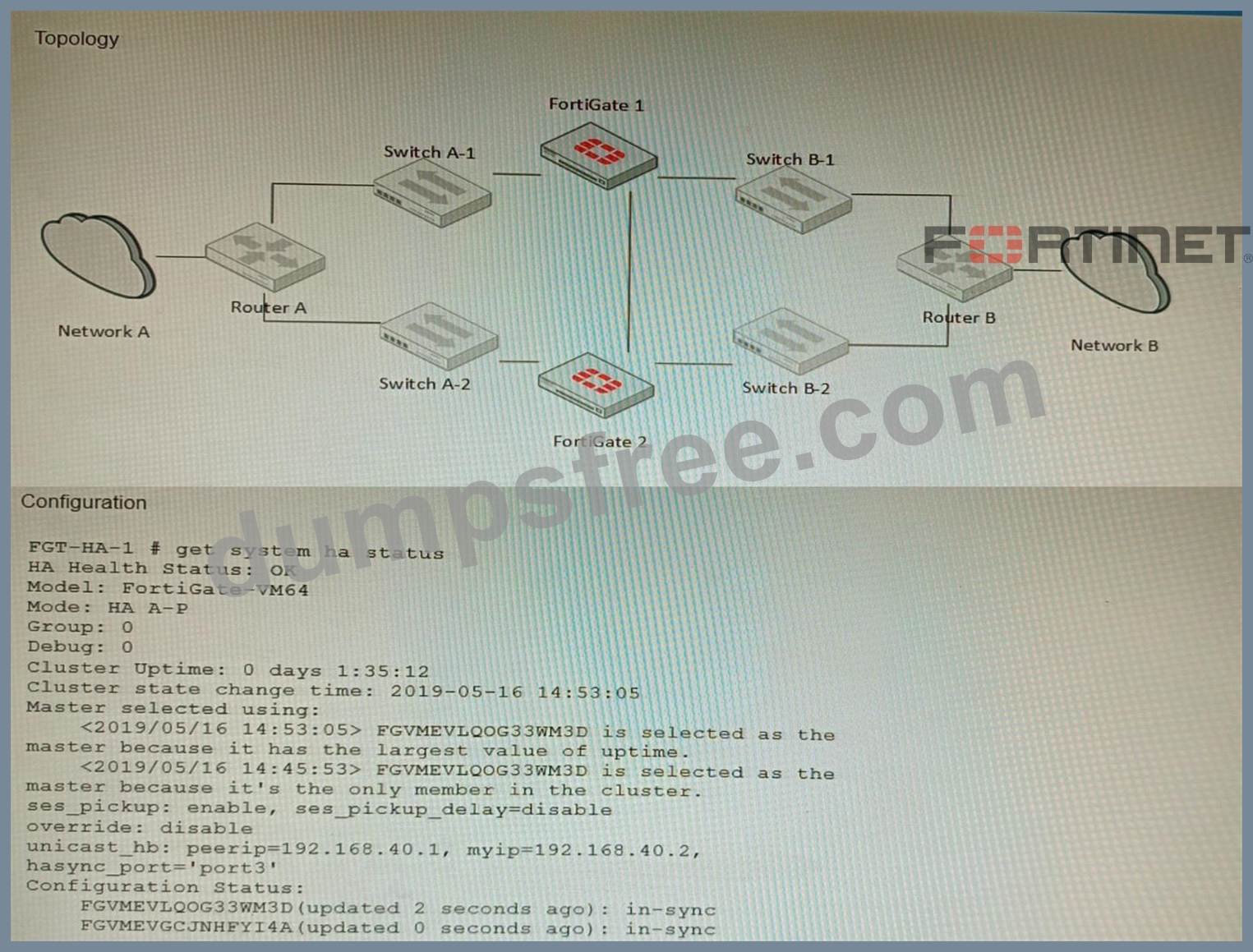
The exhibits show a FortiGate network topology and the output of the status of high availability on the FortiGate.
Given this information, which statement is correct?
- A. The cluster mode can support a maximum of four (4) FortiGate VMs
- B. The cluster members are on the same network and the IP addresses were statically assigned.
- C. FGVMEVLQOG33WM3D and FGVMEVGCJNHFYI4A share a virtual MAC address.
- D. The ethertype values of the HA packets are 0x8890, 0x8891, and 0x8892
Answer: C
Explanation:
The output of the status of high availability on the FortiGate shows that the cluster mode is active-passive, which means that only one FortiGate unit is active at a time, while the other unit is in standby mode. The active unit handles all traffic and also sends HA heartbeat packets to monitor the standby unit. The standby unit becomes active if it stops receiving heartbeat packets from the active unit, or if it receives a higher priority from another cluster unit. In active-passive mode, all cluster units share a virtual MAC address for each interface, which is used as the source MAC address for all packets forwarded by the cluster. References: https://docs.fortinet.com/document/fortigate/6.4.0/cookbook/103439/high-availability-with-two-fortigates
NEW QUESTION # 28
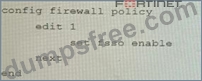
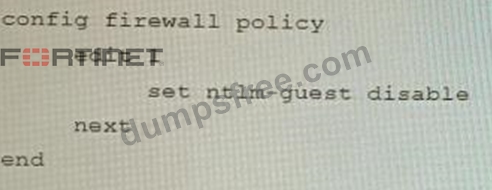
Refer to the exhibit showing a firewall policy configuration.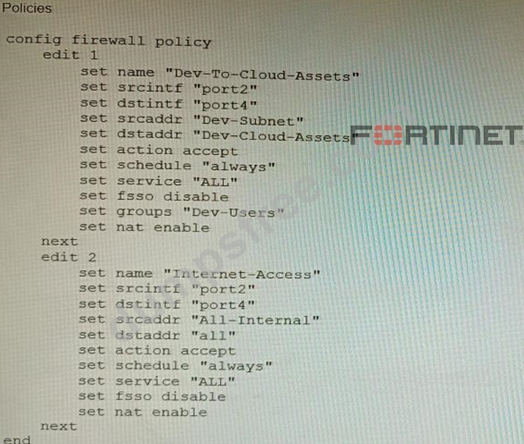
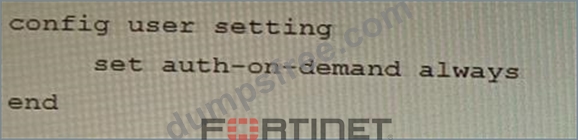
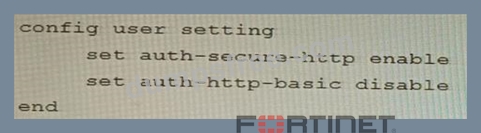
To prevent unauthorized access of their cloud assets, an administrator wants to enforce authentication on firewall policy ID 1.
What change does the administrator need to make?
- A.
- B.
- C.
- D.
Answer: B
Explanation:
B is correct because it adds an identity-based policy with SSL-VPN as the source interface and requires authentication using a user group. This will enforce authentication on firewall policy ID 1 for SSL-VPN users. Reference: https://docs.fortinet.com/document/fortigate/7.0.1/administration-guide/490351/ssl-vpn-authentication https://docs.fortinet.com/document/fortigate/7.0.1/administration-guide/490351/configuring-ssl-vpn-access-for-local-users
NEW QUESTION # 29
Refer to the exhibit.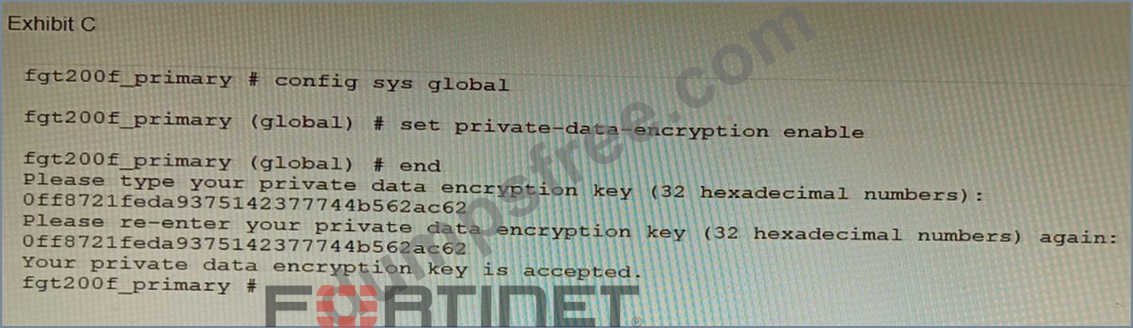
A customer has deployed a FortiGate 200F high-availability (HA) cluster that contains & TPM chip. The exhibit shows output from the FortiGate CLI session where the administrator enabled TPM.
Following these actions, the administrator immediately notices that both FortiGate high availability (HA) status and FortiManager status for the FortiGate are negatively impacted.
What are the two reasons for this behavior? (Choose two.)
- A. Configuration for TPM is not synchronized between FortiGate HA cluster members.
- B. The private-data-encryption key entered on the primary did not match the value that the TPM expected.
- C. TPM functionality is not yet compatible with FortiGate HA D The administrator needs to manually enter the hex private data encryption key in FortiManager
- D. The FortiGate has not finished the auto-update process to synchronize the new configuration to FortiManager yet.
Answer: A,B
Explanation:
The two reasons for the negative impact on the FortiGate HA status and FortiManager status after enabling TPM are:
The private-data-encryption key entered on the primary unit did not match the value that the TPM expected. This could happen if the TPM was previously enabled and then disabled, and the key was changed in between. The TPM will reject the new key and cause an error in the configuration synchronization.
Configuration for TPM is not synchronized between FortiGate HA cluster members. Each cluster member must have the same private-data-encryption key to form a valid HA cluster and synchronize their configurations. However, enabling TPM on one unit does not automatically enable it on the other units, and the key must be manually entered on each unit. To resolve these issues, the administrator should disable TPM on all units, clear the TPM data, and then enable TPM again with the same private-data-encryption key on each unit. References: https://docs.fortinet.com/document/fortigate/6.4.0/cookbook/103437/inbound-ssl-inspection https://docs.fortinet.com/document/fortigate/6.4.0/cookbook/103438/application-detection-on-ssl-offloaded-traffic
NEW QUESTION # 30
Refer to the exhibit.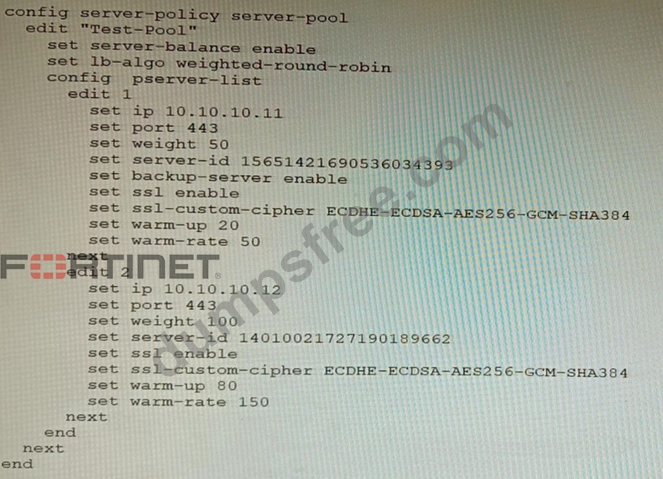
A FortiWeb appliance is configured for load balancing web sessions to internal web servers. The Server Pool is configured as shown in the exhibit.
How will the sessions be load balanced between server 1 and server 2 during normal operation?
- A. Server 1 will receive 20% of the sessions, Server 2 will receive 66.6% of the sessions
- B. Server 1 will receive 33.3% of the sessions, Server 2 will receive 66 6% of the sessions
- C. Server 1 will receive 25% of the sessions, Server 2 will receive 75% of the sessions
- D. Server 1 will receive 0% of the sessions Server 2 will receive 100% of the sessions
Answer: D
Explanation:
D is correct because server 1 has a weight of 0, which means it will not receive any sessions from the load balancer. Server 2 has a weight of 100, which means it will receive all sessions from the load balancer. This is explained in the FortiWeb Administration Guide under Server Load Balancing > Server pools > Weighted round robin. Reference: https://docs.fortinet.com/document/fortiweb/6.3.0/administration-guide/381057/server-load-balancing https://docs.fortinet.com/document/fortiweb/6.3.0/administration-guide/381057/server-load-balancing/381058/server-pools
NEW QUESTION # 31
Refer to the exhibits.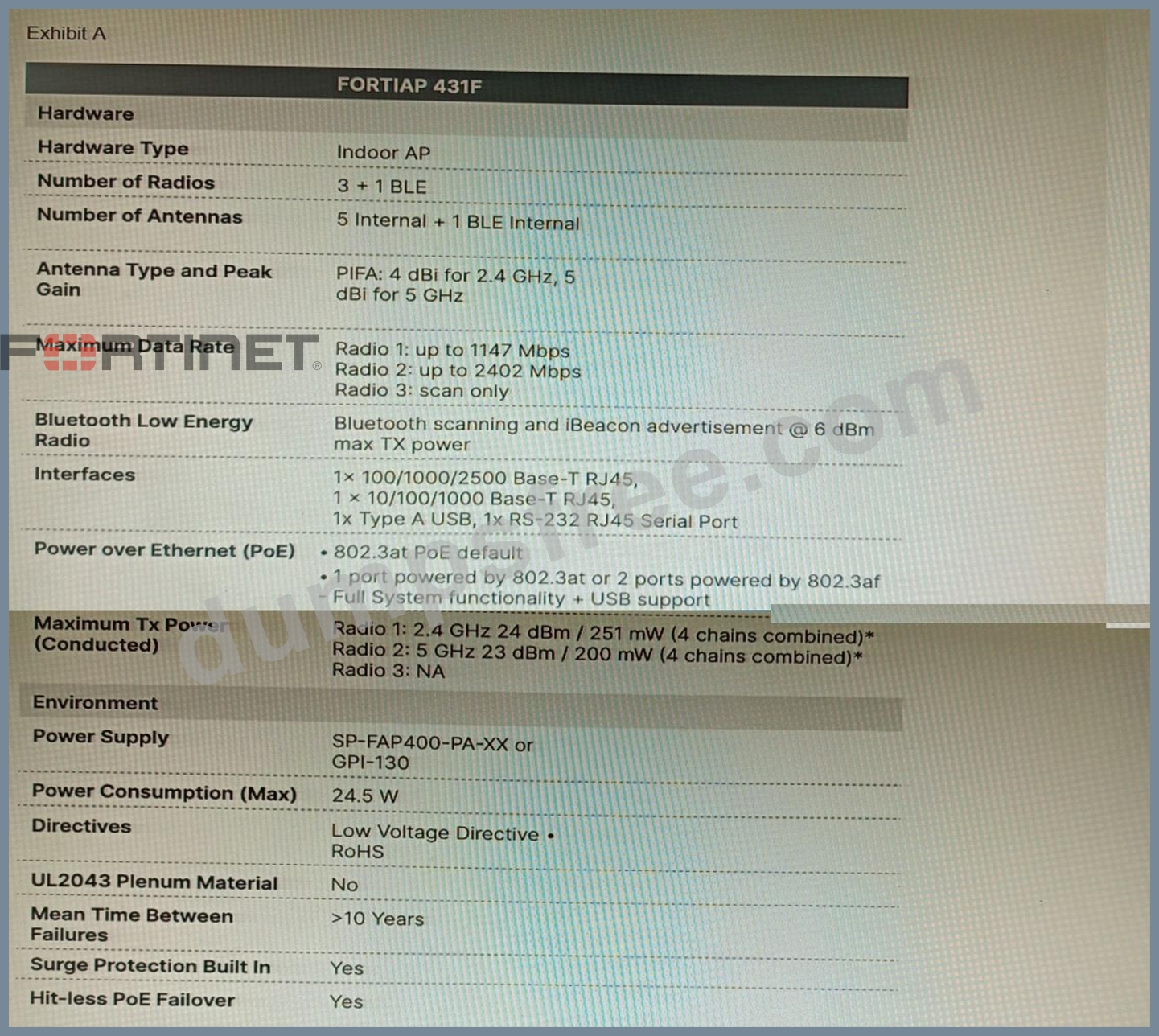
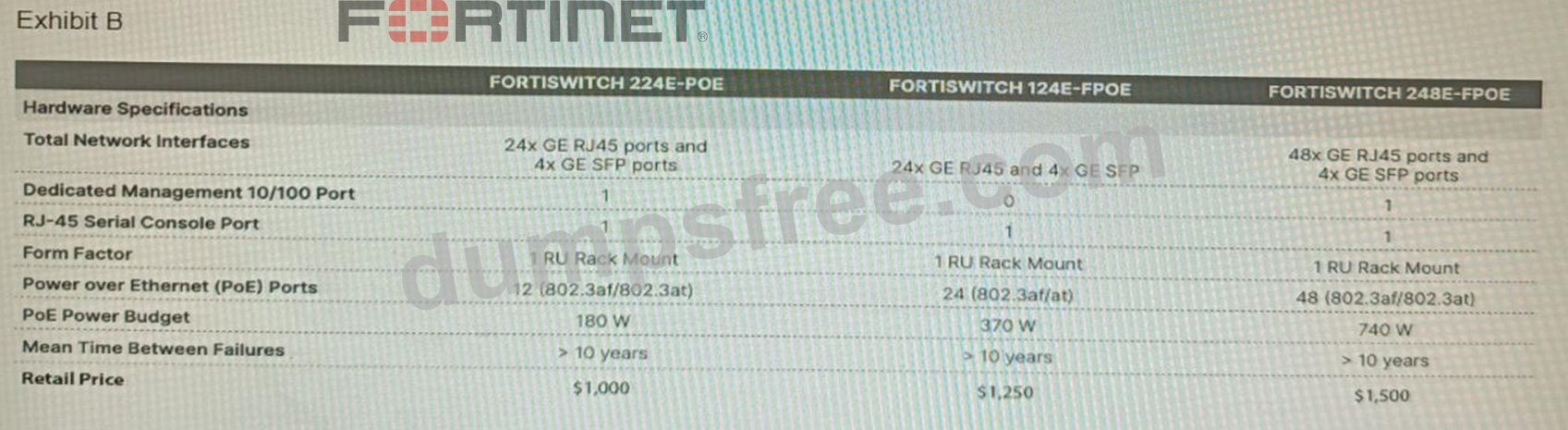
A customer wants to deploy 12 FortiAP 431F devices on high density conference center, but they do not currently have any PoE switches to connect them to. They want to be able to run them at full power while having network redundancy From the FortiSwitch models and sample retail prices shown in the exhibit, which build of materials would have the lowest cost, while fulfilling the customer's requirements?
- A. 2x FortiSwitch 124E-FPOE
- B. 2x FortiSwitch 248E-FPOE
- C. 1x FortiSwitch 248EFPOE
- D. 2x FortiSwitch 224E-POE
Answer: B
Explanation:
The customer wants to deploy 12 FortiAP 431F devices on a high density conference center, but they do not have any PoE switches to connect them to. They want to be able to run them at full power while having network redundancy. PoE switches are switches that can provide both data and power to connected devices over Ethernet cables, eliminating the need for separate power adapters or outlets. PoE switches are useful for deploying devices such as wireless access points, IP cameras, and VoIP phones in locations where power outlets are scarce or inconvenient. The FortiAP 431F is a wireless access point that supports PoE+ (IEEE 802.3at) standard, which can deliver up to 30W of power per port. The FortiAP 431F has a maximum power consumption of 25W when running at full power. Therefore, to run 12 FortiAP 431F devices at full power, the customer needs PoE switches that can provide at least 300W of total PoE power budget (25W x 12). The customer also needs network redundancy, which means that they need at least two PoE switches to connect the FortiAP devices in case one switch fails or loses power. From the FortiSwitch models and sample retail prices shown in the exhibit, the build of materials that has the lowest cost while fulfilling the customer's requirements is 2x FortiSwitch 248E-FPOE. The FortiSwitch 248E-FPOE is a PoE switch that has 48 GE ports with PoE+ capability and a total PoE power budget of 370W. It also has 4x 10 GE SFP+ uplink ports for high-speed connectivity. The sample retail price of the FortiSwitch 248E-FPOE is $1,995, which means that two units will cost $3,990. This is the lowest cost among the other options that can meet the customer's requirements. Option A is incorrect because the FortiSwitch 248EFPOE is a non-PoE switch that has no PoE capability or power budget. It cannot provide power to the FortiAP devices over Ethernet cables. Option B is incorrect because the FortiSwitch 224E-POE is a PoE switch that has only 24 GE ports with PoE+ capability and a total PoE power budget of 185W. It cannot provide enough ports or power to run 12 FortiAP devices at full power. Option D is incorrect because the FortiSwitch 124E-FPOE is a PoE switch that has only 24 GE ports with PoE+ capability and a total PoE power budget of 185W. It cannot provide enough ports or power to run 12 FortiAP devices at full power. Reference: https://www.fortinet.com/content/dam/fortinet/assets/data-sheets/FortiSwitch_Secure_Access_Series.pdf https://www.fortinet.com/content/dam/fortinet/assets/data-sheets/FortiAP_400_Series.pdf
NEW QUESTION # 32
Refer to the exhibits, which show a firewall policy configuration and a network topology.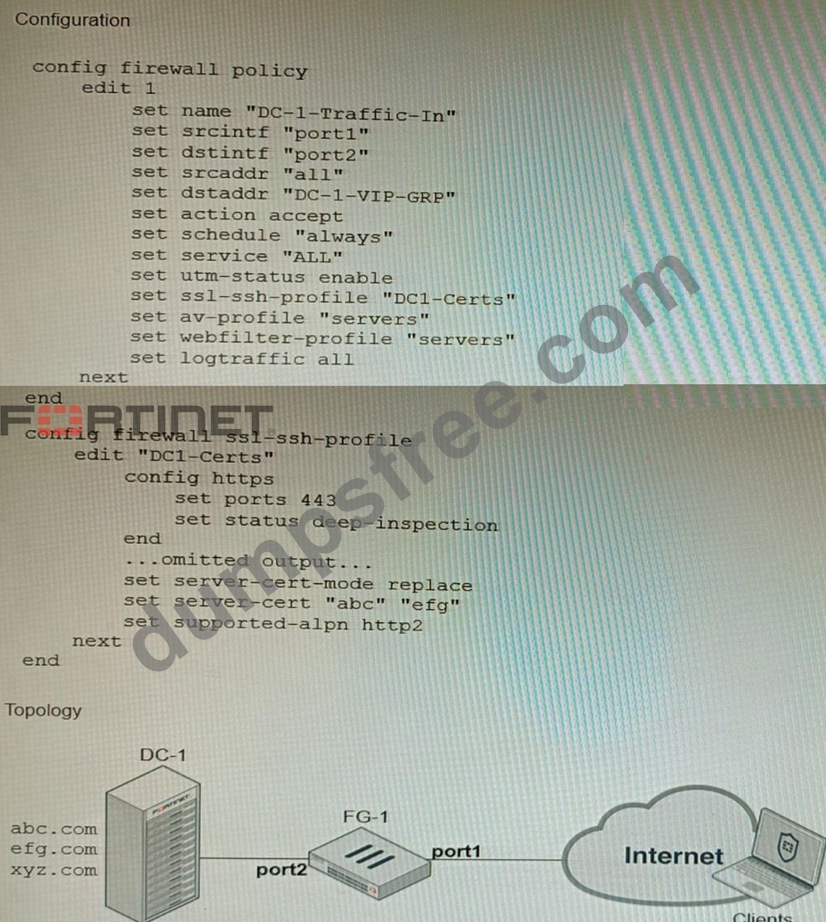
An administrator has configured an inbound SSL inspection profile on a FortiGate device (FG-1) that is protecting a data center hosting multiple web pages-Given the scenario shown in the exhibits, which certificate will FortiGate use to handle requests to xyz.com?
- A. FortiGate will fall-back to the default Fortinet_CA_SSL certificate.
- B. FortiGate will use the Fortinet_CA_Untrusted certificate for the untrusted connection,
- C. FortiGate will use the first certificate in the server-cert list-the abc.com certificate
- D. FortiGate will reject the connection since no certificate is defined.
Answer: A
Explanation:
When using inbound SSL inspection, FortiGate needs to present a certificate to the client that matches the requested domain name. If no matching certificate is found in the server-cert list, FortiGate will fall-back to the default Fortinet_CA_SSL certificate, which is self-signed and may trigger a warning on the client browser. Reference: https://docs.fortinet.com/document/fortigate/6.4.0/cookbook/103437/inbound-ssl-inspection
NEW QUESTION # 33
Review the VPN configuration shown in the exhibit.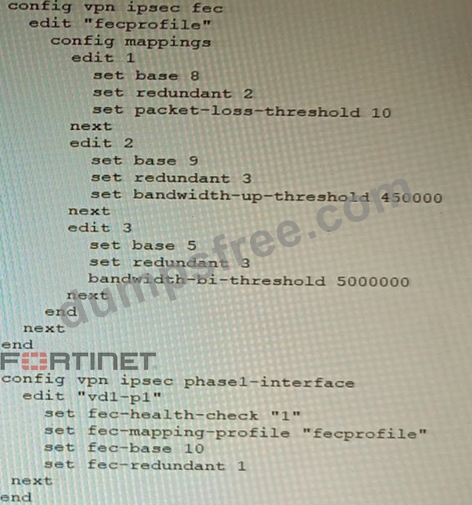
What is the Forward Error Correction behavior if the SD-WAN network traffic download is 500 Mbps and has 8% of packet loss in the environment?
- A. 3 redundant packet for every 9 base packets
- B. 3 redundant packet for every 5 base packets
- C. 1 redundant packet for every 10 base packets
- D. 2 redundant packet for every 8 base packets
Answer: B
Explanation:
Forward Error Correction (FEC) is a feature that can improve the quality of SD-WAN network traffic by adding redundant packets to the original packets. The ratio of redundant packets to base packets is determined by the FEC mode, which can be set to low, medium, or high. In low mode, the ratio is 1:10, in medium mode, the ratio is 2:8, and in high mode, the ratio is 3:5. The FEC mode can be configured manually or automatically based on the bandwidth and packet loss of the network. In this case, since the download bandwidth is 500 Mbps and the packet loss is 8%, the FEC mode is automatically set to high, which means that 3 redundant packets are added for every 5 base packets. Reference: https://docs.fortinet.com/document/fortigate/7.0.0/sd-wan/19662/forward-error-correction-fec
NEW QUESTION # 34
What is the benefit of using FortiGate NAC LAN Segments?
- A. It allows for assignment of dynamic address objects matching NAC policy.
- B. It provides support for IGMP snooping between hosts within the same VLAN
- C. It provides physical isolation without changing the IP address of hosts.
- D. It provides support for multiple DHCP servers within the same VLAN.
Answer: A
Explanation:
FortiGate NAC LAN Segments are a feature that allows users to assign different VLANs to different LAN segments without changing the IP address of hosts or bouncing the switch port. This provides physical isolation while maintaining firewall sessions and avoiding DHCP issues. One benefit of using FortiGate NAC LAN Segments is that it allows for assignment of dynamic address objects matching NAC policy. This means that users can create firewall policies based on dynamic address objects that match the NAC policy criteria, such as device type, OS type, MAC address, etc. This simplifies firewall policy management and enhances security by applying different security profiles to different types of devices. Reference: https://docs.fortinet.com/document/fortigate/7.0.0/new-features/856212/nac-lan-segments-7-0-1
NEW QUESTION # 35
Which two methods are supported for importing user defined Lookup Table Data into the FortiSIEM? (Choose two.)
- A. Report
- B. API
- C. FTP
- D. SCP
Answer: A,B
Explanation:
FortiSIEM supports two methods for importing user defined Lookup Table Data:
Report: You can import lookup table data from a report. This is the most common method for importing lookup table data.
API: You can also import lookup table data using the FortiSIEM API. This is a more advanced method that allows you to import lookup table data programmatically.
FTP, SCP, and other file transfer protocols are not supported for importing lookup table data into FortiSIEM.
NEW QUESTION # 36
Refer to the exhibits.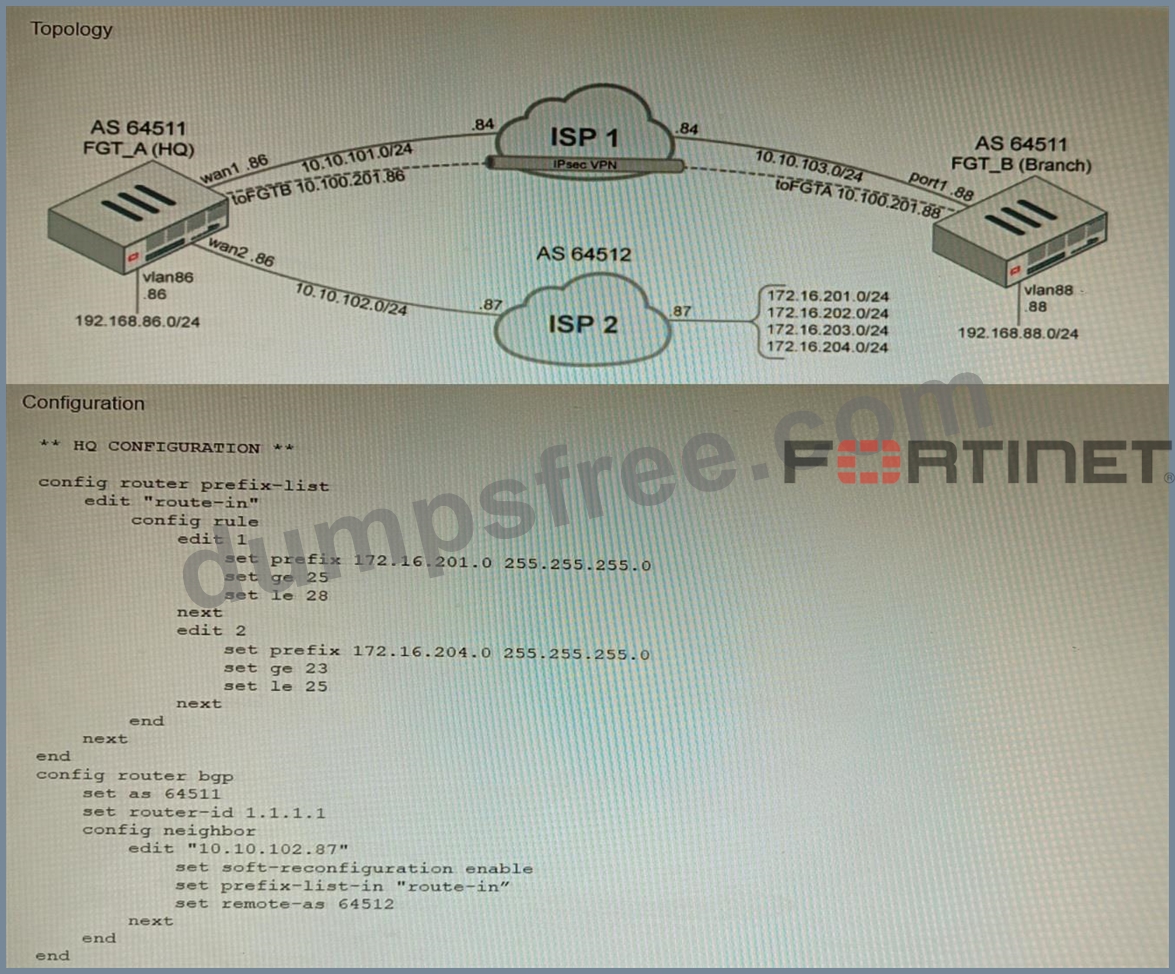
A customer has deployed a FortiGate with iBGP and eBGP routing enabled. HQ is receiving routes over eBGP from ISP 2; however, only certain routes are showing up in the routing table-Assume that BGP is working perfectly and that the only possible modifications to the routing table are solely due to the prefix list that is applied on HQ.
Given the exhibits, which two routes will be active in the routing table on the HQ firewall? (Choose two.)
- A. 172.16.204.128/25
- B. 172,620,64,27
- C. 172.16.201.96/29
- D. 172.16.204.64/27
Answer: A,B
Explanation:
A is correct because 172.16.204.128/25 matches the prefix list entry 172.16.204.0/24 ge 25 le 25. C is correct because 172.16.204.64/27 matches the prefix list entry 172.16.204.0/24 ge 27 le 27. Reference: https://docs.fortinet.com/document/fortigate/7.4.0/administration-guide/978793/bgp
NEW QUESTION # 37
An automation stitch was configured using an incoming webhook as the trigger named 'my_incoming_webhook'. The action is configured to execute the CLI Script shown: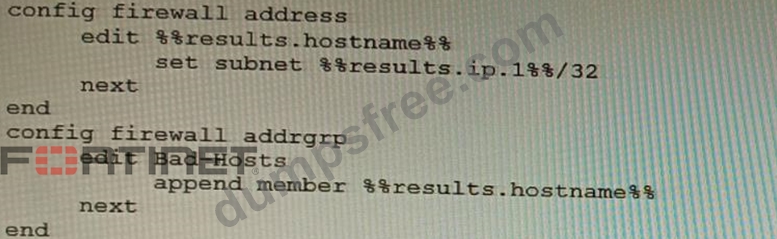
- A.

- B.

- C.

- D.

Answer: A
Explanation:
The CLI script in option A will send the log message to the webhook server. The webhook server can then be configured to take any desired action, such as storing the log message in a database or sending an email notification.
The other options are incorrect. Option B will not send the log message to the webhook server because it does not contain the curl command. Option C will send the log message to the webhook server, but it will also include the FortiGate's IP address and MAC address. This information is not necessary, and it could be used by an attacker to identify the FortiGate. Option D will not send the log message to the webhook server because it does not contain the webhook action.
References:
Automation webhook stitches: https://docs.fortinet.com/document/fortigate/7.4.0/administration-guide/989735/webhook-action Webhooks: https://en.wikipedia.org/wiki/Webhook
NEW QUESTION # 38
Refer to the exhibits.
A customer has deployed a FortiGate with iBGP and eBGP routing enabled. HQ is receiving routes over eBGP from ISP 2; however, only certain routes are showing up in the routing table-Assume that BGP is working perfectly and that the only possible modifications to the routing table are solely due to the prefix list that is applied on HQ.
Given the exhibits, which two routes will be active in the routing table on the HQ firewall? (Choose two.)
- A. 172,620,64,27
- B. 172.16.204.64/27
- C. 172.16.204.128/25
- D. 172.16.201.96/29
Answer: B,C
Explanation:
The prefix list in the exhibit is configured to match prefixes that are either in the 172.16.204.0/24 subnet or in the 172.62.0.0/16 subnet. The routes that match these prefixes will be active in the routing table on the HQ firewall.
The routes that match the following prefixes will not be active in the routing table:
172.16.201.96/29
172.62.0.64/27
These routes do not match the criteria set by the prefix list.
References:
Prefix lists | FortiGate / FortiOS 7.4.0 - Fortinet Document Library
Configuring BGP | FortiGate / FortiOS 7.4.0 - Fortinet Document Library
NEW QUESTION # 39
Refer to the exhibit.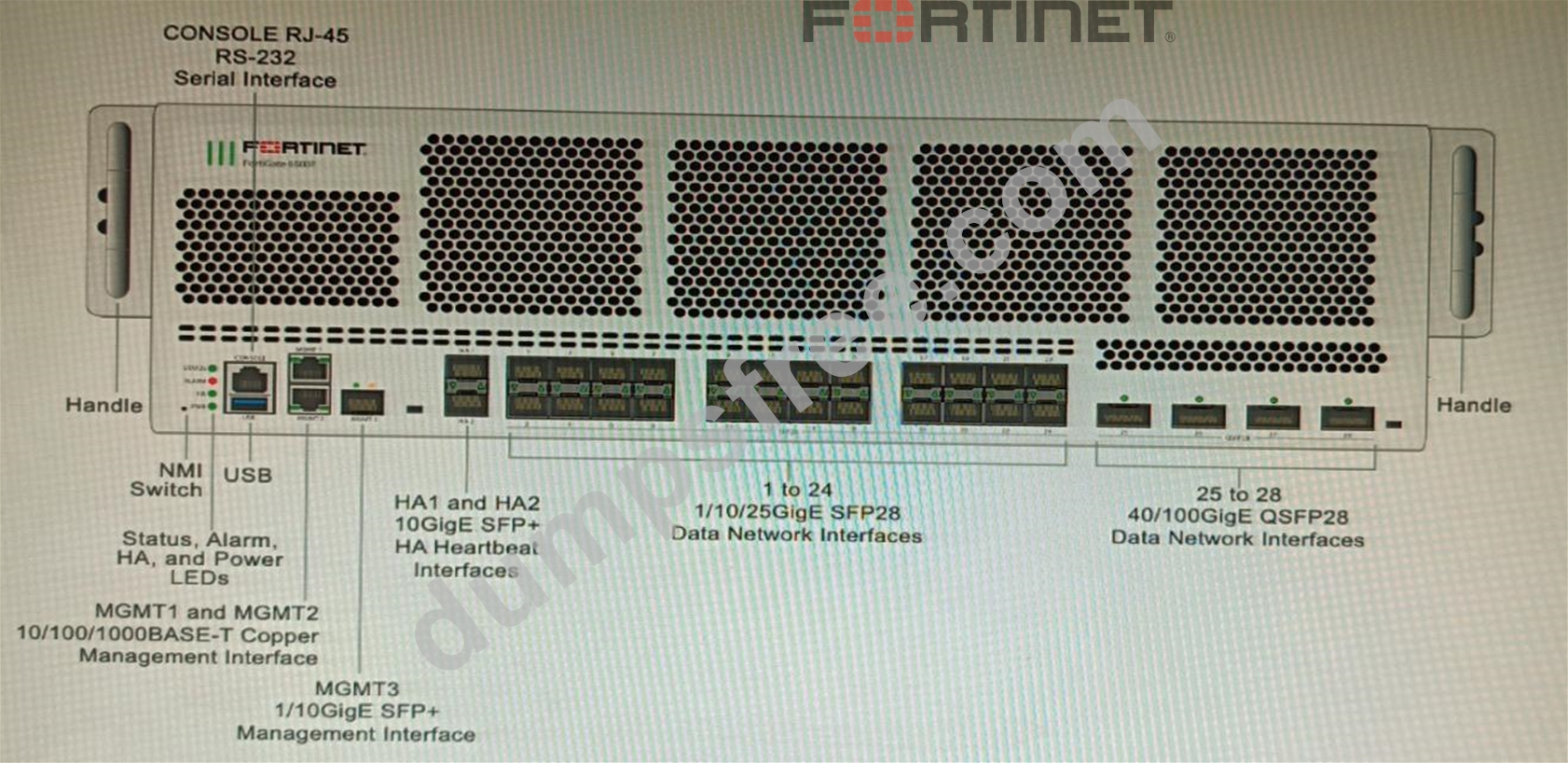
You are deploying a FortiGate 6000F. The device should be directly connected to a switch. In the future, a new hardware module providing higher speed will be installed in the switch, and the connection to the FortiGate must be moved to this higher-speed port.
You must ensure that the initial FortiGate interface connected to the switch does not affect any other port when the new module is installed and the new port speed is defined.
How should the initial connection be made?
- A. Connect the switch on any interface between ports 5 to 8.
- B. Connect the switch on any interface between ports 25 to 28
- C. Connect the switch on any interface between ports 21 to 24
- D. Connect the switch on any interface between ports 1 to 4
Answer: C
Explanation:
The FortiGate 6000F is a high-performance firewall appliance that has 28 network interfaces with different speeds and types. The device should be directly connected to a switch that will have a new hardware module providing higher speed in the future. The connection to the FortiGate must be moved to this higher-speed port without affecting any other port. Therefore, the initial connection should be made on any interface between ports 21 to 24, which are 10G SFP+ interfaces. These interfaces are independent from each other and do not share bandwidth with any other interface. This means that moving the connection to a higher-speed port in the future will not affect any other port on the FortiGate. Option A shows the correct answer. Option B is incorrect because ports 25 to 28 are 40G QSFP+ interfaces, which share bandwidth with ports 21 to 24. Moving the connection to a higher-speed port in the future will affect the bandwidth of these ports. Option C is incorrect because ports 1 to 4 are 100G QSFP28 interfaces, which share bandwidth with ports 5 to 8 and ports 9 to 12. Moving the connection to a higher-speed port in the future will affect the bandwidth of these ports. Option D is incorrect because ports 5 to 8 are 25G SFP28 interfaces, which share bandwidth with ports 1 to 4 and ports 9 to 12. Moving the connection to a higher-speed port in the future will affect the bandwidth of these ports. Reference: https://docs.fortinet.com/document/fortigate/7.0.0/hardware-acceleration-guide/19662/fortigate-6000f
NEW QUESTION # 40
Refer to the CLI output: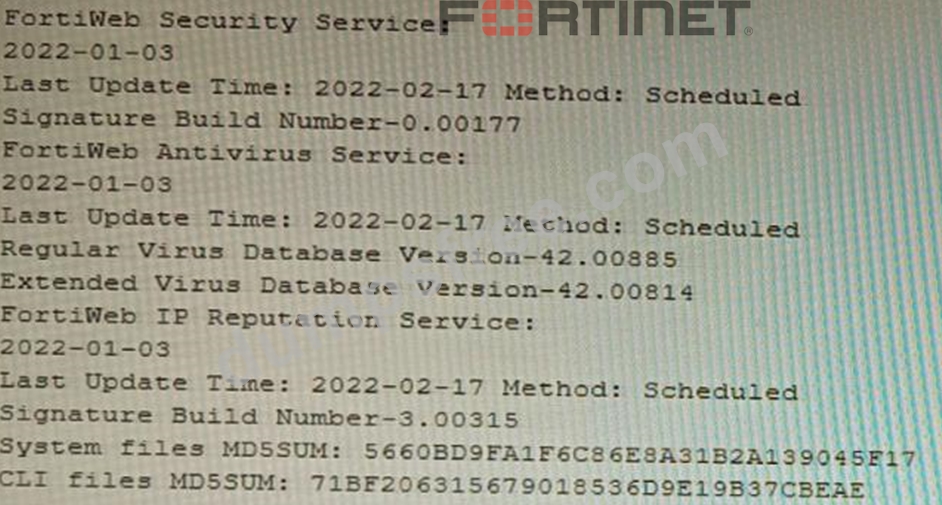
Given the information shown in the output, which two statements are correct? (Choose two.)
- A. An IP address that was previously used by an attacker will always be blocked
- B. Geographical IP policies are enabled and evaluated after local techniques.
- C. The IP Reputation feature has been manually updated
- D. Attackers can be blocked before they target the servers behind the FortiWeb.
- E. Reputation from blacklisted IP addresses from DHCP or PPPoE pools can be restored
Answer: D,E
Explanation:
The CLI output shown in the exhibit indicates that FortiWeb has enabled IP Reputation feature with local techniques enabled and geographical IP policies enabled after local techniques (set geoip-policy-order after-local). IP Reputation feature is a feature that allows FortiWeb to block or allow traffic based on the reputation score of IP addresses, which reflects their past malicious activities or behaviors. Local techniques are methods that FortiWeb uses to dynamically update its own blacklist based on its own detection of attacks or violations from IP addresses (such as signature matches, rate limiting, etc.). Geographical IP policies are rules that FortiWeb uses to block or allow traffic based on the geographical location of IP addresses (such as country, region, city, etc.). Therefore, based on the output, one correct statement is that attackers can be blocked before they target the servers behind the FortiWeb. This is because FortiWeb can use IP Reputation feature to block traffic from IP addresses that have a low reputation score or belong to a blacklisted location, which prevents them from reaching the servers and launching attacks. Another correct statement is that reputation from blacklisted IP addresses from DHCP or PPPoE pools can be restored. This is because FortiWeb can use local techniques to remove IP addresses from its own blacklist if they stop sending malicious traffic for a certain period of time (set local-techniques-expire-time), which allows them to regain their reputation and access the servers. This is useful for IP addresses that are dynamically assigned by DHCP or PPPoE and may change frequently. Reference: https://docs.fortinet.com/document/fortiweb/6.4.0/administration-guide/19662/ip-reputation https://docs.fortinet.com/document/fortiweb/6.4.0/administration-guide/19662/geographical-ip-policies
NEW QUESTION # 41
......
NSE8_812 Exam Dumps Pass with Updated 2023 Certified Exam Questions: https://www.dumpsfree.com/NSE8_812-valid-exam.html
NSE8_812 Exam Questions - Real & Updated Questions PDF: https://drive.google.com/open?id=1xkciMaNZXT7k9XXV1oDxBD4VVPoG0ROS