


[Jun 26, 2026] Get Unlimited Access to 1Z0-083 Certification Exam Cert Guide
Reliable Study Materials for 1Z0-083 Exam Success For Sure
Oracle 1Z0-083 Certification Exam is designed for database administrators who have already obtained the Oracle Database Administration I certification and are looking to expand their knowledge and skills in database administration. 1Z0-083 exam covers a wide range of topics, including database architecture, backup and recovery, performance tuning, security, and more. It is a comprehensive exam that requires a deep understanding of Oracle databases and their management.
NEW QUESTION # 69
Which two are true about RMAN duplexed backup sets? (Choose two.)
- A. They can be created by using the RMAN CONFIGURE command to specify duplexing before taking a backup.
- B. They can be created only by using the COPIES option of a BACKUP command.
- C. They can be written only to disk.
- D. They must be written to media.
- E. They can be written to media.
Answer: B,E
NEW QUESTION # 70
Identify three benefits of Unified Auditing.
- A. It improves overall auditing performance.
- B. It automatically audits Recovery Manager (RMAN) events.
- C. It guarantees zero-loss auditing.
- D. The audit trail cannot be easily modified because it is read-only.
- E. Decreased use ofstorage to store audit trail rowsin the database.
Answer: A,B,D
NEW QUESTION # 71
Which two are true about poorly performing SQL statements and their tuning in Oracle database instances?
(Choose two.)
- A. Poorly performing SQL statements can be tuned automatically by the Oracle server.
- B. SQL statements doing joins always do more physical I/O than single table queries.
- C. SQL statements doing only logical reads never require tuning because they do no physical I/O.
- D. The solution that best optimizes one SQL statement can degrade the performance of others.
- E. SQL statements performing many physical I/Os can always have their performance improved by creating indexes.
Answer: A,C
NEW QUESTION # 72
Which three are true? (Choose three.)
- A. Fine-grained auditing (FGA) policies in an application root are automatically synchronized to all application PDBs contained in the application container.
- B. Application-common OLS policies can be created in an application root inside an install/patch BEGIN-END block.
- C. Virtual Private Database (VPD) policies on objects in an application root are automatically synchronized with all application PDBs contained in the application container.
- D. Application-common Oracle Label Security (OLS) policies cannot be created in an application root outside an install/patch BEGIN-END block.
- E. Application-common TSDP policies are always container specific.
- F. Application-common Transparent Security Data Protection (TSDP) policies can be created only within an application install/patch BEGIN-END block.
- G. Unified auditing can be automatically synchronized to all application PDBs in an application container.
Answer: A,E
NEW QUESTION # 73
Which two are true about OS groups and users for Oracle Grid Infrastructure and the Oracle Relational Database Management System (RDBMS)? (Choose two.)
- A. The Oracle Grid Infrastructure owner must have OSOPER, OSBACKUPDBA, and OSKMDBA as secondary groups.
- B. By default, members of the OSASM group can access Automatic Storage Management and RDBMS instances.
- C. The primary group for the Oracle Grid Infrastructure and Oracle Database owners must be the Oracle Inventory group.
- D. The Oracle Grid Infrastructure owner owns Oracle Restart and Oracle Automatic Storage Management binaries.
- E. The Oracle Grid Infrastructure installation must be owned by the grid user.
- F. The same OSDBA group must be used for Automatic Storage Management and the Oracle Database.
Answer: C,D
NEW QUESTION # 74
Which three are true about Recovery Manager (RMAN) in Oracle Database 19c and later releases? (Choose three.)
- A. A Virtual Private Catalog used to register a container database can be created in a pluggable database.
- B. It is always possible for RMAN to connect to a pluggable database as a target.
- C. A Virtual Private Catalog used to register a container database must be created in a pluggable database.
- D. It is always possible for RMAN to connect to a pluggable database as a target if any RMAN Catalog is used.
- E. A Virtual Private Catalog used to register a container database can be created in a non-container database.
- F. It is only possible for RMAN to connect to a pluggable database as a target if an RMAN Virtual Private Catalog is used.
Answer: A,B,E
Explanation:
Explanation/Reference:
NEW QUESTION # 75
On the 10th of August, you implement an incremental database backup strategy and configure a recovery window of five days.
Level 0 backups are taken on the 10th, 17th, and 24th of August. Differential level 1 incremental backups are taken daily between the level 0 backups.
Today is the 26th of August.
Which backups will be obsolete?
- A. all backups prior to 10th of August
- B. all backups prior to 22nd of August
- C. all backups prior to 20th of August
- D. all backups prior to 24th of August
- E. all backups prior to 17th of August
Answer: E
NEW QUESTION # 76
Which two are true about Oracle instance recovery?
- A. Recovery begins from the last checkpoint position that was recorded in the control file by the checkpoint process (ckpt).
- B. Recovery begins from the beginning of the current redo log group.
- C. Recovery begins from the last checkpoint position that was calculated by the Database Writer before instance failure.
- D. Recovery begins from the start of any active redo log group or the start of the current log group if no other group is active.
- E. Recovery reads redo until the end of the redo thread, and then opens the database, smon then rolls back any dead transactions.
- F. Recovery reads redo until the end of the redo thread, smon rolls back any dead transactions, and then the database is opened.
Answer: A,D
NEW QUESTION # 77
Which three are true about Optimizer Statistics Advisor? (Choose three.)
- A. It runs automatically every night by default.
- B. It always analyzes all schemas in the database.
- C. It can be run only manually.
- D. It can recommend changes to improve the statistics gathering process.
- E. It is part of the DBMS_ADVISOR package.
- F. It is part of the DBMS_STATS package.
Answer: A,D,F
Explanation:
Explanation
https://mikedietrichde.com/2017/08/22/oracle-optimizer-statistics-advisor-in-oracle-database-12-2-0-1/
https://www.oracle.com/technetwork/database/bi-datawarehousing/twp-bp-for-stats-gather-19c-5324205.pdf
NEW QUESTION # 78
Examine this configuration:
1. CDB1 is an Oracle Database 12c Release 2 container database (CDB).
2. PDB1 and PDB2 are two pluggable databases (PDBs) in CDB1.
After successfully performing all the preupgrade tasks, you execute these commands from the Oracle Database 18c environment:
What is the outcome?
- A. It fails because PDB$SEED is in MIGRATE state.
- B. Only CDB$ROOT and PDB$SEED are upgraded.
- C. CDB$ROOT, PDB$SEED, PDB1, and PDB2 are upgraded.
- D. Only CDB$ROOT, PDB$SEED, and PDB2 are upgraded.
- E. Only CDB$ROOT, PDB$SEED, and PDB1 are upgraded.
- F. It fails because PDB2 is not in UPGRADE state.
Answer: B
NEW QUESTION # 79
Choose two. When backing up to the Oracle Fast Recovery Area (FRA), you determine that the backup takes too long and suspect a performance bottleneck. Which two are true about diagnosing and tuning these problems?
- A. If an RMAN BACKUP VALIDATE command takesroughly the same time as an actual backup, then both read and write I/O are likely bottlenecks.
- B. If an RMAN BACKUP VALIDATE command takes noticeably less time than an actual backup, then write I/O is a likely bottleneck.
- C. Data files with a high value in V$BACKUP_ASYNC_IO.SHORT_WAITS are a potential performance bottleneck when asynchronous I/O is used.
- D. If an RMAN BACKUP VALIDATE command takesroughly the same time as an actual backup, then read I/O is a likely bottleneck.F
- E. Data files with a high value in V$BACKUP_SYNC_IO.DISCRETE_BYTES_PER_SECOND are a potential performance bottleneck when synchronous I/O is used.
Answer: B,C,E
NEW QUESTION # 80
Examine this configuration:
CDB1 is a container database.
COMMON_USER_PREFIX is C##.
PDB1 is a pluggable database contained in CDB1.
APP1_ROOT is an application container contained in CDB1.
APP1_PDB1 is an application PDB contained in APP1_ROOT.
You execute these commands successfully: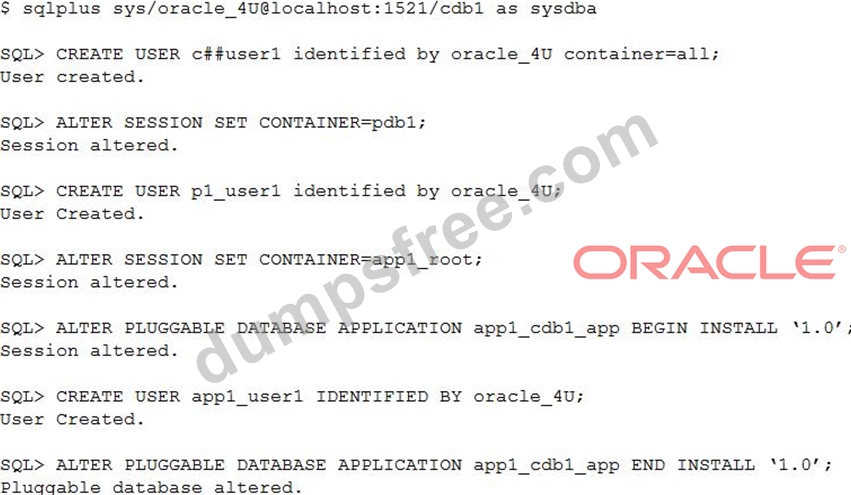
Which two are true? (Choose two.)
- A. C##_APP_USER1 can be created in CDB1.
- B. APP1_USER1 can be created in CDB1.
- C. P1_USER1 can be created in CDB1.
- D. C##_USER1 will have the same privileges and roles granted in all PDBs in CDB1.
- E. APP1_USER1 can have different privileges in each Application PDB contained in APP1_ROOT.
- F. APP1_USER1 can be created in PDB1.
Answer: D,E
NEW QUESTION # 81
Which three are true about RMAN persistent configuration settings, administration, and their effects? (Choose three.)
- A. A DBA must specify either a redundancy retention policy or a recovery window retention policy.
- B. The V$RMAN_CONFIGURATION view displays only settings with values that have been modified.
- C. Backup older than the recovery window retention policy are always deleted automatically if the backup location has insufficient space.
- D. A target database's persistent RMAN configuration settings are always stored in the target's control file
- E. Backups written to the fast recovery area (FRA) that are oboslete based on the redundancy retention policy can be deleted automatically to free space.
- F. The RMAN SHOW ALL command displays only settings with nondefault values.
- G. A target database's persistent RMAN configuration settings are always synchronized automatically with the RMAN catalog.
Answer: B,C,D
Explanation:
Reference:
https://books.google.com.pk/books? id=pUEkAAAAQBAJ&pg=PA114&lpg=PA114&dq=V$RMAN_CONFIGURATION+view+displays+only+settings
+with+values+that+have+been+modified&source=bl&ots=fhC9A7ULeX&sig=ACfU3U2- cGhTjmAOpCZhvlL5R4j6ixLRAw&hl=en&sa=X&ved=2ahUKEwjJzf- WmtnoAhXT8eAKHQ9uBG8Q6AEwAHoECAwQJg#v=onepage&q=V%24RMAN_CONFIGURATION%20view
%20displays%20only%20settings%20with%20values%20that%20have%20been%20modified&f=false
NEW QUESTION # 82
Choose three. Which three are true about post-upgrade activities when upgrading an Oracle database using Database Upgrade Assistant?
- A. Time zone files must be upgraded manually using the DBMS_DST PL/SQL package.
- B. Any Recovery Manager (RMAN) recovery catalog must be upgraded manually.
- C. The new extended data type capability must be enabled by running the utlrp.sql script
- D. After a manual upgrade, TNSNAMES.ORA entries must be updated to reflect the new ORACLE_HOME.
- E. The Oracle Application Express configuration should be updated after upgrading Oracle Database.
Answer: B,C,E
NEW QUESTION # 83
Which two are true about RMAN backups when using a media manager to write backups to tape when there are only two tape drives? (Choose two.)
- A. Any backup set written to the SBT device in this configuration can contain a maximum of two backup pieces.
- B. SBT tape compression and RMAN backup compression should be used in parallel.
- C. SBT tape compression can be used even if no RMAN compression is configured.
- D. Any backup written to the SBT device in this configuration can contain a maximum of two backup sets.
- E. The SBT device should be configured to use PARALLELISM 2 to allow both tape drive to be used simultaneously.
Answer: C,E
Explanation:
sbt tape compression independently can be used on the TAPE side. Oracle recommends You should not use both tape compression provided by the media manager _and_ binary compression provided by RMAN. If the media manager compression is efficient, then it is usually the better choice. Using RMAN-compressed backup sets can be an effective alternative to reduce bandwidth used to move uncompressed backup sets over a network to the media manager, if the CPU overhead required to compress the data in RMAN is acceptable.
NEW QUESTION # 84
In performance management, which two factors might reduce the ability of an application to scale to a large number of users? (Choose two.)
- A. the number of tablespaces containing tables updated by a transaction
- B. poorly written SQL
- C. poorly trained users who do not commit transactions
- D. the number of data files containing extents belonging to tables updated by a transaction
- E. issuing multiple savepoints during a transaction
Answer: A,B
NEW QUESTION # 85
Your container database, CDB1, has an application container, HR_ROOT, with an application PDB, HR_PDB1.
You have the required privilege to clone HR_PDB1to container database CDB2, which does not contain HR_ROOT.
Which two are always true? (Choose two.)
- A. A common user must exist in CDB2 with the CREATE PLUGGABLE DATABASE privilege.
- B. All transactions in HR_PDB1 of CDB1 must commit before the cloning process starts.
- C. Cloning HR_ROOT automatically clones HR_PDB1.
- D. CDB1 and CDB2 must be in shared undo mode.
- E. The HR_PDB1 clone created in CDB2 will be in mount state when cloning ends.
Answer: A,E
Explanation:
After you create the application PDB, it is in mounted mode, and its status is NEW.
https://docs.oracle.com/en/database/oracle/oracle-database/21/multi/creating-application- pdb.html#GUID-88E61123-F651-47D7-9977-B589268EBD29
NEW QUESTION # 86
Which two are true about server-generated alerts? (Choose two.)
- A. Stateless alerts can be purged manually from the alert history.
- B. Stateless alerts are automatically cleared.
- C. Stateful alerts must be created by a DBA after resolving the problem.
- D. Stateless alerts can be cleared manually.
- E. Stateful alerts are purged automatically from the alert history.
Answer: A,D
Explanation:
Explanation
Except for the tablespace space usage metric, which is database related, the other metrics are instance related.
Threshold alerts are also referred to as stateful alerts which are automatically cleared when an alert condition clears. Stateful alert appears in DBA_OUTSTANDING_ALERTS and when cleared go to DBA_ALERT_HISTORY. Other server-generated alerts correspond to specific database events such as ORA-* errors, "Snapshot too old" errors, Recovery Area Low on Free Space, Resumable Session Suspended.
These are non threshold based alerts, also referred to as stateless alerts. Stateless alerts go directly to the History table. +++ Most alerts (such as "Out of Space") are cleared automatically when the cause of the problem disappears. However, other alerts (such as generic alert log errors) are sent to you for notification and must be acknowledged by you. After taking the corrective measures, you acknowledge an alert by clearing or purging it. Clearing an alert sends the alert to the Alert History which is accessible from Monitoring sub menu.
Purging an alert removes it from the Alert History.
NEW QUESTION # 87
Which three are true in Oracle 19c and later releases? (Choose three.)
- A. Schema Only accounts can be granted administrator privileges.
- B. Privilege Analysis is included in Oracle Enterprise Edition and no longer requires Database Vault.
- C. Unified Auditing can be configured to audit only events that are issued directly by an audited user.
- D. Unified Auditing can be configured to audit only events that are issued indirectly by an audited user.
- E. All the Oracle-supplied accounts are Schema Only accounts.
- F. If the password file location changes, then the new location is used automatically by the Oracle Server.
Answer: A,B,E
Explanation:
Reference:
https://mandysandhu.com/2018/04/30/oracle-database-18c-schema-only-accounts/
NEW QUESTION # 88
Which four are true about duplicating a database using Recovery Manager (RMAN)? (Choose four.)
- A. A connection to an auxiliary instance is always required.
- B. Duplication can be done by having the target database instance push copies to the auxiliary database instance.
- C. A connection to the recovery catalog instance is always required.
- D. A new DBID is always created for the duplicated database.
- E. Duplication can be done by having the auxiliary database instance pull backup sets from the target database instance.
- F. A subset of the target database can be duplicated.
- G. A connection to the target database instance is always required.
- H. A backup of the target database is always required.
Answer: A,B,E,F
NEW QUESTION # 89
Which two are true about data movement between a non-CDB and a PDB using Data Pump?
- A. A new PDB is automatically created when importing a non-CDB into a CDB.
- B. Moving data from a non-CDB to a PDB is only possible by using conventional export and import.
- C. Tablespaces are automatically created as needed while importing full exports in either a non-CDB or a PDB.
- D. Oracle attempts to convert conventional database users to local users when moving schemas from a non-CDB to a PDB.
- E. Moving data from a PDB to a non-CDB is only possible by using transportable tablespace export and import.
- F. Oracle attempts to convert common users to conventional users when moving schemas from a PDB to a non-CDB.
Answer: A,C
NEW QUESTION # 90
Which four are true about duplicating a database using Recovery Manager (RMAN)? (Choose four.)
- A. A connection to an auxiliary instance is always required.
- B. Duplication can be done by having the target database instance push copies to the auxiliary database instance.
- C. A connection to the recovery catalog instance is always required.
- D. A new DBID is always created for the duplicated database.
- E. Duplication can be done by having the auxiliary database instance pull backup sets from the target database instance.
- F. A subset of the target database can be duplicated.
- G. A connection to the target database instance is always required.
- H. A backup of the target database is always required.
Answer: A,B,E,F
Explanation:
A duplicate database is a copy of your target database. With the FOR STANDBY clause, it keeps the same unique database identifier(DBID); If FOR STANDBY not specified it creates a new DBID. The duplicate database can include the same content or only a subset from the source database. It can be in the same host or a separate host. The principal work of the duplication is performed by the auxiliary channels.These channels correspond to a server session on the auxiliary instance on the destination host for backup based duplication. For active database duplication the target channels perform the work of pushing data file copies to the auxiliary instance (if number of allocated target channels is greater than the number of allocated auxiliary channels).
NEW QUESTION # 91
......
New Oracle 1Z0-083 Dumps & Questions: https://www.dumpsfree.com/1Z0-083-valid-exam.html
100% Latest Most updated 1Z0-083 Questions and Answers: https://drive.google.com/open?id=1mjyJU8FlFbVET4cj2JWYiaDlsgdP_zdb