


Best Microsoft SC-300 2026 Training With 346 QA's
Microsoft SC-300 Certification Exam Questions
Microsoft SC-300, also known as the Microsoft Identity and Access Administrator certification exam, is designed for IT professionals who are responsible for managing and implementing security measures in their organization's identity and access management systems. Microsoft Identity and Access Administrator certification exam validates the knowledge and skills required to manage and secure Microsoft's identity and access technologies, including Azure Active Directory, Microsoft 365 Identity and Access, and Microsoft Identity Manager.
NEW QUESTION # 184
You need to configure the MFA settings for users who connect from the Boston office. The solution must meet the authentication requirements and the access requirements. What should you configure?
- A. named locations that have a private IP address range
- B. named locations that have a public IP address range
- C. trusted IPs that have a public IP address range
- D. trusted IPs that have a private IP address range
Answer: B
Explanation:
Reference:
https://docs.microsoft.com/en-us/azure/active-directory/conditional-access/location-condition
Topic 1, Litware, Inc
Identity Environment
The network contains an Active Directory forest named litware.com that is linked to an Azure Active Directory (Azure AD) tenant named litware.com. Azure AD Connect uses pass-through authentication and has password hash synchronization disabled.
Litware.com contains a user named User1 who oversees all application development. Litware implements Azure AD Application Proxy.
Fabrikam has an Azure AD tenant named fabrikam.com. The users at Fabrikam access the resources in litware.com by using guest accounts in the litware.com tenant.
Cloud Environment
All the users at Litware have Microsoft 365 Enterprise E5 licenses. All the built-in anomaly detection polices in Microsoft Cloud App Security are enabled.
Litware has an Azure subscription associated to the litware.com Azure AD tenant. The subscription contains an Azure Sentinel instance that uses the Azure Active Directory connector and the Office 365 connector. Azure Sentinel currently collects the Azure AD sign-ins logs and audit logs.
On-premises Environment
The on-premises network contains the severs shown in the following table.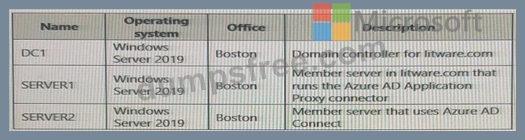
Both Litware offices connect directly to the internet. Both offices connect to virtual networks in the Azure subscription by using a site-to-site VPN connection. All on-premises domain controllers are prevented from accessing the internet.
Delegation Requirements
Litware identifies the following delegation requirements:
* Delegate the management of privileged roles by using Azure AD Privileged Identity Management (PIM).
* Prevent nonprivileged users from registering applications in the litware.com Azure AD tenant-
* Use custom catalogs and custom programs for Identity Governance.
* Ensure that User1 can create enterprise applications in Azure AD. Use the principle of least privilege.
Licensing Requirements
Litware recently added a custom user attribute named LWLicenses to the litware.com Active Directory forest. Litware wants to manage the assignment of Azure AD licenses by modifying the value of the LWLicenses attribute. Users who have the appropriate value for LWLicenses must be added automatically to Microsoft 365 group that he appropriate license assigned.
Management Requirement
Litware wants to create a group named LWGroup1 will contain all the Azure AD user accounts for Litware but exclude all the Azure AD guest accounts.
Authentication Requirements
Litware identifies the following authentication requirements:
* Implement multi-factor authentication (MFA) for all Litware users.
* Exempt users from using MFA to authenticate to Azure AD from the Boston office of Litware.
* Implement a banned password list for the litware.com forest.
* Enforce MFA when accessing on-premises applications.
* Automatically detect and remediate externally leaked credentials
Access Requirements
Litware wants to create a group named LWGroup1 that will contain all the Azure AD user accounts for Litware but exclude all the Azure AD guest accounts.
Monitoring Requirements
Litware wants to use the Fusion rule in Azure Sentinel to detect multi-staged that include a combination of suspicious Azure AD sign-ins followed by anomalous Microsoft Office 365 activity.
NEW QUESTION # 185
You have a new Microsoft 365 tenant that uses a domain name of contoso.onmicrosoft.com.
You register the name contoso.com with a domain registrar.
You need to use contoso.com as the default domain name for new Microsoft 365 users.
Which four actions should you perform in sequence? To answer, move the appropriate actions from the list of actions to the answer area and arrange them in the correct order.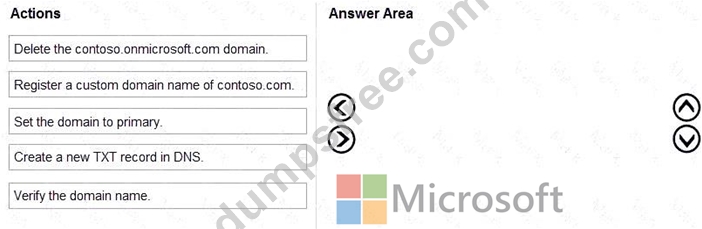
Answer:
Explanation: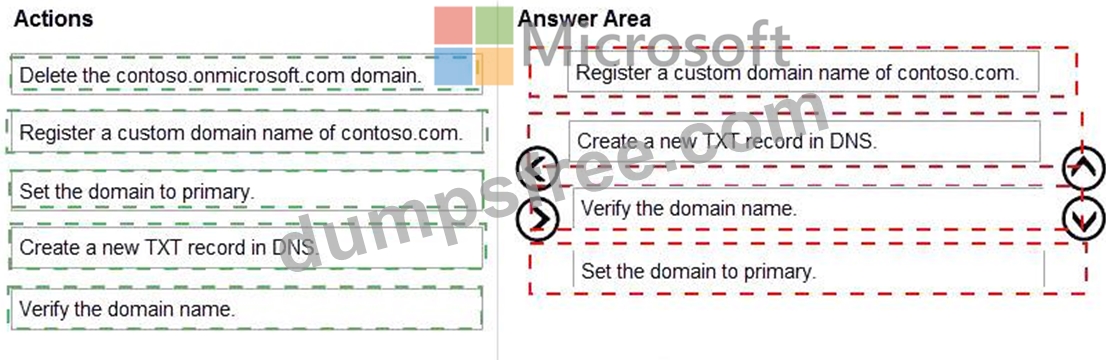
Explanation: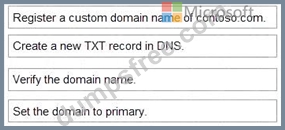
According to the Microsoft SC-300: Identity and Access Administrator Study Guide and Microsoft Learn documentation under "Add and configure custom domains in Microsoft 365", when an organization acquires a new Microsoft 365 tenant, it starts with a default domain such as contoso.onmicrosoft.com. To use a friendly and company-branded domain like contoso.com for email and user principal names (UPNs), administrators must follow a specific sequence of steps to integrate the custom domain into Azure AD
/Microsoft 365.
First, register the custom domain in Azure Active Directory. This action adds contoso.com to your tenant and prepares Microsoft 365 to validate ownership.
After adding the domain, Microsoft 365 provides a TXT record to add to your DNS zone (at your registrar or DNS host). This record proves that your organization owns the domain.
Once the TXT record is published and propagated, return to the Microsoft 365 admin center or use PowerShell to verify the domain. This step confirms domain ownership and completes the domain setup.
Finally, after verification, set contoso.com as the primary domain. Doing this ensures that all newly created users automatically receive user principal names (email addresses) ending in @contoso.com.
Microsoft documentation states:
"After verifying ownership of the custom domain, you can set it as the default (primary) domain for new users in Microsoft 365."
NEW QUESTION # 186
You have an Azure Active Directory (Azure AD) tenant that: contains a user named User1.
You need to ensure that User1 can create new catalogs and add1 resources to the catalogs they own.
What should you do?
- A. From the Roles and administrators blade, modify the Service support administrator role.
- B. From the Roles and administrators blade, modify the Groups administrator role.
- C. From the Identity Governance blade, modify the roles and administrators for the General catalog.
- D. From the Identity Governance blade, modify the Entitlement management settings.
Answer: D
Explanation:
Delegate entitlement management
By default, only Global Administrators and User Administrators can create and manage catalogs, and can manage all catalogs. Users added to entitlement management as Catalog creators can also create catalogs and will become the owner of any catalogs they create.
Reference:
https://docs.microsoft.com/en-us/azure/active-directory/governance/entitlement-management- delegate-catalog#as-an-it-administrator-delegate-to-a-catalog-creator
NEW QUESTION # 187
You have two Microsoft Entra tenants named contoso.com and fabhkam.com. Contoso.com contains the users shown in the following table.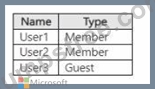
Contoso.com contains the groups shown in the following table.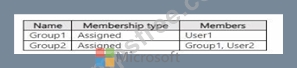
You configure cross-tenant synchronization from contoso.com to fabrikam.com and enable cross-tenant synchronization for User3 and Group2.
For each of the following statements, select Yes if the statement is true. Otherwise, select No.
NOTE: Each correct selection is worth one point.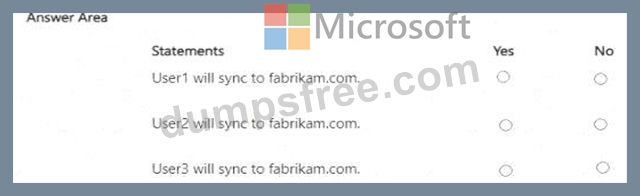
Answer:
Explanation: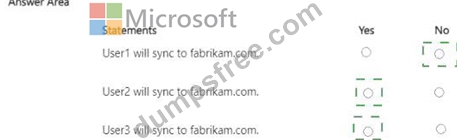
Explanation: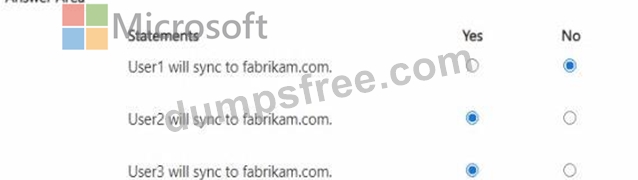
NEW QUESTION # 188
You need to configure app registration in Azure AD to meet the delegation requirements.
What should you do? To answer, select the appropriate options in the answer area.
NOTE: Each correct selection is worth one point.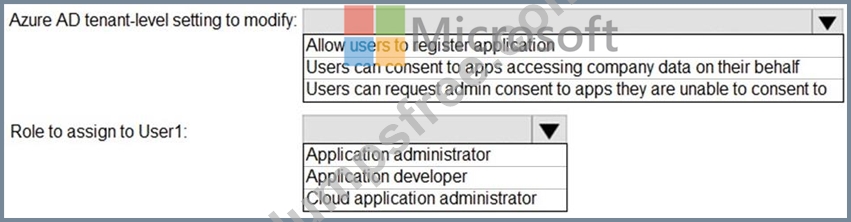
Answer:
Explanation: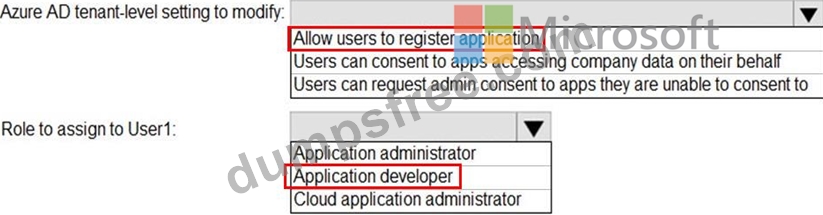
Reference:
https://docs.microsoft.com/en-us/azure/active-directory/roles/delegate-app-roles
NEW QUESTION # 189
You have an Azure Active Directory (Azure AD) tenant that contains an administrative unit named Department1.
Department1 has the users shown in the Users exhibit. (Click the Users tab.)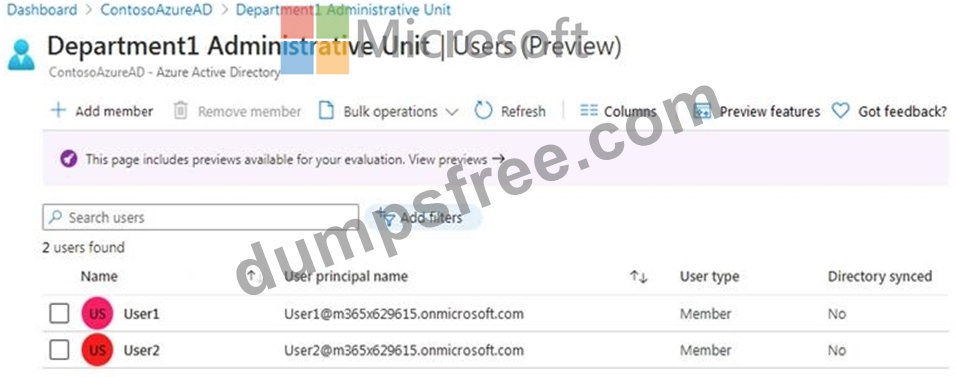
Department1 has the groups shown in the Groups exhibit. (Click the Groups tab.)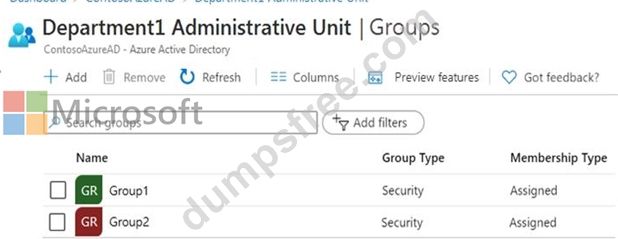
Department1 has the user administrator assignments shown in the Assignments exhibit. (Click the Assignments tab.)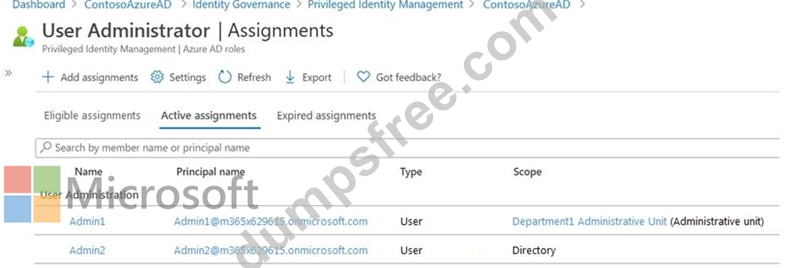
The members of Group2 are shown in the Group2 exhibit. (Click the Group2 tab.)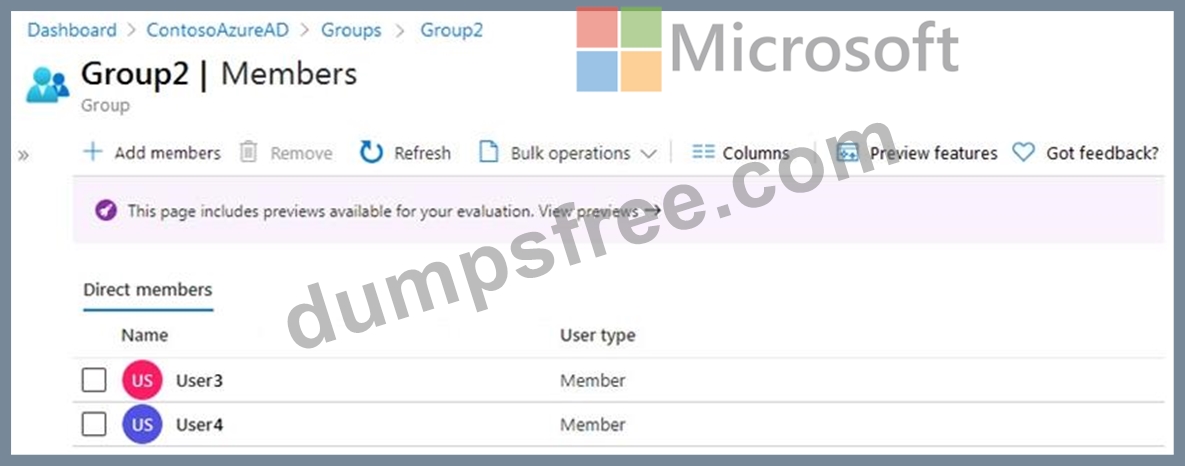
For each of the following statements, select Yes if the statement is true. Otherwise, select No.
NOTE: Each correct selection is worth one point.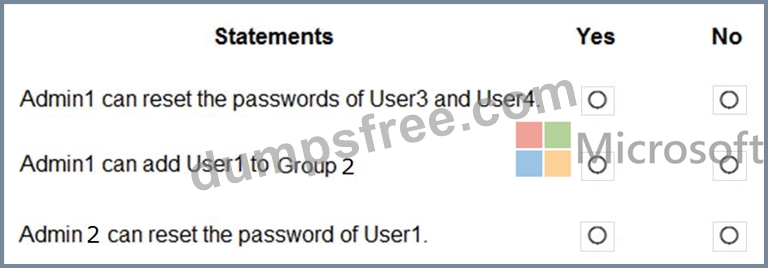
Answer:
Explanation: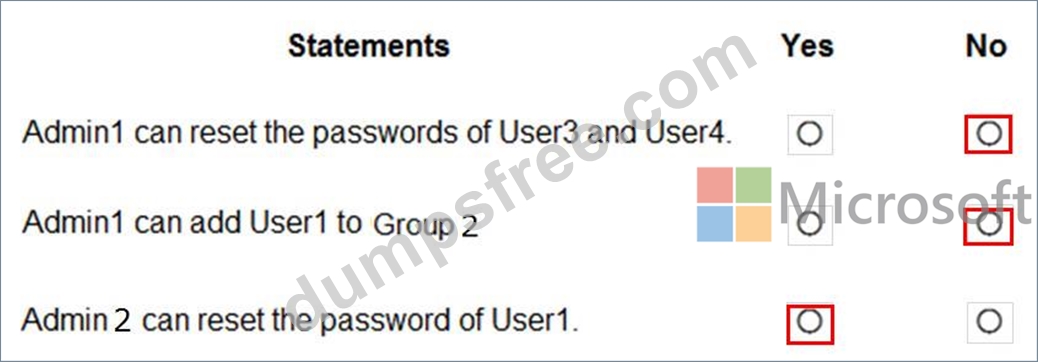
Reference:
https://docs.microsoft.com/en-us/azure/active-directory/roles/administrative-units
NEW QUESTION # 190
You implement the planned changes for SSPR.
What occurs when User3 attempts to use SSPR? To answer, select the appropriate options in the answer area.
NOTE: Each correct selection is worth one point.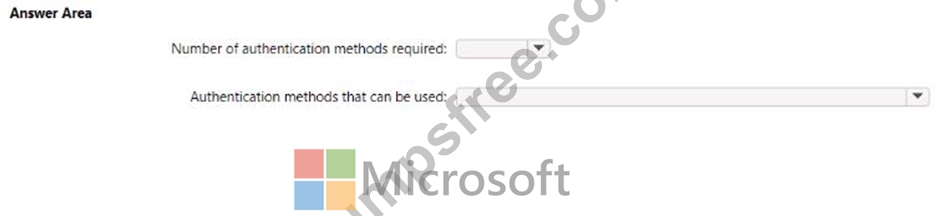
Answer:
Explanation:
Answer is
NEW QUESTION # 191
You have a Microsoft 365 E5 subscription that contains the users shown in the following table.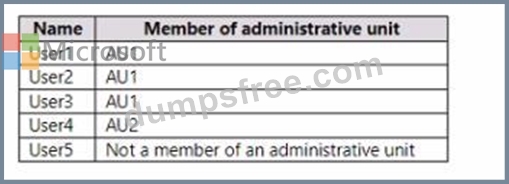
The users are assigned the roles shown in the following table.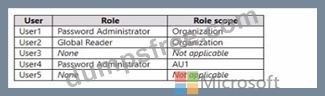
For which users can User1 and User4 reset passwords? To answer, select the appropriate options in the answer area.
NOTE: Each correct selection is worth one point.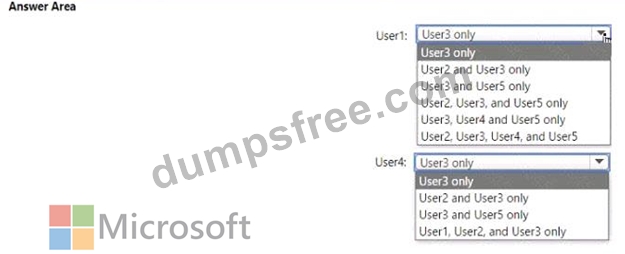
Answer:
Explanation: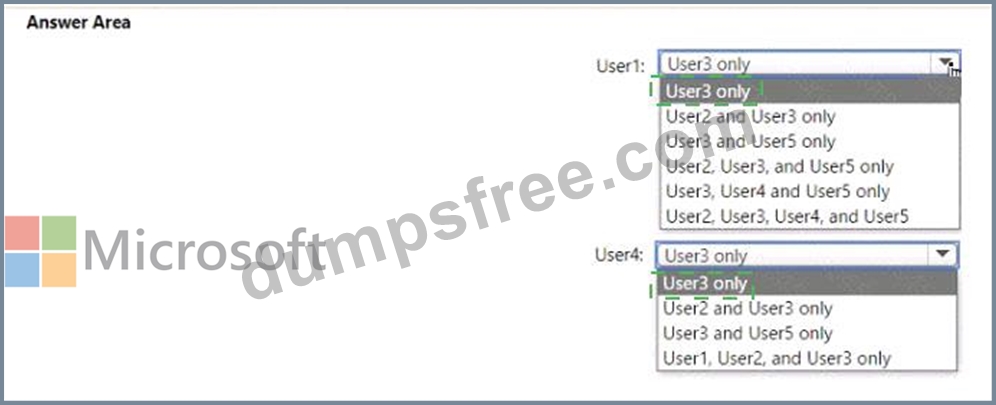
Explanation:
NEW QUESTION # 192
You have an Azure Active Directory (Azure AD) tenant that contains the following objects.
- A device named Devie1
- Users named User1, User2, User3, User4, and User5
- Five groups named Group1, Group2, Group3, Group4, and Group5
The groups are configured as shown in the following table.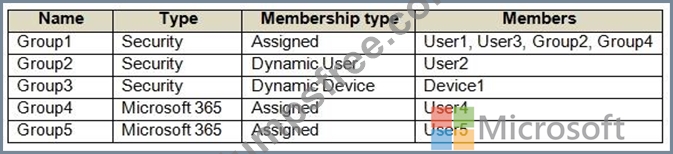
How many licenses are used if you assign the Microsoft 365 Enterprise E5 license to Group1?
- A. 0
- B. 1
- C. 2
- D. 3
Answer: B
Explanation:
Group-based licensing currently does not support groups that contain other groups (nested groups). If you apply a license to a nested group, only the immediate first-level user members of the group have the licenses applied.
Reference:
https://docs.microsoft.com/en-us/azure/active-directory/enterprise-users/licensing-group- advanced#limitations-and-known-issues
NEW QUESTION # 193
Note: This question is part of a series of questions that present the same scenario. Each question in the series contains a unique solution that might meet the stated goals. Some question sets might have more than one correct solution, while others might not have a correct solution.
After you answer a question in this section, you will NOT be able to return to it. As a result, these questions will not appear in the review screen.
You have a Microsoft 365 tenant.
You have 100 IT administrators who are organized into 10 departments.
You create the access review shown in the exhibit. (Click theExhibittab.)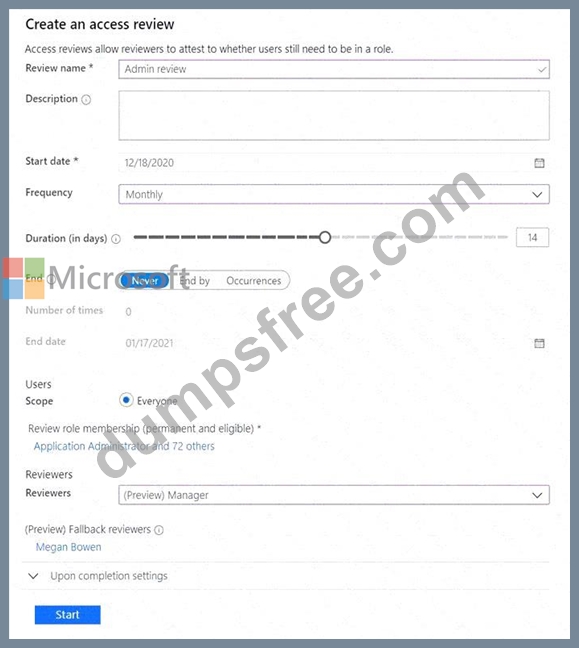
You discover that all access review requests are received by Megan Bowen.
You need to ensure that the manager of each department receives the access reviews of their respective department.
Solution: You create a separate access review for each role.
Does this meet the goal?
- A. NoD18912E1457D5D1DDCBD40AB3BF70D5D
- B. Yes
Answer: A
Explanation:
In this scenario, all access review notifications are going to Megan Bowen, the fallback reviewer, instead of department managers. Creating a separate access review for each role does not meet the requirement because the issue lies in the reviewer selection, not the number of reviews.
Microsoft documentation clarifies:
"To have reviews sent to each user's manager, the reviewer type must be set to 'Manager'. The system uses the 'manager' attribute from Azure AD user properties." Thus, you don't need separate reviews for each role; you need to configure the reviewer type to Manager or update user account manager attributes. Therefore, the proposed solution (creating separate reviews) does not meet the goal.
NEW QUESTION # 194
Your network contains an on-premises Active Directory domain named contoso.com. The domain contains the objects shown in the following table.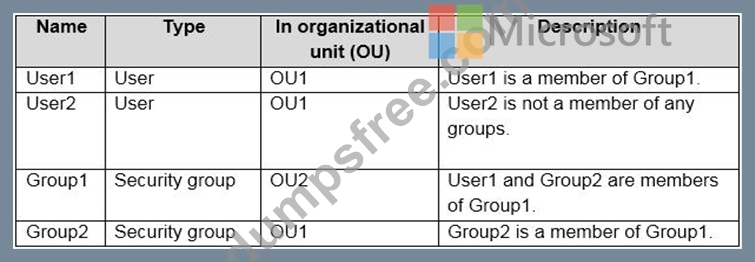
You install Azure AD Connect. You configure the Domain and OU filtering settings as shown in the Domain and OU Filtering exhibit. (Click the Domain and OU Filtering tab.)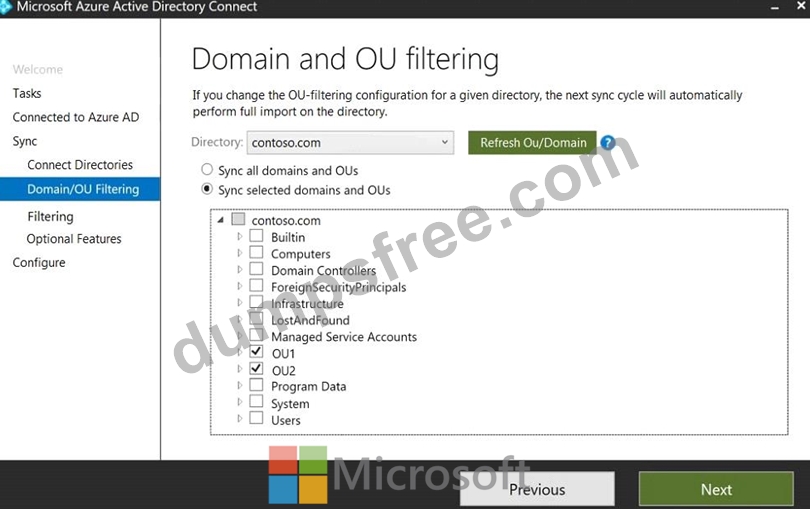
You configure the Filter users and devices settings as shown in the Filter Users and Devices exhibit. (Click the Filter Users and Devices tab.)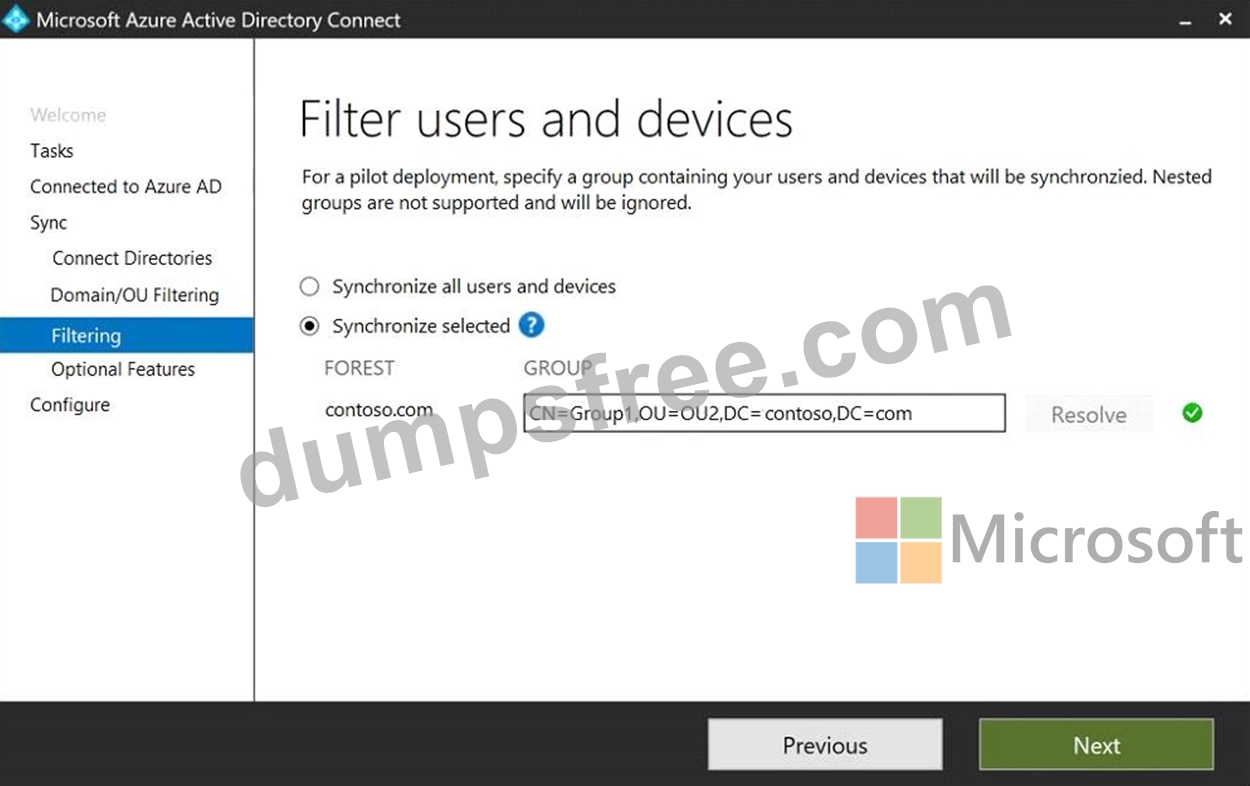
For each of the following statements, select Yes if the statement is true. Otherwise, select No.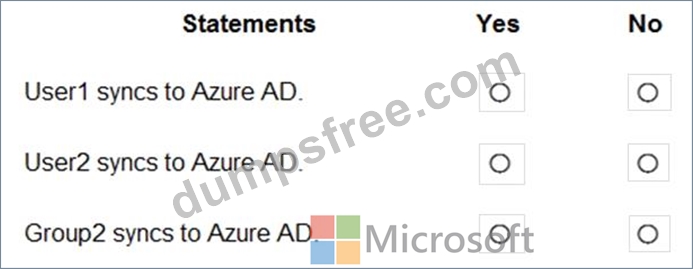
Answer:
Explanation: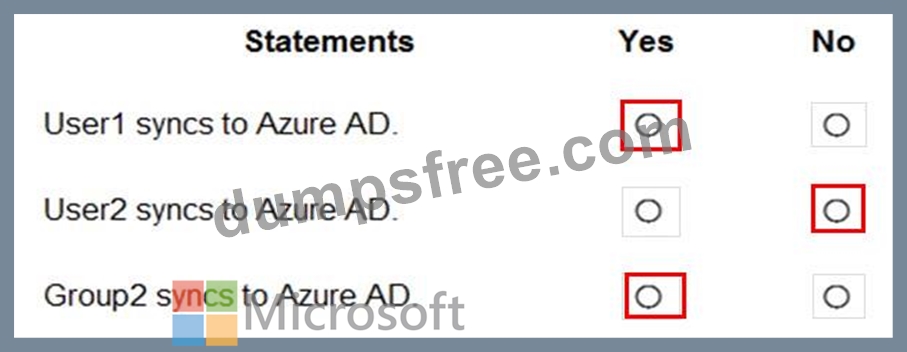
Reference:
https://docs.microsoft.com/en-us/azure/active-directory/hybrid/how-to-connect-install-custom
NEW QUESTION # 195
You have an Azure AD tenant that contains the users shown in the following table.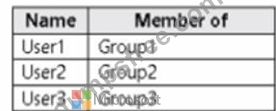
The tenant has the authentication methods shown in the following table.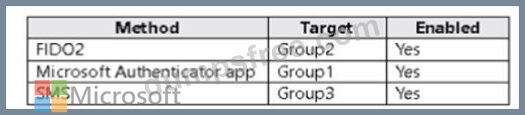
Which users will sign in to cloud apps by matching a number shown in the app with a number shown on their phone?
- A. User1 only
- B. User1 and User2 only
- C. User2 only
- D. User2 and User3 only
- E. User3 only
Answer: B
NEW QUESTION # 196
You need to meet the technical requirements for the probability that user identifies were compromised.
What should the users do first, and what should you configure? To answer, select the appropriate options in the answer area.
NOTE: Each correct selection is worth one point.
Answer:
Explanation:
NEW QUESTION # 197
You have an Azure AD tenant named Contoso that contains a terms of use (ToU) named Terms1 and an access package. Contoso users collaborate with an external organization named Fabrikam. Fabrikam users must accept Terms1 before being allowed to use the access package.
You need to identify which users accepted or declined Terms1.
What should you use?
- A. the Usage and Insights report
- B. provisioning logs
- C. sign-in logs
- D. audit logs
Answer: D
NEW QUESTION # 198
Your network contains an Active Directory forest named contoso.com that is linked to an Azure Active Directory (Azure AD) tenant named contoso.com by using Azure AD Connect.
Attire AD Connect is installed on a server named Server 1.
You deploy a new server named Server? that runs Windows Server 2019.
You need to implement a failover server for Azure AD Connect. The solution must minimize how long it takes to fail over if Server1 fails.
Which three actions should you perform in sequence? To answer, move the appropriate actions from the list of actions to the answer area and arrange them in the correct order.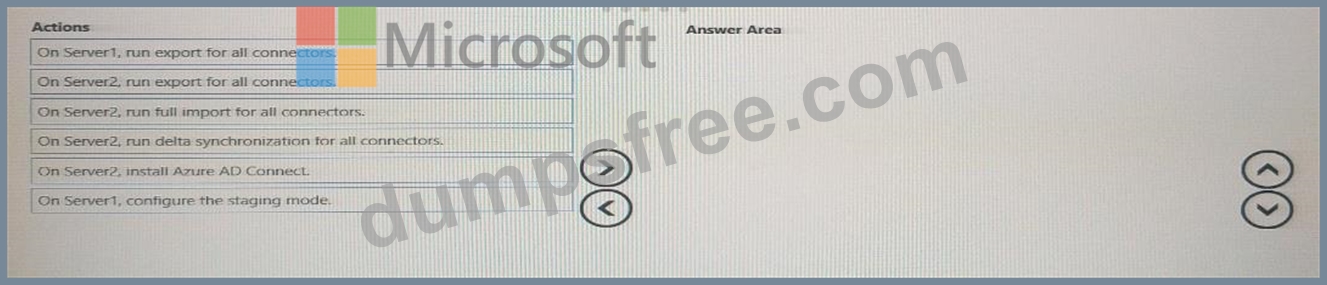
Answer:
Explanation: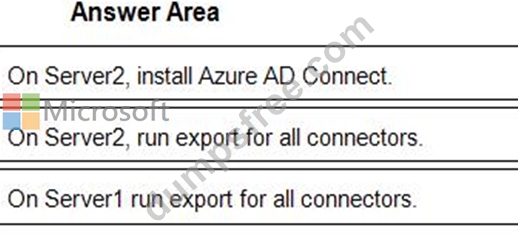
1 - On Server2, install Azure AD Connect.
2 - On Server2, run export for all connectors.
3 - On Server1 run export for all connectors.
NEW QUESTION # 199
Case Study 1 - Contoso, Ltd
Overview
Contoso, Ltd. is a consulting company that has a main office in Montreal and branch offices in London and Seattle.
Contoso has a partnership with a company named Fabrikam, Inc. Fabrikam has an Azure Active Directory (Azure AD) tenant named fabrikam.com.
Existing Environment. Existing Environment
The on-premises network of Contoso contains an Active Directory domain named contoso.com.
The domain contains an organizational unit (OU) named Contoso_Resources. The Contoso_Resources OU contains all users and computers.
The contoso.com Active Directory domain contains the users shown in the following table.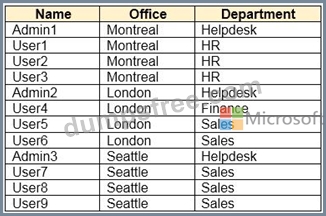
Existing Environment. Microsoft 365/Azure Environment
Contoso has an Azure AD tenant named contoso.com that has the following associated licenses:
* Microsoft Office 365 Enterprise E5
* Enterprise Mobility + Security
* Windows 10 Enterprise E3
* Project Plan 3
Azure AD Connect is configured between Azure AD and Active Directory Domain Services (AD DS). Only the Contoso_Resources OU is synced.
Helpdesk administrators routinely use the Microsoft 365 admin center to manage user settings.
User administrators currently use the Microsoft 365 admin center to manually assign licenses. All users have all licenses assigned besides the following exceptions:
* The users in the London office have the Microsoft 365 Phone System license unassigned.
* The users in the Seattle office have the Yammer Enterprise license unassigned.
Security defaults are disabled for contoso.com.
Contoso uses Azure AD Privileged Identity Management (PIM) to protect administrative roles.
Existing Environment. Problem Statements
Contoso identifies the following issues:
* Currently, all the helpdesk administrators can manage user licenses throughout the entire Microsoft 365 tenant.
* The user administrators report that it is tedious to manually configure the different license requirements for each Contoso office.
* The helpdesk administrators spend too much time provisioning internal and guest access to the required Microsoft 365 services and apps.
* Currently, the helpdesk administrators can perform tasks by using the User administrator role without justification or approval.
* When the Logs node is selected in Azure AD, an error message appears stating that Log Analytics integration is not enabled.
Requirements. Planned Changes
Contoso plans to implement the following changes:
* Implement self-service password reset (SSPR).
* Analyze Azure audit activity logs by using Azure Monitor.
* Simplify license allocation for new users added to the tenant.
* Collaborate with the users at Fabrikam on a joint marketing campaign.
* Configure the User administrator role to require justification and approval to activate.
* Implement a custom line-of-business Azure web app named App1. App1 will be accessible from the internet and authenticated by using Azure AD accounts.
* For new users in the marketing department, implement an automated approval workflow to provide access to a Microsoft SharePoint Online site, group, and app.
Contoso plans to acquire a company named Adatum Corporation. One hundred new ADatum users will be created in an Active Directory OU named Adatum. The users will be located in London and Seattle.
Requirement. Technical Requirements
Contoso identifies the following technical requirements:
* All users must be synced from AD DS to the contoso.com Azure AD tenant.
* App1 must have a redirect URI pointed to https://contoso.com/auth- response.
* License allocation for new users must be assigned automatically based on the location of the user.
* Fabrikam users must have access to the marketing department's SharePoint site for a maximum of 90 days.
* Administrative actions performed in Azure AD must be audited. Audit logs must be retained for one year.
* The helpdesk administrators must be able to manage licenses for only the users in their respective office.
* Users must be forced to change their password if there is a probability that the users' identity was compromised.
Question
You need to resolve the issue of the sales department users.
What should you configure for the Azure AD tenant?
- A. the User settings
- B. the Device settings
- C. the Access reviews settings
- D. Security defaults
Answer: C
Explanation:
Access Review: Fabrikam users must have access to the marketing department's SharePoint site for a maximum of 90 days.
NEW QUESTION # 200
SIMULATION
Use the following login credentials as needed:
To enter your username, place your cursor in the Sign in box and click on the username below.
To enter your password, place your cursor in the Enter password box and click on the password below.
Microsoft 365 Username:[email protected]
Microsoft 365 Password: =1122334455667788
If the Microsoft 365 portal does not load successfully in the browser, press CTRL-K to reload the portal in a new browser tab.
The following information is for technical support purposes only:
Lab Instance: 99999999
You plan to use access packages to assign access to resources.
You need to create a catalog named Catalog that will contain the following resources:
- The Contoso SharePoint Online site
- The Mark 8 Project Team group
- The Salesforce app
To complete this task, sign in to the appropriate admin center.
Answer:
Explanation: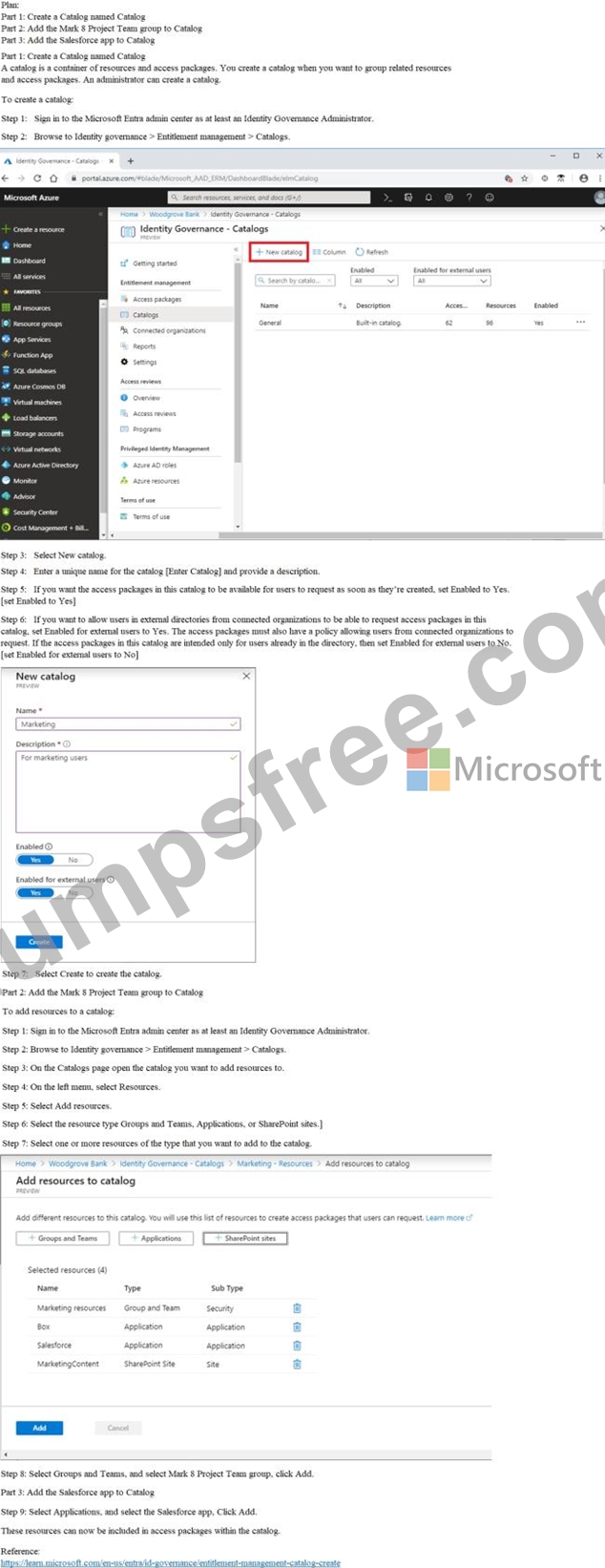
NEW QUESTION # 201
Drag and Drop Question
You have a Microsoft 365 E5 tenant.
You purchase a cloud app named App1.
You need to enable real-time session-level monitoring of App1 by using Microsoft Defender for Cloud Apps.
In which order should you perform the actions? To answer, move the appropriate actions from the list of actions to the answer area and arrange them in the correct order.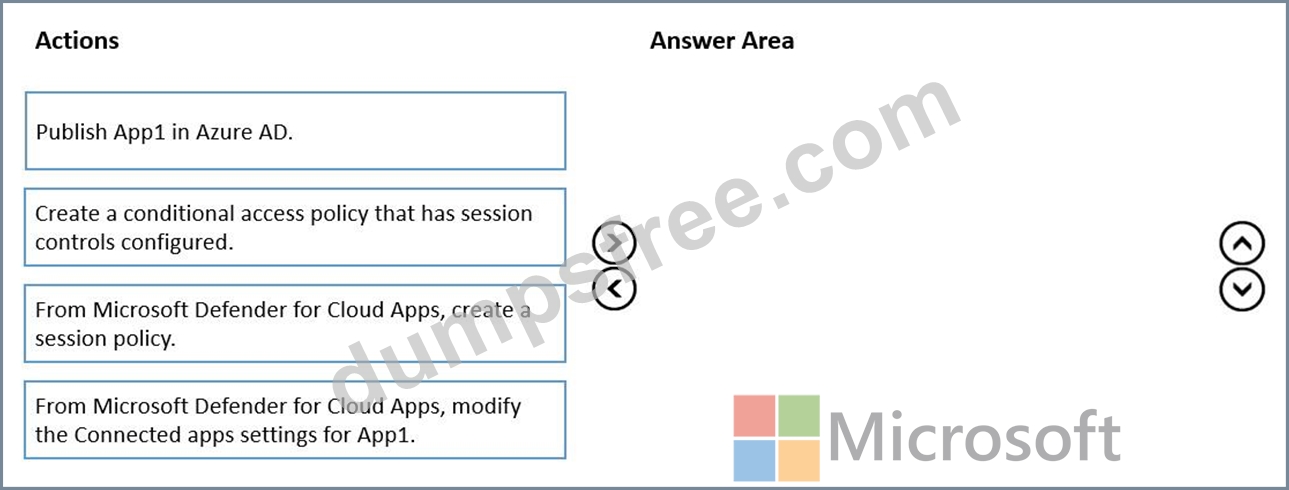
Answer:
Explanation: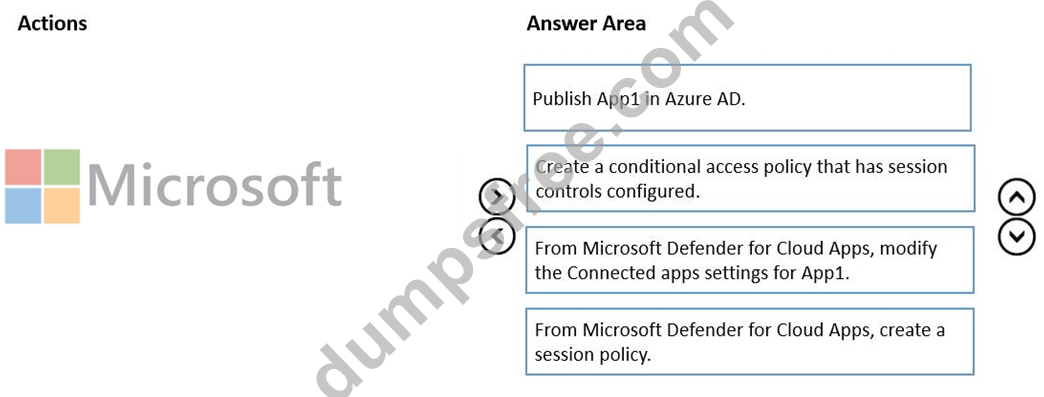
Explanation:
https://techcommunity.microsoft.com/t5/itops-talk-blog/step-by-step-blocking-data-downloads-via- microsoft-cloud-app/ba-p/326357
NEW QUESTION # 202
You have an Azure subscription.
You need to create two custom roles named Role1 and Role2. The solution must meet the following requirements:
* Users that are assigned Role1 can create or delete instances of Azure Container Apps.
* Users that are assigned Role2 can enforce adaptive network hardening rules.
Which resource provider permissions are required for each role? To answer, select the appropriate options in the answer area.
NOTE: Each correct selection is worth one point.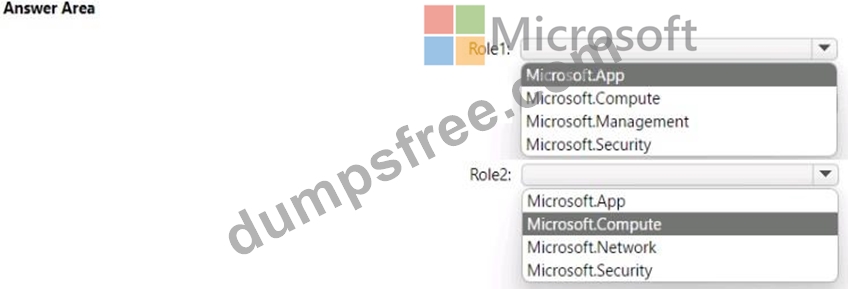
Answer:
Explanation: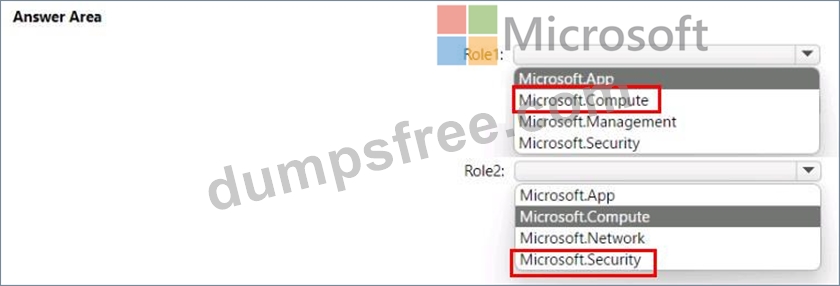
NEW QUESTION # 203
......
Quickly and Easily Pass Microsoft Exam with SC-300 real Dumps: https://www.dumpsfree.com/SC-300-valid-exam.html
Realistic SC-300 Dumps Questions To Gain Brilliant Result: https://drive.google.com/open?id=1XH1VlDaLjQ-z-2KjF75CkRGCm80ZSy4L